

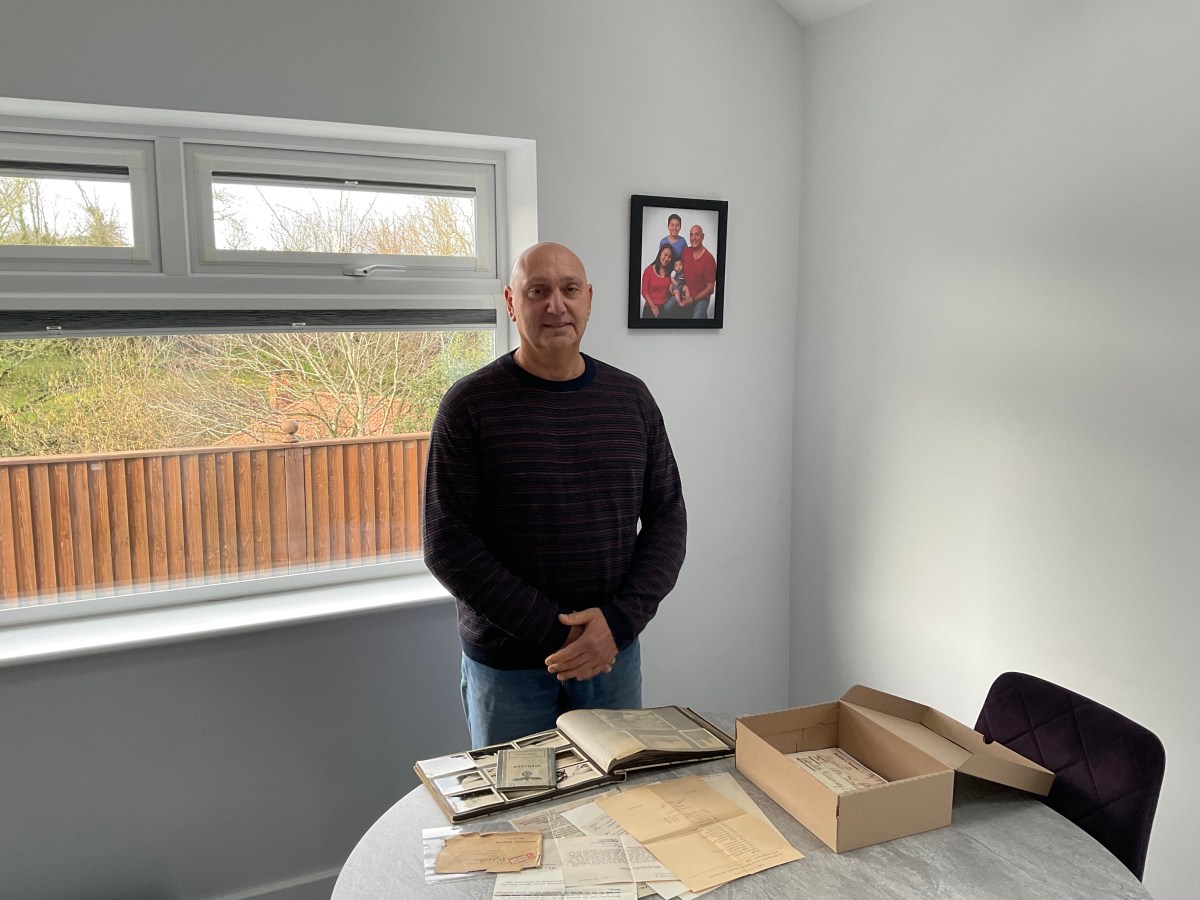
A military history enthusiast from Guernsey was “astonished and excited” when he opened a photo album he bought on eBay to discover it was full of pictures of the Channel Islands taken by a German sailor during World War Two.
Tim Osborne, a pilot and local tour guide, told Express he had “no idea” the album had a connection to the Channel Islands when he bought it for about £120 fifteen years ago, adding: “It was a complete surprise.”
The photos had been taken in the early 1940s by Jakob Hugo Arnold, an Oberbootsmannmaat (Senior Petty Officer) in the German Navy, while he was stationed in Guernsey.

Mr Osborne said: “I was two or three pages in and I thought, ‘Wait a second, I recognise that’. I knew straight away, hey, this is Guernsey.”
The album was accompanied by a “treasure trove” of documents, which were not mentioned in the eBay listing, including Jakob’s Wehrpass (military passport) and letters sent to his widow after he died in 1942.
Film premieres
Mr Osborne spent several years researching Jacob’s life and has now created a short film showcasing his discoveries.
The film has also been translated into German by Astrid Lorez, who grew up in Jakob’s home town of Ingelheim, in south western Germany.
The town’s local history society is planning a premiere later this year.


Mr Osborne hopes find a sponsor so he can put on a Guernsey premiere as well to show “different perspective on the Occupation”.
“I want this film to make people think differently. If possible, I want to adjust the balance from ‘Nazi this’ and ‘Nazi that’ to make people think in a more balanced manner,” he explained.
“I really want people here to have the chance to see the film and find out about Jakob’s life. It would probably cost well under £1,000 to hire a venue so I’m hoping to find a local company to help.”
Human side
Mr Osborne said one of the reasons he wanted to create the film was to show that many German soldiers and sailors had a good relationship with islanders.
“They weren’t particularly nasty to anyone,” he added.
Mr Osborne said his grandfather Lloyd Le Provost owed his life to a German soldier who overlooked the fact he had a crystal radio set instead of reporting.
Being caught would almost certainly have led to Mr Le Provost being deported, he explained.
“In fact, [the German soldier] used to stand in front of [Grandad’s radio] while his men or guards would come in and search the house, so they couldn’t see the radio,” said Mr Osborne.
“They became friends … and remained friends after the war.”
Teasing the Germans
Mr Osborne said his mother, Kay, who was four or five years old during the Occupation, would tease German soldiers and even stand on the garden gate to knock their helmets off.
“Sometimes they would make her pick it up and give her a little pinch of the cheek, while other times they could give her a sweet or something,” he explained. “It was a friendly little thing.”
Mr Osborne said he wanted to show that German troops like Jakob “had a life like us”.
“He wanted to be with his wife, but his job was in the military,” he added.
READ MORE…
You can read Jakob’s story exclusively in Express, along with then-and-now versions of many of the photos he took.
