

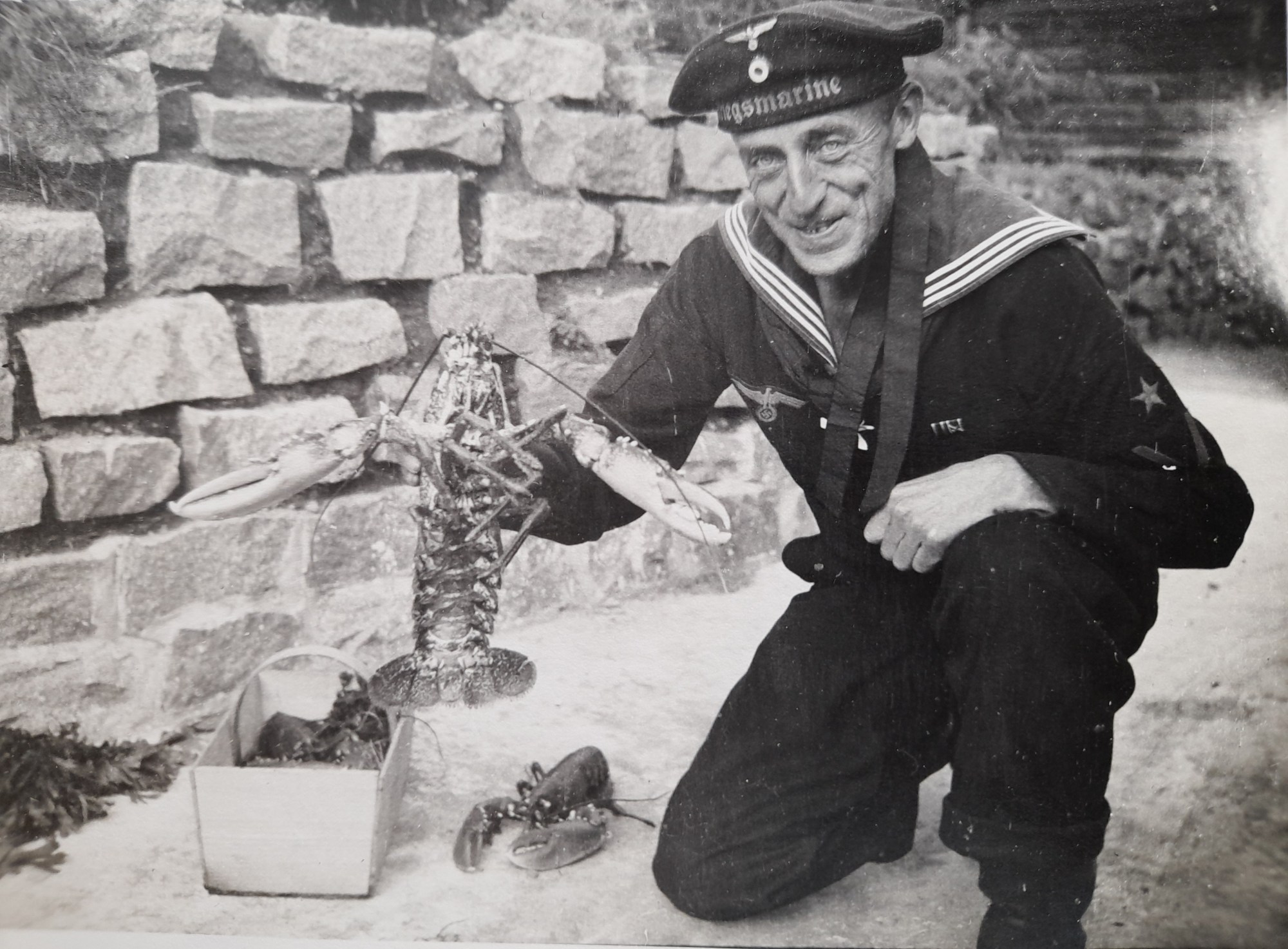
When Jakob Hugo Arnold was born in 1896, Guernsey was in the middle of the so-called Telephone War, with the island’s government pulling down telephone wires installed – without permission – by Britain’s National Telephone Company.
Forty-four years later, Jakob – by then a retired stained glass maker – would arrive in the Bailiwick, just five weeks after a very different war had reached the island – as part of Germany’s navy. So how did a glassmaker from south western Germany end up swapping stained glass for taking snaps of Guernsey?
A new documentary from local tour guide Tim Osborne helps bring to the surface the remarkable and relatable story of this ordinary German sailor.

Mr Osborne uncovered Jakob’s story when he bought a photo album from eBay which unexpectedly turned out to contain pictures taken in Guernsey and Jersey, as well as a collection of immaculately-preserved documents.
The documents, which were not mentioned in the eBay listing, included Jakob’s Wehrpass (military passport) and letters sent to his widow after he died in 1942.
From this limited starting point, Mr Osborne was able to piece together other details of Jakob’s life and family, with the help of Astrid Lorenz, a history buff who grew up in Jakob’s home town of Ingelheim.

Boats in his blood
Jakob was born in August 1896 to Adam and Rosalia, in Mainz-Amöneburg – then a suburb of the city of Mainz. He was the youngest of three brothers.
His father was a schiffer, meaning a boatsman or skipper, which Mr Osborne believes helps explain why Jakob later joined the German navy.
“He would have grown up around boats,” Mr Osborne said.
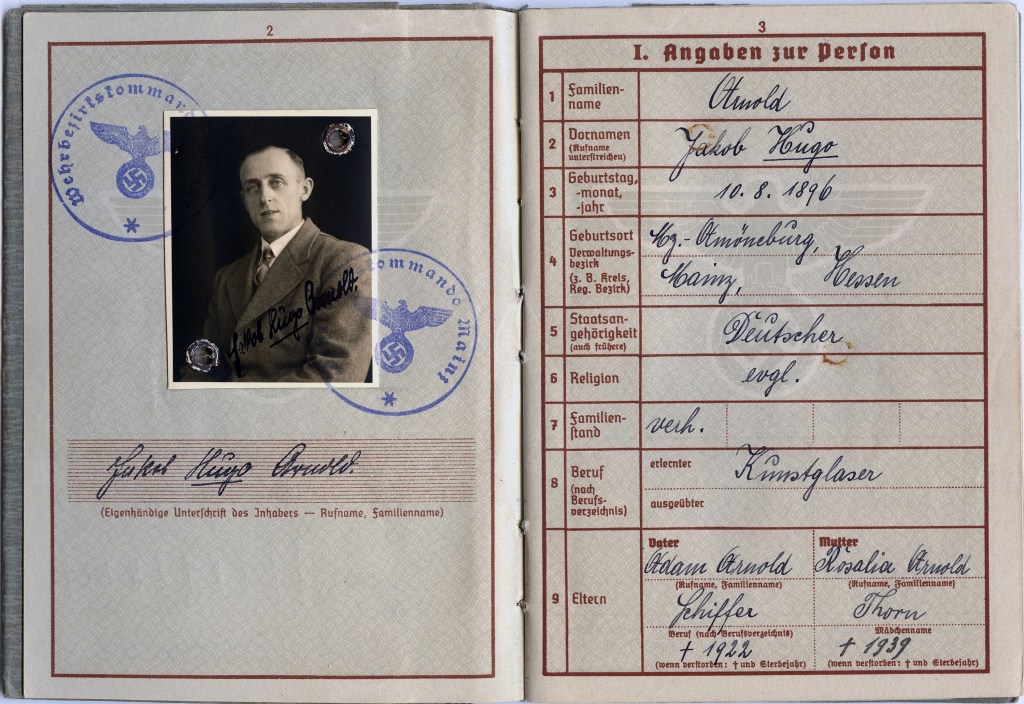
Jakob’s military passport shows his father was a ‘Schiffer’. (Mike Deane and Tim Osborne) 
The original envelope addressed to Elisabeta Arnold, which contained news of her husband’s death. 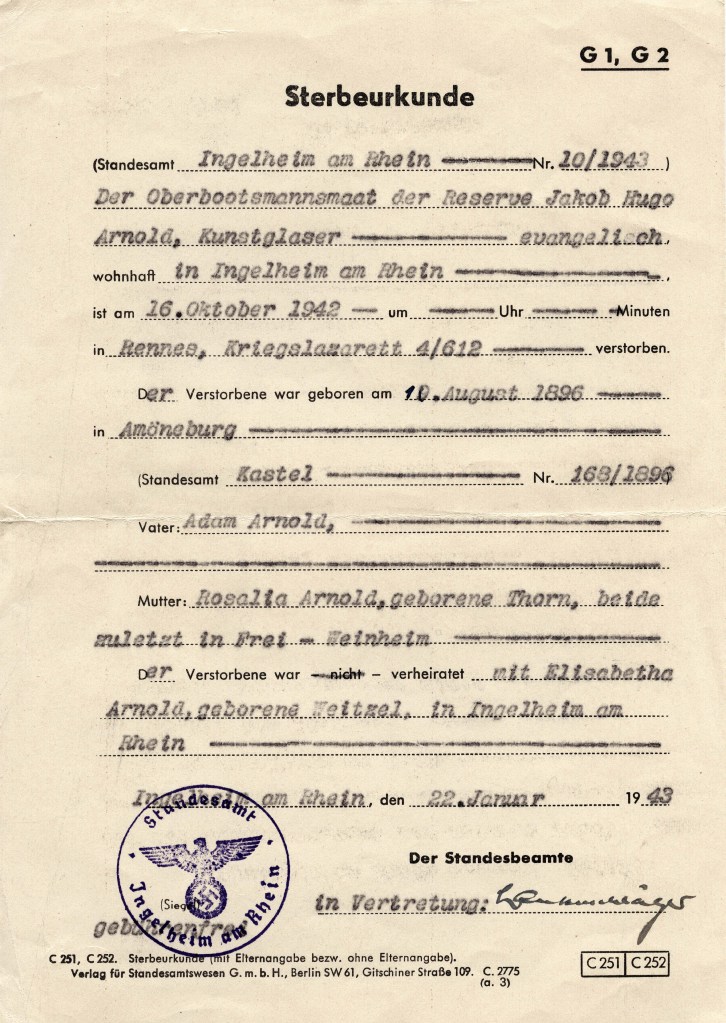
The official notice of Jakob’s death. (Mike Deane and Tim Osborne) 
After this death, the navy sent Elisabeta a list of Jakob’s belongings. 
However, the navy wrote to Elisabeta explaining that they couldn’t find Jakob’s camera. 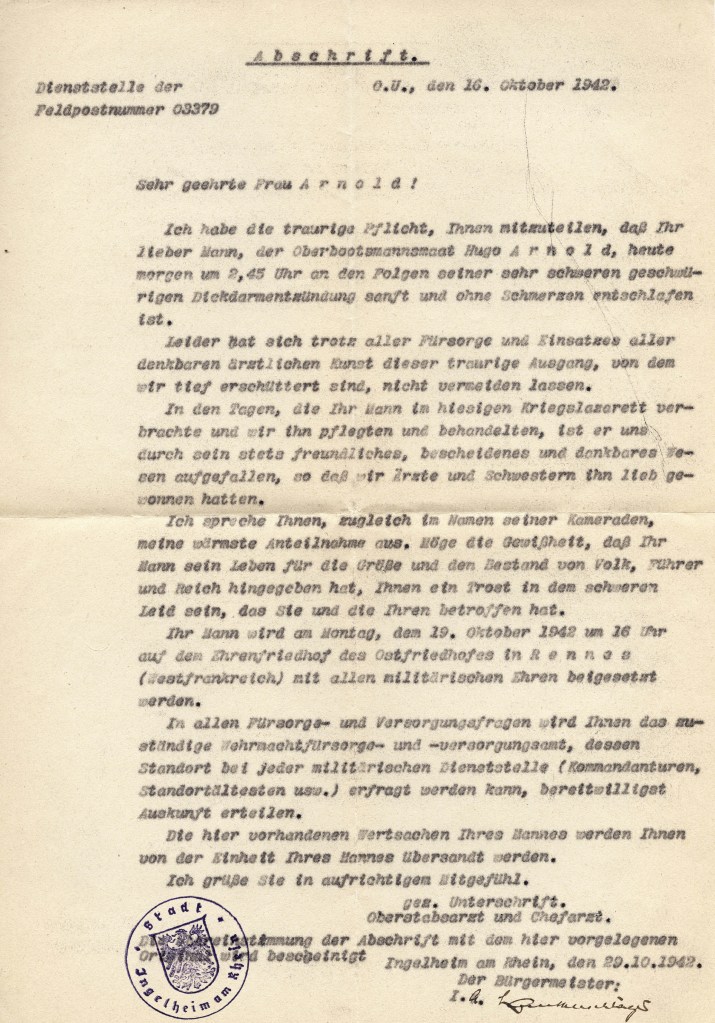
Doctors at the Rennes field hospital wrote to Jakob’s window to praise his character. (Mike Deane and Tim Osborne) 
Jakob’s birth certificate shows he was born in 1896. (Mike Deane and Tim Osborne) 
In 1953 Elisabeta successfully applied to have his body repatriated to Ingelheim am Rhein in Germany. (Mike Deane and Tim Osborne) 
Jakob and Elisabeta’s marriage was recorded in the church register. (Mike Deane and Tim Osborne) 
Architectural drawings of Jakob and Elizabeta’s house in Ingelheim. (Mike Deane and Tim Osborne)
Medal for bravery
Jakob first volunteered for the navy in January 1915, aged 18, joining as an Obermatrose (Able Seaman).
Little is known about how he spent World War One or where he was stationed. However, he was awarded the Iron Cross Second Class on 16 June 1918 – for an act of bravery.
He was briefly interred in a Swiss prisoner-of-war camp at the end of the war, before leaving the service nine days after the end of hostilities.
Church bells and stained-glass windows
After World War One, Jakob returned to civilian life, working as a “glazier in a stained glass window factory”.
He met and fell in love with Elizabeta Witzel, marrying her in June 1922.
After the wedding, the couple lived with Elizabeta’s parents in Ingelheim am Rhein, before buying their own house in the town years later.
The following July the couple had a baby girl, Irma Elvira Arnold, but she tragically died in January 1924, aged just six months.
“They never had any more children,” Mr Osborne explained.
“They might have wanted another, but maybe she was too distraught to go through it again? We don’t know, but that could very well be a reason why.”


In 1937, as tensions were growing between Hitler’s Germany and the other European powers, Jakob – who was now in his 40s – signed up as a navy reservist.
The first eight months of World War Two, from September 1939 to May 1940, were known as the ‘phoney war’, because there were no major conflicts, with Britain, France, and their allies choosing economic warfare and a naval blockade instead.
This all ended when Germany invaded France and the Low Countries on 10 May 1940.
Within a matter of weeks Winston Churchill became British Prime Minister and the Dunkirk evacuation took place – the phoney war was well and truly over.
In July, Jakob was called up for eight weeks of basic training. The day after he finished he was sent to Guernsey.


Jakob’s first stint in Guernsey only lasted three months, but he returned to the Channel Islands in April 1941 after his unit left St Malo, in France.
A keen amateur photographer, Jakob captured pictures of his short stay in Jersey, including this one of German officers at Plémont, in the north west of the island.
As part of his research, Mr Osborne took photos in the same locations of many of Jakob’s photos to create then-and-now comparisons.


After a few days in Jersey, Jakob’s unit travelled to Guernsey where they worked in St Peter Port harbour under the command of the Haffenkommandant (German Harbour Commander).


Jakob and many of his colleagues stayed at the Victoria Hotel on Glategny Esplanade.
The building – which was near the modern-day Marina Court Apartments – has since been demolished.
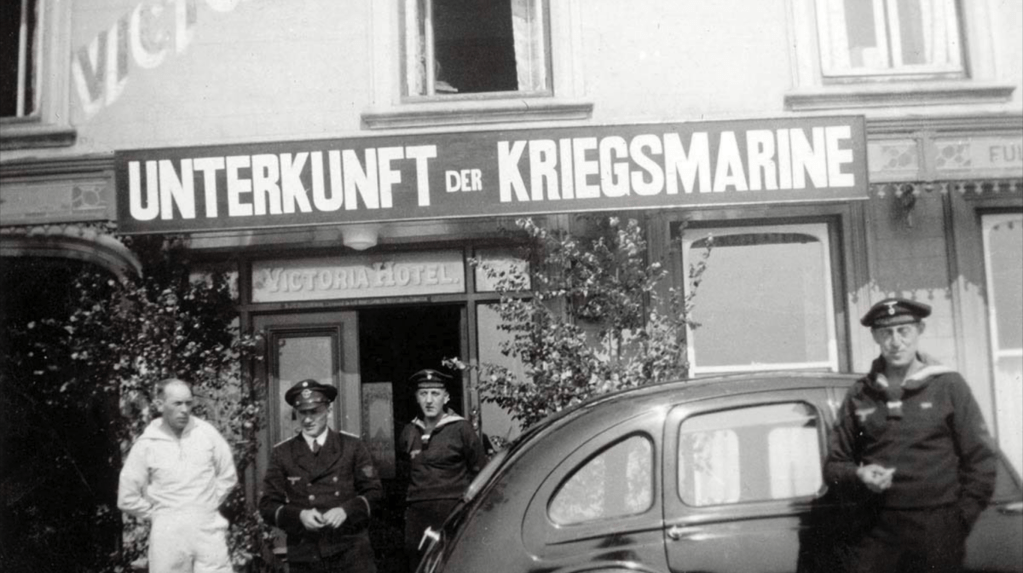
Like other German soldiers and sailors stationed in Guernsey, Jakob spent leisure time at the The Dolphins, a 1930s Art Deco house near Jerbourg Point, which had been commandeered by the occupying forces as a Soldatenheim – a place for troops to socialise and rest.
Mr Osborne said he had spoken to one Guernsey local, Betty Crocker, who lived in the area and had worked at The Dolphins as a teenage waitress during the war.
She remembered the troops “always being polite”, Mr Osborne said.


Jakob was promoted in March 1942 to Oberbootsmannmaat (Senior Petty Officer), but that September he was admitted to hospital in Guernsey with gastrointestinal problems.
At the start of October, as his symptoms became more severe, he was transferred to the field hospital at Rennes, in northern France.
![A letter written in German. In English, it reads:
Copy (Abschrift)
Office of the
Field Post Number 03379
O.J. (Upper Ingelheim), 16 October 1942
Dear Mrs Arnold,
It is my painful duty to inform you that your beloved husband, Oberbootsmannmaat (Boatswain’s Mate) Jakob Hugo Arnold, passed away quietly and without suffering at 2.45 a.m. this morning as a consequence of a most severe ulcerative inflammation of the large intestine.
Regrettably, despite the devoted care bestowed upon him and the utmost application of all available medical skill, this grievous outcome, which has deeply affected us all, could not be averted.
During the days your husband spent under our care in the military hospital here, he distinguished himself by his unfailingly kind, modest and grateful demeanour, so that he came to be held in sincere affection by both the medical officers and the nursing staff.
I wish to convey to you, at the same time and on behalf of my comrades, my deepest sympathy. May the knowledge that your husband gave his life for the greatness and preservation of the People, the Führer and the Reich bring you some measure of comfort in the heavy sorrow which has fallen upon you and your family. Your husband will be laid to rest with full military honours on Monday, 19 October 1942, at 4.00 p.m., in the Field of Honour at the Eastern Cemetery, Rennes (Western France).
In all matters concerning welfare and provision, the competent Wehrmacht Welfare and Pensions Office, whose location may be ascertained from any military authority (command headquarters, senior local commands, etc.), will be ready to provide you with full information. The personal valuables of your husband currently held here will be forwarded to you by his unit.
I remain, in sincere sympathy,
[signed]
Senior Staff Medical Officer and Chief Medical Officer
---
Seal of the Town of Ingelheim
Certified that this copy is a true and accurate reproduction of the original document submitted here.
Ingelheim am Rhein, 29 October 1942
The Mayor
for and on behalf ( name)](https://www.bailiwickexpress.com/wp-content/uploads/2026/01/image00004-1-715x1024.jpg)
He died on 16 October at about 02:45 from a “most severe ulcerative inflammation of the large intestine”. He was 46.
A letter to Elisabeta from the Chief Medical Officer said Jakob did not suffer and the doctors and nurses were “deeply affected” by his death.
He said Jakob had “distinguished himself by his unfailingly kind, modest and grateful demeanour, so that he came to be held in sincere affection by both the medical officers and the nursing staff”.
Jakob’s personal belongings were returned to Elisabeta shortly after his death, but the navy apologised as they were unable to find his camera.
Jakob was buried with full military honours in the eastern cemetery in Rennes.
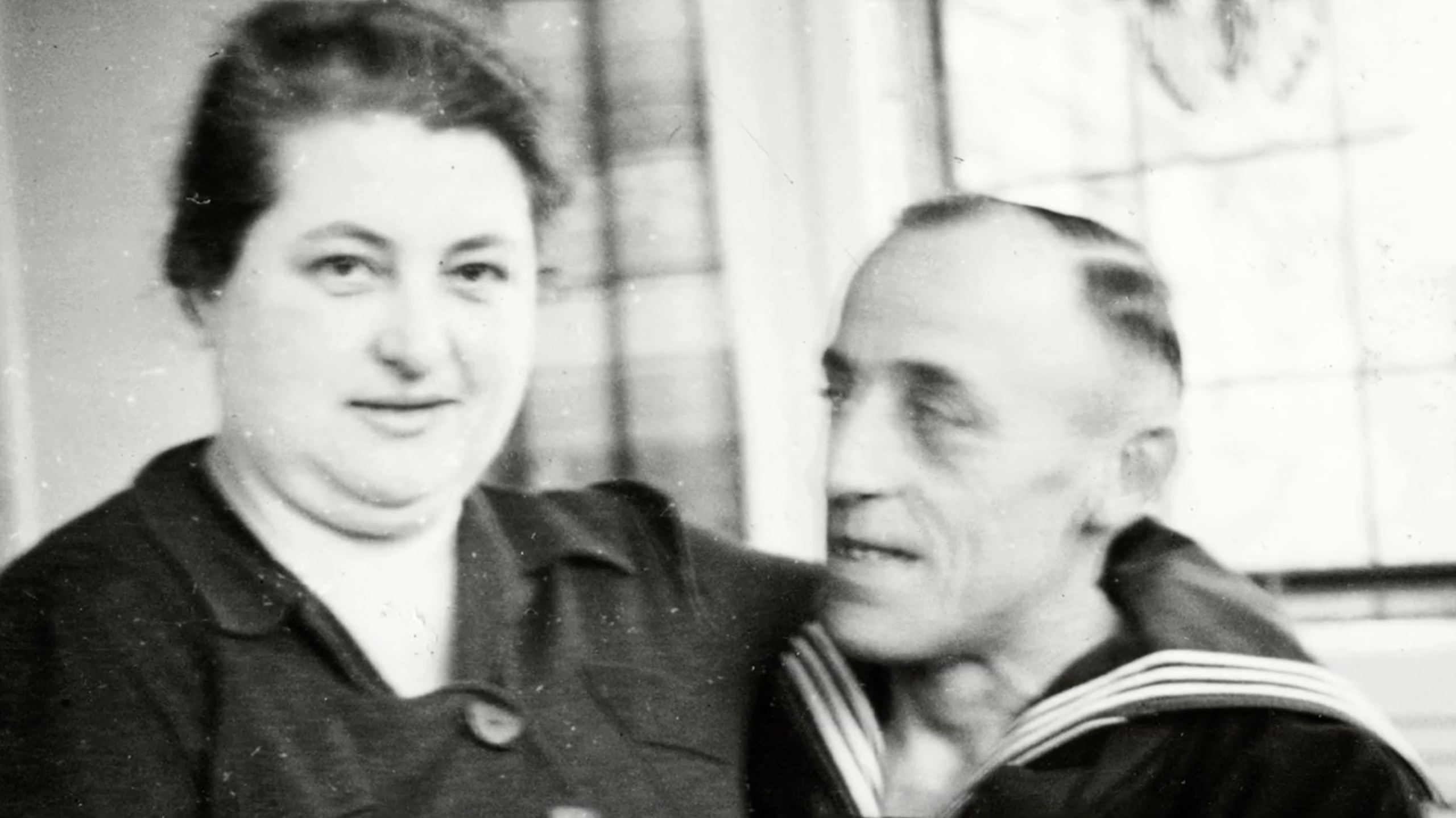
Elisabeta was “clearly heartbroken”, Mr Osborne said, and never remarried after his death.
She arranged for his body to be returned to his home town in 1953.
Elisabeta was buried next to Jakob when she died in 1985 in the cemetery of their home town. The couple remain there to this day.
