


Why are there accusations that changes to the Open Market housing register may breach human rights law, and could lead to the States facing a £200m compensation bill?
Changes are afoot for how homes can be listed on the Open Market , which the States say will boost supply, confidence and demystify the application process.
But Deputy Rob Curgenven, who is leading scrutineer of the plans, claims there are around 20 people who will be burned by the law changes.
Around 20 applicants who submitted bids under the old system may consider legal action if their cases are dismissed, with one already understood to be doing just that.
Express takes a deeper look…

The Open Market in a nutshell
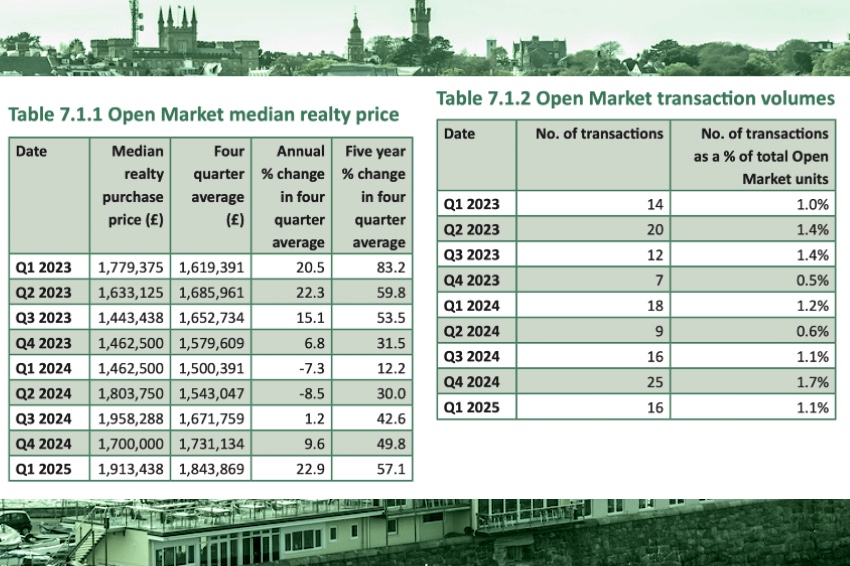
The Open Market is a small selection of homes available for people to live or invest in even if they aren’t a local resident.
It was set up after the Second World War to make living in Guernsey more attractive and flexible to British residents, while protecting the majority of homes for local people.
Locals and people with certain permits can access any property, while the Open Market – some 1,600 properties – gives more options to accommodate non-locals.
It has long been argued that the Open Market supports the local economy and is an important tool to balance supply and demand in the wider housing market.
There are four parts to it:
- Part A is for private, single family homes.
- Part B covers hotels.
- Part C is for nursing and residential homes.
- Part D is for lodgings.
The Committee for Environment & Infrastructure had powers to list properties on the Open Market register between 2016 and 2025 – but responsibility has now transferred entirely to the new Committee for Housing.
The current system allows homes to gain Open Market status subject to an application fee of £500, and a registering fee of £324 if an application is approved – but this could soon change.
Changes on the horizon
The new policy that was green-lit by the States in March included:
- Increased fees applying for and registering on the Open Market, including a windfall tax of up to £750,000 to account for the increase in property value.
- Pre-registering of properties that are under construction.
- Exceptional permission for existing properties.
- A cap of up to three new properties registered every year.
- Transferring a registration to a new build property, as long as it isn’t more than one-third of units in new housing developments.
- Allowing long-term Open Market residents to transfer their status to a smaller local market home.
- Allowing owners to apply for full Part A status if part of their home is local market, or some parts are excluded such as lodgings.
Environment & Infrastructure successfully made the case that a controlled increase of up to three new homes per year would boost the market and improve the quality and diversity of homes available.
Additionally, a one-for-one switch through transfers from the local to open market would support people looking to downsize to a smaller home, freeing up larger family homes for locals.
Transfers would also be available to future new builds which would allow a greater variety and quality of homes for buyers, while also giving extra financial certainty to property developers who could sell a portion of a new housing on the more lucrative Open Market.
The benefits? At least £1.5m per year extra for the States from the increased fees and windfall tax, a reinvigorated Open Market for British nationals – some of whom may consider fleeing the UK over the government’s tax reforms – and clarity over how properties may be moved into the Open Market.
All of this at a time when the market has been in stasis for years, with the number of single family homes available technically decreasing in that time because all or part of some of them have been reclassified as lodgings.
However, the first raft of legislation which will be put before the States as early as next month excludes, at this stage, plans for the interim registrations of future new builds.

What’s the rub?
For years it’s been unclear how much growth the Open Market needed and what types of property were in demand.
Coupled with low application fees, and rumours that several people were making moves to profit, this led to accusations of exploitation.
Loose rules, unclear criteria, and the threat of loopholes being exploited prompted Environment & Infrastructure to act.
The story starts with an application in 2021 to register a local home on the Open Market.
The States made clear the following year it planned to review how properties can move between the two markets – but since the application was made before this could’ve been known a decision had to be made.
E&I approved the application after receiving legal advice.
Rumours swirled that a precedent had been set. The policy was unclear. Pay the modest fees and your home could be Open Market. The value of your asset could skyrocket overnight.
To stop an attempted goldrush from speculators and a sudden growth in the Open Market – which would simultaneously reduce the number of local homes while potentially dampening the value of existing Open Market homes – E&I pulled the brakes.
It effectively put applicants on notice that nothing would be decided until a new policy was in place.
How do we know this? E&I has already had to defend its position.
Disclaimers were placed on the relevant application forms that while they would be accepted, nothing would be decided given a new policy being drawn up in the background.
The objective was to prevent legal challenges should applications be denied or deferred.
As mentioned above, dozens of similar applications have been made since then.
The issue now is if the new legislation is passed it will wipe out those applications, with fees returned and an encouragement made to reapply under the new regime.
At least one of those applicants has cried foul, with Deputy Curgenven saying an appeal is being taken against the President of Housing – someone who didn’t draw up the rules, leading a Committee which did not exist until a few months ago.
Deputy Curgenven argues that wiping out existing applications while legal action is underway could breach the European Convention on Human Rights, which protects people’s right to a fair trial and to keep their property.
Specifically, any legal changes which could alter the outcome of court actions in which the government is a party is deemed a breach of article six. Deleting outstanding applications may also be considered a deprivation of property under human rights law.
Deputy Curgenven fears if this is the case other applicants could sue the States for, in the worst case scenario, hundreds of millions of pounds in compensation.
He has submitted 15 formal parliamentary questions to Housing which must be answered within two weeks.
These include how pre-existing rights under the previous law will be protected, how many outstanding applications there are, if further appeals are expected and what the costs could be, what legal advice was issued, and whether it believes the legislation may be applied retrospectively.
The States has maintained it has acted reasonably in line with legal advice and that the new Open Market legislation doesn’t remove or reduce any pre-existing rights.
Deputy Lindsay de Sausmarez, then E&I President but now the President of Policy & Resources, set out a defence last January.
“The Law Officers of the Crown were consulted on the matter and the Committee was advised that, while it would not be legally compliant to prevent applications from being submitted, it could notify potential applicants that it would not be considering any applications until the inscriptions policy is agreed,” she said.
“This was legally defendable because the fact that the inscriptions policy was being developed had been formally noted by the States in October 2022, no applications had been submitted since then, and therefore anyone applying after the Committee had advised that it would not be considering applications until the policy had been finalised would apply fully in the knowledge and expectation that that would be the case.”
“Legal advice from the Law Officers confirmed that there is no time limit prescribed in the Law on when such applications shall be dealt with. It confirmed further that public law principles would require the Committee to act ‘reasonably’ and not frustrate the intent of the legislation, but it is appropriate that such applications are dealt with consistently by reference to a policy.”
