


Guernsey’s digital strategy could turn the island into a ‘Digital Lighthouse’, it suggests, with priorities laid out for funding and work streams.
The strategy is a wordy read for anyone interested in Guernsey’s government plans to transform not just the digital infrastructure the island uses for it’s day to day operations, but the way the term ‘digital’ is viewed.
30 pages, seven ‘pillars’, and five phases have been used to help construct the bulk of the strategy, in which the States argues that the need for greater investment, focus, and time and effort is spent on ensuring Guernsey gets a grip on it’s digital dealings.
“It is important to recognise that the term digital no longer means just an IT system. Instead, it has, and will, increasingly become an enabler for everything in our community. Digital, therefore, is not just about technology, it is about transforming the way people live, connect and work” – Foreword, States of Guernsey Digital Strategy 2024 – 2029; Enabling Digital Services for the States of Guernsey.

The ‘goals’ the States sets with its new digital strategy
The goals set by the States in this strategy outline its desired outcomes for digital transformation, focusing on improved service delivery, customer satisfaction, and digital maturity.
Key targets include increasing digital service usage for priority services by 50% within two years of MyGov’s launch, achieving a 75% customer satisfaction score for MyGov within two years, and ensuring 80% of relevant customer-facing services are accessible via MyGov within five years.
The States aims to increase online payments to 70% within two years and issue Digital IDs to 50% of eligible residents within four years.
There is also a focus on customer experience and transforming organisational infrastructure for a ‘Digital Government First’ approach, with a goal to maintain MyGov platform uptime at 99.9% per month.
Additionally, the States plan to expand available online services to 80% of all relevant government services within five years, achieve a ‘Low’ risk rating in annual penetration tests for MyGov, and boost digital literacy programme participation by 30% within two years. They also aim to implement three-five high-value digital initiatives each year.
How the States of Guernsey aims to achieve these goals
So what actions are the States of Guernsey taking to achieve this lengthy list of goals
Firstly they plan to evaluate the current digital landscape and get a better understanding of the existing systems, processes, and infrastructure, which will then see an optimisation of those digital transformation processes.
They want to see effective culture change and improve communications. This includes recognising the importance of organisational buy-in and effective communication, before establishing the Digital Strategy and the leadership requirements for digital transformation. This aims to provide a ‘clear roadmap’ and ensures that the necessary leadership is in place.
Part of the planned digital revolution would see the development and implement a data strategy, the implementation of ‘suitable digital technologies’, and would see the creation of an ‘appropriate support team structure’.

The seven pillars
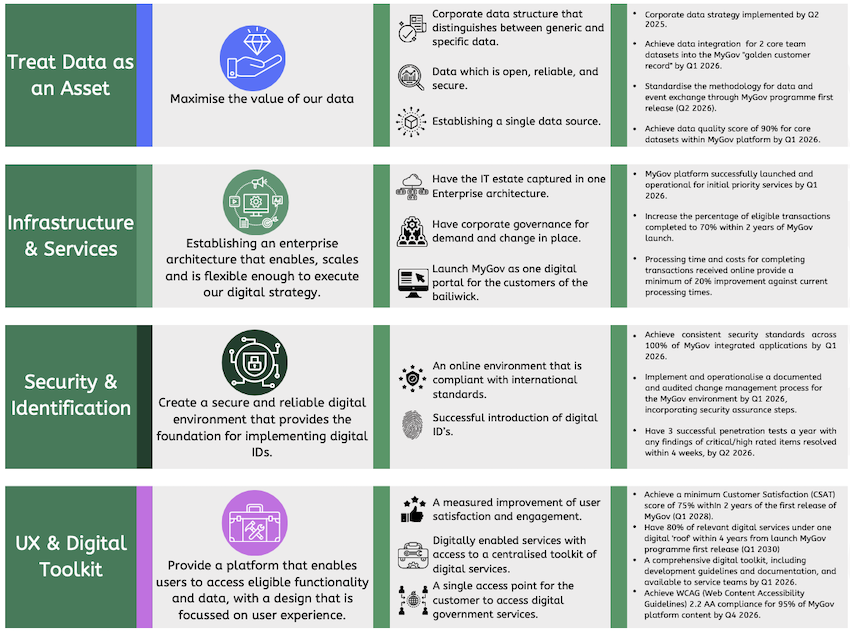
The states have poured the concrete for their foundations into seven pillars, these start with Pillar 1 – Security and Identification, which seeks to provide a ‘transparent, secure, reliable, and user-friendly digital environment’. It would see the implementation of digital IDs in compliance with international standards.
Pillar 2 focuses on Infrastructure and Services. The States says this will hope to increase digital interactions with the public, while reducing the number of offline interactions.
They add that this involves consolidating all digital States of Guernsey services under one virtual ‘roof’, providing a streamlined, efficient, and user-friendly digital experience which is reliable and fast. The platform on which additional digital services will be built will be established under this workstream.
Pillar 3 is UX and the Digital Toolkit, this aims to realign the States of Guernsey’s digital operational model so that it has a greater focus on a consistent and intuitive customer experience.
Pillar 4 is built around a ‘Digital Workforce and Community’ which looks to provide new economic and personal development opportunities by further enhancing digital literacy and skills across the States of Guernsey and the community.
‘Innovation and Collaboration as a Constant’ is the title of Pillar number 5, which aims to “Cultivate a culture of continuous innovation that promotes collaboration among the private sector, educational institutions, and States of Guernsey services”.
Whilst Pillar 6 wants to see Data treated as an asset.
The States says they will “maximise the value of data as a strategic asset whilst ensuring its security and privacy. We will identify the data that matters for delivering better customer outcomes, making it accessible across the States of Guernsey to achieve better insights into our operations and in turn promote better decision making”.
Lastly Pillar 7 focuses on Leadership and Governance, and will look to “transform organisational foundations to embrace a ‘Digital Government first’ approach, ensuring robust and effective governance structures are in place to support this vision.
The five phases
Not content with their seven pillars, the States have also incorporated a five phase approach to delivering on these objectives, and these are aimed to help guide the States on their Digital transformation journey.
“This plan will serve as our roadmap, guiding substantial change in our operations and demanding significant investment in finance, time, and expertise” – Foreword, States of Guernsey Digital Strategy 2024 – 2029; Enabling Digital Services for the States of Guernsey.
Phase One is to assess, two to strategise, and three to design. The fourth is to implement the “strategic roadmap” and then finally to continuously monitor and evaluate how the digital transformation is going with phase five, measure.
These phases will help Guernsey keep to it’s Digital Strategy commitments, with the States adding at the end of the Strategy document: “The execution of our Digital Strategy will balance the enhancement of front-end services with the optimisation of back-end operations. Learning from successful digital initiatives implemented in other jurisdictions, we will adopt best practices and lessons learned. An important aspect of our Strategy is a commitment to continuous improvement.”
