


With “heightened volatility” being blamed for rising electricity prices in Alderney, utility bill payers in Guernsey and Sark may be wondering what’s coming next for them.
Express takes a deep dive to explore what tariff rises mean across the Bailiwick, and takes a look at who is paying what…
Alderney Electricity Limited this week announced a 9.8% tariff increase, from 1 April – blaming global volatility.
The utility was keen to distinguish between the tariff increase – which will help AEL cover its “long standing structural pressures” – and the barrel price of oil which is likely to continue to fluctuate and is a direct result of the conflict in the Middle East.
While electricity tariffs may not fluctuate because of what’s going on globally, the barrel price of oil does affect motorists, people who heat their homes using oil, and other prices that we all pay.
Those prices have jumped since America bombed Iran at the end of February.
Bailiwick prices
With Alderney’s electricity tariffs increasing from 1 April, customers in the other islands may be wondering if price rises are coming their way too.
In both Alderney and Sark, oil is imported to run their power stations, while in Guernsey most electricity is supplied through the cable that runs to France via Jersey.
That cable means electricity prices in Guernsey are protected from some of the volatility that is leading to high oil and petrol prices, through forward purchasing and lengthy agreements with suppliers.

Alderney Electricity Limited said the unit price its customers now need to pay has to go up after being held below inflation for too long. That protected customers from interim shocks when global prices have increased such as when Russia invaded Ukraine in 2022, said Managing Director Chris MacGregor.
He said the decision to increase tariffs now followed a review of the Company’s finances earlier this year, which showed that holding electricity prices had protected customers but meant income was insufficient to cover the long-term cost of operating Alderney’s electricity system.
In Guernsey, tariffs held steady for a decade during a regulatory void, before Guernsey Electricity was allowed to put prices up in July 2022. Annual increases have been levied since then with another due this summer.
In Sark, an independent price regulator sets a maximum amount that can be charged, following well documented high prices in the island.
Tariffs
Alderney’s tariff rise on 1 April will represent a 6.4% above inflation (3.4%) increase.
Mr MacGregor said even after the price increase comes in next month, electricity prices in Alderney will remain below the level they would have reached if tariffs had simply kept pace with inflation over recent years.
“Any upward movement in energy prices is unwelcome and will affect all our community” he acknowledged.
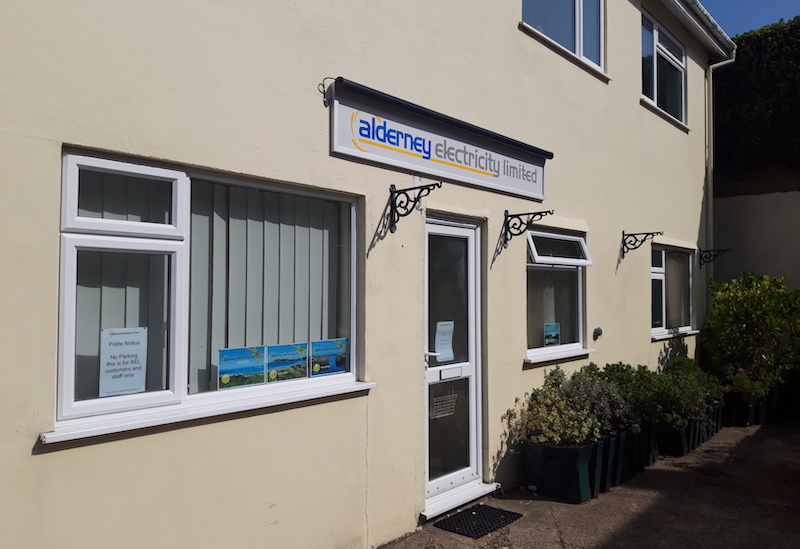
Mr MacGregor said the price adjustment is necessary to ensure a safe, reliable and sustainable electricity network, and a financially sound company capable of investing in the island’s future resilience.
“It is my duty to act now to reduce vulnerability to future shocks, not to defer the problem to a later date,” he said.
Mr MacGregor said the tariff increase had been agreed by the AEL board in February but would come in on 1 April, when the longer days and warmer weather mean customers shouldn’t be using as much electricity.
The electricity price in Alderney – for a customer on Tariff Scale C1 – will be 24.69p per unit from 1 April – with a standing charge on top.
The price rise means that a household on Tariff C, using around 600 units of electricity per quarter, the cost will go up by around £20 per quarter or around £1.50 per week.
A household on Tariff C, with a 6-room assessment, will likely see an increase of around £40 per quarter, or just over £3 per week.
In Sark, everyone on the island’s grid pays the same price per unit – and it is much higher than in Alderney for various reasons.
The privately owned Sark Electricity Limited has its unit price set by an independent price commissioner.
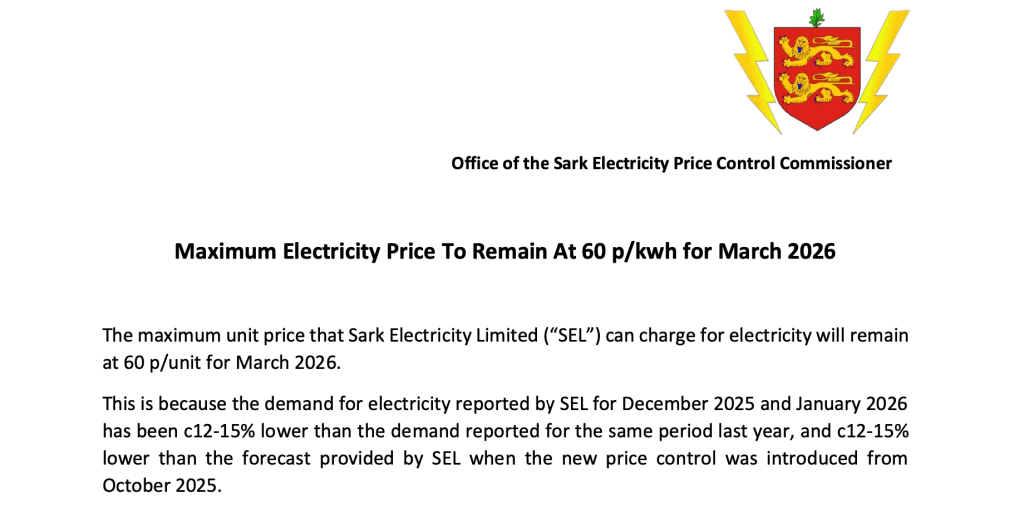
For March 2026, the maximum unit price that SEL can charge is 60 p/unit, with standing or meter rental charges on top.
Sark’s electricity is entirely reliant on the import of diesel to run its generators that are at the top of Harbour Hill.
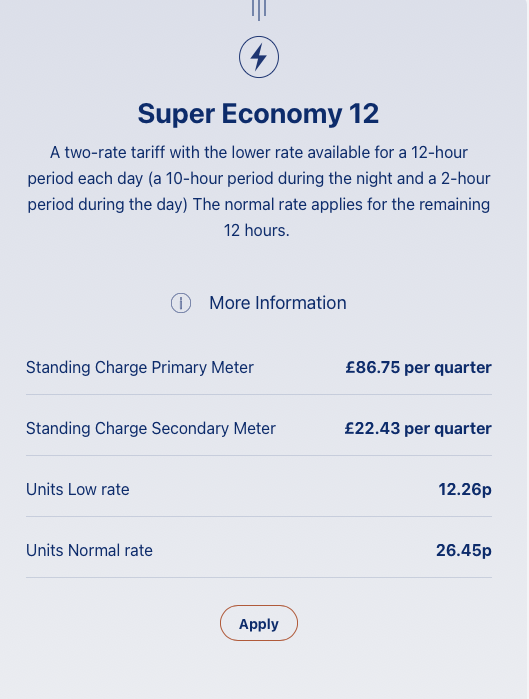
In Guernsey, where the island is linked to France, via Jersey, through an underground cable, unit prices for customers on Super Economy 12 are 26.45 p/unit at peak times and 12.26p on the ‘cheap rate’.
The tariff is expected to change from July, with announcement in advance.
Customers are largely protected from the global volatility in power prices due to the inter-connector linking Guernsey, via Jersey, with France, meaning the islands can import cheaper energy from the European grid.
Guernsey Electricity also has to keep an eye on the price of oil though, as it is legally mandated by the States to keep a months worth of oil at the power station so that if there is a fault with the cable to France, the island’s power stays switched on.
That oil is stored in a large ‘tank farm’ and if any oil is used – for example, when topping up the amount of electricity coming through the cable at peak times – it has to be replaced so the four week’s worth of supply is maintained.
That purchasing will be subject to the same volatility that Alderney Electricity and Sark Electricity both face, and it is also driving up the price of heating oil and petrol for Bailiwick residents too.
Elsewhere
The closest equivalent to Guernsey’s Super Economy 12 rate in Jersey sees customers on the Economy 7 day rate paying 23.22p/unit or 11.74p/unit including GST.

The average unit price in the UK, for customers on a standard variable tariff, is 24.67 pence per kWh, while in France it is approximately 27.76 cents.
Global impacts
In announcing that Alderney’s electricity prices are going up, the MD of AEL was keen to distinguish between this tariff adjustment and the recent global developments affecting oil prices.
He explained that Alderney’s energy system is particularly exposed to global fuel markets because the island does not have an electricity inter-connector like Guernsey and Jersey do, and it relies almost entirely on diesel-generated electricity – like Sark does.
This means that changes in international oil prices directly affect the cost of generating electricity on the smaller islands.
AEL said since the escalation of conflict in the Middle East wholesale fuel prices have risen sharply – with the announcement that fuel prices in Alderney were going up this week, reflecting the higher wholesale price paid for the latest shipment of fuel.
For Alderney, the landed cost of fuel has increased substantially this year, said AEL.
Since January, wholesale price paid for diesel has increased by nearly 50% and Kerosene (heating oil) is up by over 80%.
When these increases in the cost of fossil fuel are also considered, the combined impact on electricity costs for a typical customer will be higher than the planned tariff adjustment alone.
Mr MacGregor was keen to stress, again, that price adjustments are necessary to ensure a safe, reliable and sustainable electricity network, and a financially sound company capable of investing in the island’s future resilience.
“It is my duty to act now to reduce vulnerability to future shocks, not to defer the problem to a later date,” he MacGregor.
What has conflict in the Middle East got to do with us?
Energy markets are global, meaning shocks in one region quickly affects prices elsewhere.
Global prices started to move sharply immediately after Iran was bombed, and the US Energy Information Administration said as of March 19 2026, crude oil prices are just under $100 per barrel.
That’s up $30 a barrel since the end of last year.
Heating oil in particular is sensitive to disruptions affecting aviation fuel.
In information shared with customers earlier this month, ATF explained that “although crude oil has risen, the main driver of heating oil prices in the UK and therefore the Channel Islands is jet fuel, as both fuels are kerosene-based”.
The company added that “the wholesale price of jet fuel has more than doubled, reaching its highest level in over three years”.
What is causing the spike in jet fuel prices?
Supply routes are a key factor.
ATF noted that “around 40% of Europe’s jet fuel imports normally come from the Middle East via the Strait of Hormuz, which is currently blocked”.
If shipments through that route are disrupted, alternative supply becomes harder and more expensive.
As the fuel business explained: “European refineries cannot fully replace this supply, and shipping costs from other regions are rising, pushing wholesale prices higher.”
What does that mean for heating oil?
Higher wholesale prices for fuel can quickly feed through to household heating costs.
ATF warned earlier this month that “higher wholesale prices mean distributors pay more for fuel, which unfortunately leads to higher prices for customers”.
The company also said demand patterns have changed as the crisis unfolds.
It explained that “demand is also higher than usual as households order early due to the Middle East crisis, so prices are currently updated daily”.
Are petrol and diesel affected in the same way?
The picture is more mixed.
ATF said diesel prices “have substantially increased as the UK relies on the net import of diesel”.
Petrol markets are less exposed to the same pressures.
The company said “increases have been more limited, as the UK does not rely on the imports of petrol”.
Guernsey Fuel and Oil Watch – an independent price comparison page – said the cheapest petrol available on island now is 154.0p – up 3p since the end of February.
News reports from elsewhere show prices are rising across the globe, with many blaming the disruption to supply routes through the Strait of Hormuz (Al Jazeera).
Nigeria was leading the way with price hikes earlier this week with a 39.5% increase at its petrol pump prices since the conflict in the Middle East began in February.
Laos, Australia, and Vietnam have each reported rises above 30% while the USA has seen pump prices rise just under 25%.
