


The latest data available shows rental prices have continued to soar in Guernsey, rising another 8.2% over the past year – and up a whopping 51.7% compared with 2020.
The States’ latest Property Price Bulletin was published last week, confirming there’s been no let up in the pressure on renters.
The data also proved that property values are dropping, with the average purchase price for a local market property dropping 3.1% in a year, and 3.9% over the last quarter.
While it might be a ‘buyers market’ with prices dropping, it remains a lengthy process with transactions taking an average of 251 days to complete.
The Open Market is showing an opposite trend to the local market with the raw median price climbing by almost half a million pounds over the past year.
The numbers
The mix adjusted average purchase price for Local Market properties was £580,412 at the end of March this year.
This is 3.9% down on the previous quarter (Q4 2024) and a 3.2% decrease compared to the same quarter in the previous year (Q1 2024).
There were more Local Market sales going through court compared to a year ago with 166 transactions during the first quarter of 2025 and 93 in the first quarter of 2024, but that number does fluctuate a lot with 188 sales completing in the last quarter of last year.
It’s also taking considerably longer to sell properties at the moment compared to previous years, with the average time from first being advertised to purchase completion now sitting at 251 days.
Despite property values dropping, renters continue to pay out more each passing year.
The mix adjusted average rental price for a Local Market property reached £2,068 per calendar month earlier this year.
That’s an 8.2% increase compared to a year prior, and a substantial 51.7% increase compared to Q1 2020.

Pictured; The latest data for local market sales, as per the Guernsey Quarterly Residential Property Prices Bulletin, Q1 2025. 
Pictured; The average purchase prices, as per the Guernsey Quarterly Residential Property Prices Bulletin, Q1 2025. 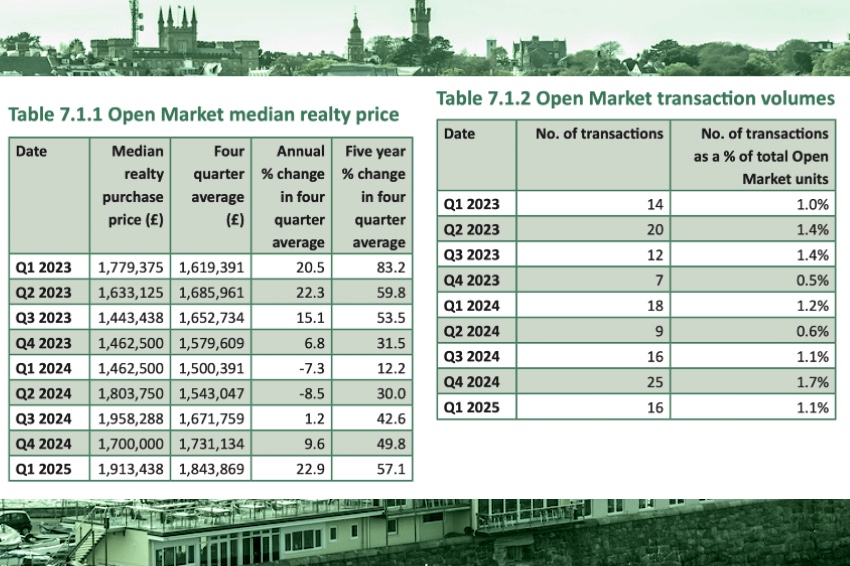
Pictured; Data sets for the Open Market, as per the Guernsey Quarterly Residential Property Prices Bulletin, Q1 2025.
On the Open Market, the raw median price of the 16 properties sold in the first quarter of 2025 was £1,913,438, compared with £1,462,500 a year ago.
What are industry experts saying?
Both the Institute of Directors and Savills have acknowledges the key trends identified in the official statistics, and both say they recognise the slight decrease or downward pressure on local market prices. Both have also pointed out the increase in the number of local market transactions compared to previous periods.
The IoD takes a broader macroeconomic and policy-oriented view, emphasising the implications of the property market trends for the overall economy, social well-being, and government policy.
It’s focused on issues like housing supply, affordability, and the impact of rental costs on inflation, through Richard Hemans, the IoD Guernsey’s lead on economics.
“Over the last 12 months the local market saw prices fall slightly but transactions recover strongly, whilst the open market enjoyed double digit increases in both prices and transactions. The cost of renting a property is still rising fast, whilst the affordability of ownership is improving although still elevated.
“The latest figures confirm what we already know in that we are not building enough homes, which is the key driver of price and affordability pressures. This has to remain one of the top priorities for the next States and is fundamental to our social and economic prosperity.”

Mr Hemans has also pinpointed a lack of building as a reason for the island’ s housing problems.
“Only 71 new property units were created over the last 12 months and 527 over the last five years, which is significantly lower than the target of 310 units per annum, or 1,550 over five years. Over the last quarter the number of property units fell by 5.
“This explains why Guernsey house prices will continue to remain high and strong in the context of full employment, robust earnings, falling interest rates and a growing population driven by positive net migration. The scale of the housing challenge has been recognised, and momentum is building to address the issue, but over the short term this disequilibrium will ensure that prices remain elevated whilst transactions will remain below historic levels.”
Meanwhile, estate agency Savills has provided a more market-oriented and transactional perspective.
“The market since the start of the year has been somewhat of a mixed bag, said Stuart Leslie, the Head of Residential Sales at Savills Guernsey.
“The number of sales agreed is up on the previous two years and is at a level that we would expect when compared to the historic data. However, average values appear to have dipped.
“It’s rare that we see such an obvious downward trend in prices. Buyers have been a little more cautious with their budgets, but it’s also reflective of the type of properties that sold in the early part of this year.
“There has been strong demand for one and two-bedroom apartments, for example, alongside two and three-bedroom bungalows and houses, which will obviously be marketed at a lower price than larger homes.”

Mr Leslie shared his predictions for the near future, saying it’s likely to remain a ‘buyers market’ for now.
“We’re expecting to see the continuation of a needs-based market through the rest of the spring and into summer, where committed buyers come to the fore and demand for ‘best in class’ remains most resilient.
“Interest rates are also likely to continue to fall and mortgage markets will become more competitive, which should gradually bring more buyers into the market and underpin prices over the medium term.”
