


A new five-year plan for dealing with substance use and misuse in Guernsey has been published.
Health and Social Care’s latest plan to “reduce the harms associated with alcohol, drugs, tobacco, nicotine products and emerging substances of concern” will run from 2027-32, continuing the work started by the previous five-year plan which was launched in 2021 against the backdrop of the covid pandemic.
The major difference between the two five-year plans is an amplified focus on the variety of nicotine based substances now available, including vapes and nicotine pouches, adding a renewed focus to Guernsey’s efforts to achieve ‘smoke-free status’.
The new strategy also offers further insight on the use and misuse of medicinal cannabis, which has become a more prominent factor for HSC to consider since the previous strategy was published in 2021, following changes to cannabis laws in 2021.
The strategy also looks at the impact of alcohol on Guernsey’s community, including the rates at which alcohol claims lives.
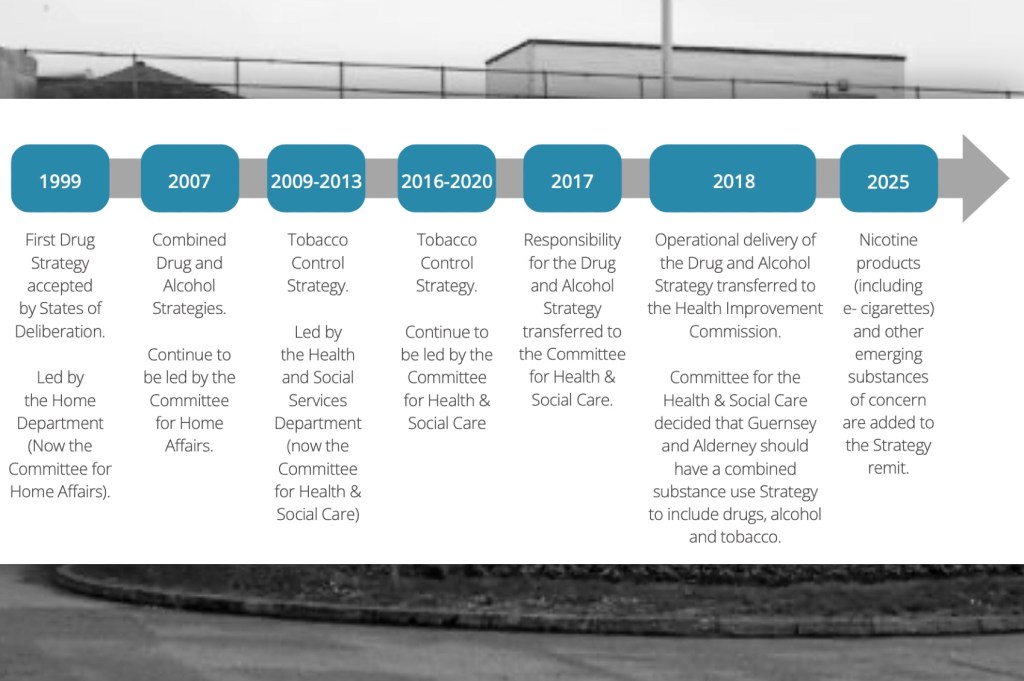
Smoking, nicotine products, and emerging substances of concern
The latest iteration of the island’s Combined Substance Use Strategy has the same aims as its predecessor – to reduce the harms associated with alcohol, drugs, and nicotine.
The 2027-32 strategy shifts focus from a reactive treatment model to a proactive, four-pillar approach focussing on ‘Awareness, Prevention, Services, and Policy’, with a primary goal set to reduce stigma, address the social causes of substance use, and to halve the number of smokers in Guernsey which will result in the island being designated ‘smoke-free’.
The previous strategy that was unveiled in 2021 focused on the triad of ‘drugs, alcohol, and tobacco’, while the 2027 strategy expands this significantly to include modern nicotine delivery systems, such as vapes, and a broader category of risks associated with all substances.
For the 2021–26 strategy the term ‘substance use’ referred to the use of drugs or alcohol, and included substances such as cigarettes, controlled drugs, prescription drugs, inhalants and solvents. The 2027–32 strategy is focussed on “alcohol, drugs, tobacco, nicotine products and other emerging substances of concern”.
The surveys supporting the strategies
The 2027–32 Substance Use Strategy is underpinned by a mix of local data, public engagement, and international health frameworks.
It uses both the Joint Strategic Needs Assessment from 2025, and the 2023 Wellbeing Survey carried out by Public Health, and relies heavily on public engagement with those involved in delivering health services.
The latter of those is conducted every five years, with the next coming up in 2028.
Guernsey’s Director of Public Health, Dr Nicola Brink said this kind of research enables professionals to “monitor trends” that may be having an impact on the island.
“It’s been done for decades now, and so what we try and do is keep some of the questions the same so we can monitor trends with time. However, we also then put new questions in to look at new and emerging concerns.”
Dr Brink said “the last survey was the first survey that we did completely in house, so we’re looking at providing the survey through the public health team, and I was enormously proud that the team stepped up to the mark.”
The previous island-wide survey in 2023 was well received according to Andrea Nightingale, the Substance Use Lead for the Combined Substance Use Strategy, who said that “if you do surveys very regularly, then you might not actually get the engagement, but by doing it sort of a five year cycle, I think we had as many, if not more, on this particular survey than we’ve ever had.”
She concluded that “you can really get a good example of what’s going on in the community with people engaging with it”.
Social stigmas and strategy
While both reports have advocated for a “health-led approach” to substance use management, the 2027-32 strategy elevates the social barrier of stigma up to a primary strategic priority.
The old strategy for 2021-26 was defined by three themes: “Preventing and Reducing Harm; Building Recovery; Partnership of Purpose”.
The new five year plan is focussing on four distinct pillars, those being ‘Awareness and Stigma Reduction’, ‘Prevention Activities’, ‘Operational Services’, and ‘Policy and Legislation’.
The new strategy states that “tackling stigma and reducing barriers to people seeking help when it is needed is key to minimising the harms caused by substances”.
Medicinal cannabis
The stance on medicinal cannabis has significantly evolved over the past five years, after Guernsey legalised it in 2020, and that’s reflected within the strategy from HSC.
The use of medical cannabis has been moved from an excluded clinical matter in the previous strategy to a regulated safeguarding concern.
So while it wasn’t covered in the previous strategy, the use of medicinal cannabis is now highlighted, with a focus on the impact medicinal cannabis has had on Guernsey’s black market.
“Public Health Services and the States of Guernsey Police have noted concerns regarding the illicit diversion of medicinal cannabis in the community, recognising the need for robust regulation”
2027-32 substance use strategy
The new strategy says almost four-fifths of people consuming cannabis are still receiving it illegally.
“11.9% of adults (16+) had used cannabis in the last 12 months,” it says, and that “78.8% of these users did not have it prescribed to them”.
That said, the amount of other illegal drugs consumed remains low, with just 2% of adults reporting illegal drugs usage excluding cannabis, in 2022 through a public health survey carried out in 2023.

Alcohol
Alcohol remains the leading cause of substance-related harm in Guernsey, according to the 2027–32 Substance Use Strategy.
Quoting from the 2023 Wellbeing survey once again, HSC points to the ”23.7% of all adults” who say they drink more than the recommended maximum of 14 units weekly, and the 15.8% of adults who “binge drink”.
The 2027–32 strategy points to the human cost that alcohol has on society, with the survey saying that on average “approximately 10 deaths per year are specifically attributed to alcohol”.
It further notes that in just two years, between 2022 and 2024, in Guernsey the “alcohol-specific mortality was 13.1 deaths per 100,000”.
By comparison there were 26 drug poisoning deaths in Guernsey over an eight year period, between 2013 and 2021.

Tobacco
The new strategy highlights a sharp increase in e-cigarette use, with the percentage of adults currently vaping or using e-cigarettes increasing from 6% in 2018 to 11% in 2023.
HSC says it is now working on “ensuring vapes and other nicotine products are only used as a tool for adult smokers to quit”, with the 2027-32 strategy shifting focus towards Guernsey achieving its ‘smoke-free’ ambition while addressing the rise of vaping.
HSC had previously set a goal to “keep the adult smoking prevalence rate below 10%”, while the new five year plan promotes ”a mandate for change” with a defined “ambition of achieving smoke-free status (defined as fewer than 5% of the population smoking)”.
Just over 9% of the population smoked tobacco in 2023 according to Public Health data.

The housing crisis
The ongoing housing crisis – which has left around 1,000 people homeless, at risk of homelessness or in insecure housing – was referenced in the new substance strategy too.
HSC highlighted the impact of housing problems on the likelihood of people turning to substances.
The 2027-32 strategy relies on new data to link substance use to broader social inequalities, with 2023’s Wellbeing Survey finding that harmful substance use was “associated with housing tenure, with those in private rental accommodation more likely to have high risk drinking behaviours”.
The data also suggests that people “living in affordable housing were more likely to binge drink or smoke tobacco daily”.
Young people
The 2027-32 strategy shows an ongoing concerning rise in the number of young people vaping – an existing concern for HSC and public health.
Data shows that the number of students in Year 8 and Year 10 who regularly vape, which is defined as more than once a week, saw a sharp increase from 2% in 2019 to 10% in 2022.
Work has already started to address concerns around vaping with recent legal changes meaning it is now illegal to sell vapes to anyone under 18 and disposable vapes are banned in Guernsey and Alderney.
Andrea Nightingale, the Substance Use Lead for the Combined Substance Use Strategy, said there is now a focus on educating young people against vaping.
“We found that young people were vaping probably more than most so we commissioned Action for Children to do our education services and within that, we provided for brand new vaping lessons which we took into schools.
“That enabled us to give us all the information that they needed to know, what vapes were, how they worked, and giving them the short term consequences that they were taking if they were smoking or vaping.
“A survey was done with all the young people which Public Health conducted. We now have a young people’s vaping service or treatment service, and a self help booklet that they have to be able to help and support themselves.”
The new strategy also indicates almost a third of Guernsey students drink alcohol.
31.5% of Year 10 students responding to the 2023 Wellbeing Survey said they’d had more than a sip of alcohol in the previous week.
Read more:
