


Guernsey’s too expensive to live in, it’s too expensive to get off, and the government doesn’t listen.
Those are just some of the concerns shared by hundreds of young people, who took part in a study which “clearly” details why so many are considering leaving the island, or have already left.
Other worries include the high cost of renting or buying a home, and the prospect of not enough people working and paying tax to support the services we need.
Despite highlighting the Bailiwick’s safety, natural environment, and strong sense of community, more than a third of the young people said they didn’t expect to live here after finishing their education.
Nearly a third think they will, while the rest are unsure.
Dr Nicola Brink, Guernsey’s Director of Public Health and Medical Officer of Health, said the “message we received is clear”.
“Young people care deeply about their future here, but many are uncertain whether the Bailiwick can offer them an affordable, sustainable and fulfilling life as they move into adulthood,” she warned.
The report

The findings were published in the 118th Medical Officer of Health Report earlier this month.
Covering 2025 and 2026, it focuses on young people and their views around their future and specifically their future living in the Bailiwick.
‘Shaping Tomorrow: The Voice of Future Generations’ includes data collated through discussions with approximately 200 young people aged 16 to 24 across Guernsey and Alderney.
Dr Brink said she chose to focus the report on young people because “they are the future of our islands, and their experiences, concerns and aspirations must be at the heart of how we shape that future”.
The data
Nine focus group sessions were held in March this year, with around 200 young people involved including students from The Guernsey Institute and the Sixth Form Centre.
Others were recruited from the Youth Forum which includes students from the private colleges and States schools.
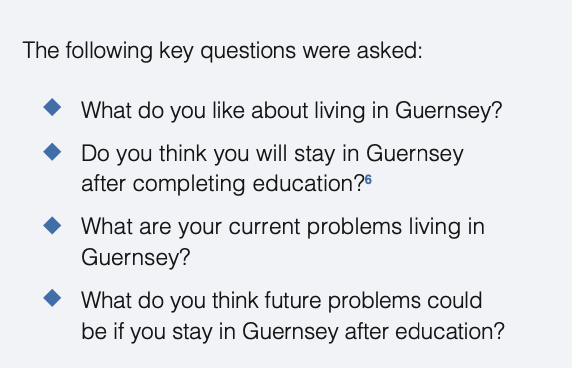
Dr Brink said the questions asked were designed to find out “what matters to them, what they value, and what they worry about – both now and for the years ahead”.
She pledged to listen to, and act on their answers.
“Listening to young people as well as older members of our community is important, but listening alone is not enough,” Dr Brink said.
“We must also act on what they are telling us. Their perspectives should remain prominent when decisions are made and there should be mechanisms to feedback to young people so they understand why decisions are or cannot be made. This is a responsibility of all of us, but particularly of those in positions of leadership.
The answers
Question 1 – What do you like about living in Guernsey?
The report states that “by far the most prominent reason that participants liked living in Guernsey was its safety”.
Many of the young people involved in the study expanded on this by describing low crime rates and feeling safe when they go outside.
The natural beauty of the island was also mentioned as an important reason why participants enjoyed living here, particularly its beaches.
Other reasons which were mentioned, though less frequently, included job opportunities, the close community and ease of getting around the island.
Question 2 – Do you think you will stay in Guernsey after completing education?
Just 27% of the young people said they’re confident they will stay in Guernsey after finishing their education.
36% were confident they won’t be, while 37% were unsure.
Follow up questions were asked about why some may want to stay or leave the island.
The main reasons given for expecting to stay were family and social connections, safety, and quality of life.
The main reasons given by those who thought they would leave included plans to live closer to family elsewhere, the high cost of living, lack of career opportunities, the lack of diverse retail and social opportunities, and poor weather.
Question 3 – What are your current challenges living in Guernsey?
The top three current challenges identified were road transport, lack of activities, and education.
Under concerns about road transport, the surveyed young people mentioned the cost, including the price of fuel, car insurance, driving tests, and the cost of public transport.
“Inadequate infrastructure” was also referenced with concerns around small and narrow roads.
The number and large size of cars on the roads, and dangerous driving were also cited, while some of the young people surveyed expressed “a need for more bikes on the roads”.
Under concerns about activities, the young people surveyed expressed that a lack of them, especially during the winter months, at low cost or free, is a challenge.
Longstanding issues around staffing, including a lack of subject specific teachers and high teacher turnover, were the main concerns raised around education.
Other issues included concerns around higher education and the perceived lack of clear decision making around future facilities and services.
Question 4 – What do you think future challenges will be if you stay in Guernsey after education?
The cost of living, the cost of buying or renting a home, and work-related concerns dominated answers about the surveyed young people’s potential futures in Guernsey.

Top concerns
Outside of the above challenges, cited by the young people themselves, the focus group sessions gave Public Health a clear direction on the ‘top five future concerns’ of young people in Guernsey and Alderney.
They were also able to set aside the areas of ‘least concern’.
Other concerns raised by the young people surveyed included climate change, “getting the job I want”, mental health and wellbeing, and digital threats.

Response
Public Health has said that this study “provides insight into the lived experiences, priorities and aspirations of young people aged 16–24 years in Guernsey and Alderney”
“Taken together, these findings highlight that while Guernsey offers a high-quality and safe living environment, young people are uncertain whether these benefits translate into a realistic, affordable and fulfilling future.”
It’s hoped that the data can be used to guide future decisions to help the Bailiwick “sustain a healthy, vibrant and resilient population for the future”.
“Public Health has a vital and wide-ranging role in supporting this ambition,” said Public Health.
“Its scope extends far beyond traditional perceptions, encompassing strategic leadership, public health intelligence, screening, and programme management, alongside a diverse range of operational services. These include the Public Health Nursing Team, Quitline, Healthy Minds, the States Analytical Laboratory, and the Orchard Centre for Sexual Health. Together, these functions form an integrated system that works to protect and promote health, prevent illness, reduce inequalities, and support individuals and communities across the life course.
“By continuing to invest in this broad spectrum of public health activity, and by listening carefully to the voices of young people, we hope to play our part in ensuring a healthier, more resilient population – now and for generations to come.”
Public Health said its staff will now be adapting services to respond to issues raised.
“Our challenge to you, valued reader, is to think about what role you too could play, whether in your professional or personal life, to building a better future for young people in our islands.”
Listening
Dr Brink said “the message from young people is clear”.
“They care deeply about their future here, but many are uncertain whether the Bailiwick can offer them an affordable, sustainable and fulfilling life as they move into adulthood. They have told us about many aspects of life that affect their health, including the high cost of living, the challenge of accessing housing, the cost of travel to and from the islands, and the need for meaningful opportunities. Just as importantly, they have told us that they do not always feel heard.
“Listening to young people as well as older members of our community is important, but listening alone is not enough. We must also act on what they are telling us. Their perspectives should remain prominent when decisions are made and there should be mechanisms to feedback to young people so they understand why decisions are or cannot be made. This is a responsibility of all of us, but particularly of those in positions of leadership.”

Having now listened to, and collated the views of around 200 young people, Dr Brink said Public Health is now asking politicians and senior leaders to “listen, hear and act on the views of young people”.
She said they need to “move beyond short-term solutions and take a long-term view that supports future generations; and to invest in prevention, opportunity and the wider determinants of health such as housing, education and employment. Failure to prevent the preventable is not acceptable.
“The decisions we make now will shape the health, wellbeing and sustainability of our islands for decades to come.”
