


Golden Guernseys might have been a thing of the past had it not been for the tireless efforts of Miriam Milbourne – who has long been credited with saving the breed.
Her efforts have been well documented by various organisations including The Golden Guernsey Goat Society, The Guernsey Goat Society, Guernsey Museums, Jimmy’s Farm, Country Life UK, The Goat Life, The Financial Times, and many more.

There are historic references to golden-coloured goats in Guernsey for more than 200 years, including documented reports written in 1826.
They are a dairy breed described as having ‘a pleasant temperament and a steady milk yield with good nutritional qualities’.
The origin of the Golden Guernsey Goat (Capra aegagrus hircus) is uncertain, though research on DNA by the University of Cordoba concluded that it is ‘indigenous to Guernsey’.
One hundred years ago the animals must have been a rare sight though, because in 1924 Miss Milbourne found some living “among scrub herds” – presumably on L’ancresse Common where she lived for her whole life – and she decided to look after them.
She is known to have started caring for the animals from this time onwards, before later starting to breed them.
By the end of the 1930s she had a small herd of her own.
She would soon be risking her life to save those animals and to preserve the breed’s future.

During the five year long Occupation of Guernsey during the Second World War, the island’s entire population began to starve.
Food became increasingly limited as time went on due to rationing and restrictions on importations, farming, fishing and scavenging.
When the German’s lost control of France the service lines for the Channel Islands were cut off, and aside from Red Cross packages being delivered in December 1944 and early 1945, both the Occupying Forces and the local population were left to eat whatever was on island.
All animals that could be slaughtered for food were, including pets.
To prevent her Golden Guernsey Goats being eaten by the German soldiers – or other starving residents – Miss Milbourne hid the animals in caves along the north coast of the island.
This deception would have cost her her life if she had been found out. But she wasn’t and this foresight helped the long term preservation of the breed.
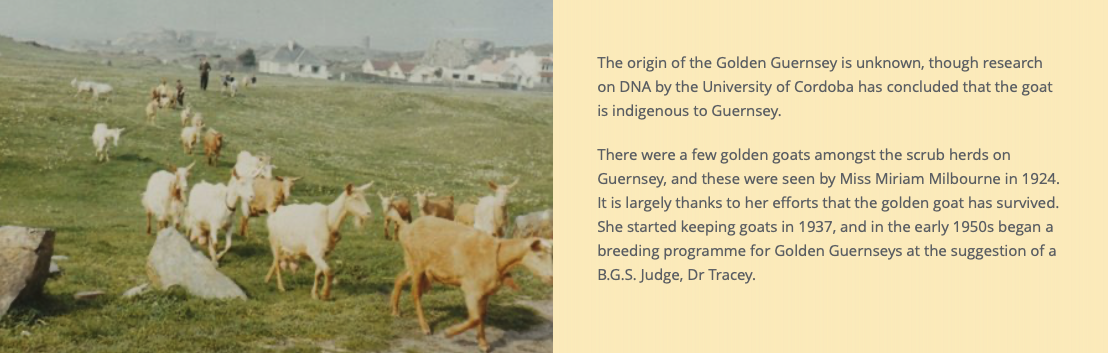
Pictured: Information taken from the Golden Guernsey Goat Society website. Read more HERE.
Miss Milbourne continued breeding the goats after the Occupation ended and by the 1950s she had more than 30.
They were known to be unruly and people who still live at L’ancresse today can recall the animals wandering freely after escaping from her home and gardens.
Ron Harnden, who moved to Guernsey in the early 1960s and has lived at L’ancresse ever since, remembers the goats often making their way around the common and sometimes causing problems for other people by eating flowers in their gardens.
Miss Milbourne had other goats in her heed such as including British Guernsey Goats, and she would sometimes give these animals – and the Golden Guernsey Goats – to other people so they could use them for milk and further breed them.
The Harnden family were one to take on some of her goats.
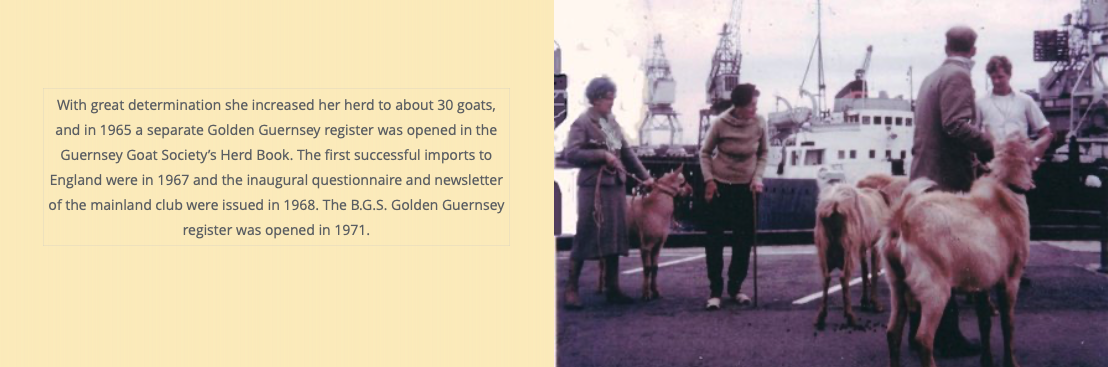
Pictured: Information taken from the Golden Guernsey Goat Society website. Read more HERE.
Ms Milbourne’s perseverance with the breed succeeded and the number of Golden Guernsey Goats under her watchful eye continue to grow.
By the mid 1960s a Golden Guernsey Register was established in the Guernsey Goat Societies herd book.
The breed started to be imported into England in the late 60s and the British Goat Society’s Golden Guernsey Goat register was opened in 1971.
Golden Guernsey Goats can today be found across the world, but they remain relatively few in number.
Miss Milbourne’s efforts to preserve and breed the animals has seen her noted as a notable woman of Guernsey by the island’s museum service, and she’s recorded in Rob Batiste’s ‘Guernsey Greats’ book.
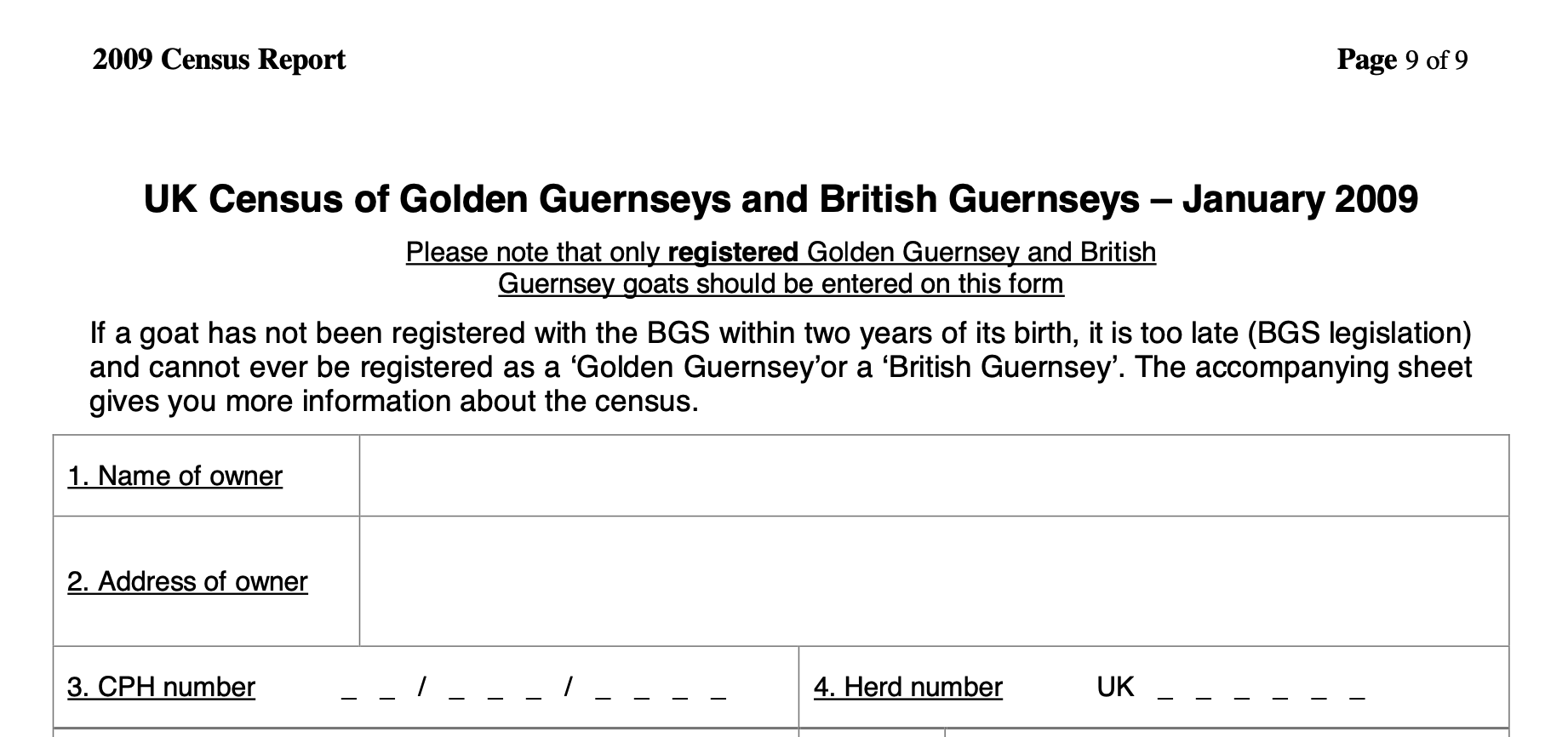
Pictured: The census was held during 2009 and the data released in 2010. It can be read HERE.
The most recent census of Golden Guernsey Goats was held in 2009, amid concerns that the current population had been ‘overstated’.
Fears about the declining number in the breed had been confirmed through the prior census held in 2005, and there were concerns that the number had further depleted after it was reported that around 40 Golden Guernsey and British Guernsey goats had succumbed to Bovine TB during 2008.
Reports from the UK fuelled these concerns with data showing higher than normal death rates among female Golden Guernseys in certain parts of the country.
With the number of breeding females and available males not known it was decided that another census would be held just five years after the last to ascertain the population in the UK and Channel Islands of both Golden Guernsey and British Guernsey goats.
The 2009 census showed that the UK and CI population was below 800 in total.
Further data collated in 2019, reported to Domestic Animal Diversity Information System (DAD-IS) were 1,381 for the Golden Guernsey (171 for the British Guernsey).
In the 2024-5 Watchlist compiled by the Rare Breed Survival Trust, Golden Guernseys were classed as an ‘at risk’ breed.

With Golden Guernsey Goats remaining so rare, an application was made to grant them a Royal title.
That was approved and they are now officially called Royal Golden Guernsey Goats.
It is the first time in recent history that the protected title has been granted to a livestock breed.
The Royal title was conferred on Summerville Tamsin on Tuesday during the Royal Visit of His Majesty King Charles III and Queen Camilla to Guernsey.
The King is Patron of the Rare Breeds Survival Trust, meaning the honour being bestowed on the Golden Guernsey is “wonderful recognition” of their breed, said Christopher Price, the Trust’s Chief Executive.
“We are delighted that His Majesty is conferring this special title on this iconic native breed,” he said.

Pictured: A Royal Golden Guernsey Goat with (inset) a British Guernsey goat.
“It is a wonderful recognition of the Golden Guernsey’s cultural and historical significance as well as these goats’ value to biodiversity, to the environment and to sustainable food production. Golden Guernseys are really efficient milk producers, and the milk is great for making yoghurt or cheese.
“The breed also excels in conservation grazing which supports biodiversity. Being choosey in what they eat, their grazing can provide very specific environmental benefits.
“We are extremely grateful to His Majesty for his continued, greatly valued support for British rare native livestock and equine breeds.”
Keith Opie, President of the Golden Guernsey Goat Breed Society agreed that “this is an incredible honour and even more significant as the breed is classed as ‘at
risk’ by the Rare Breeds Survival Trust.
“It reached a low point in the 1990s but encouragingly it has since been gaining in popularity,” he said.

Pictured: King Charles III conferred the Royal title on the Golden Guernsey Goat breed at a small ceremony attended by Summerville Tamsin.
“It is a unique breed, known to have been native to Guernsey for some 200 years, and is ideal for small holdings. These goats are gentle, smaller and more fine-boned than many British breeds, and produce delicious milk.”
His Excellency Lieutenant General Richard Cripwell CB, CBE, the Lieutenant-Governor of the Bailiwick of Guernsey said the King’s first visit to the island as Monarch will be even more special with this special recognition being bestowed upon our goats.
“The recognition being granted to our special and rare breed, the Golden Guernsey, is a wonderful and fitting way to mark the significance of His Majesty’s first visit to the island as King, an island whose relationship with the Crown is at its core constitutionally as well as historically,” he said.
“It’s a legacy and a tremendous honour that will stay with Guernsey for future generations.”

Pictured: Summerville Tamsin was the first to receive the Royal title on behalf of her breed – the Royal Golden Guernsey Goat.
The Royal Golden Guernsey Goat is ‘smaller and more fine-boned than other British milking goats’, with ‘a great variety in coat length’.
Adult males weigh 190-200lbs and adult females from 120-130lbs.
They are described as “easy to handle”, and the males are usually horned; often “splendidly”.
The breed standard allows variation in the golden colour, along with small white markings on the head, but no Swiss markings are accepted.
They have a straight or slightly dished facial line; the ears have a slight upturn at the tip and the neck is slender.
READ MORE…
Royally approved goats, oysters, seaweed, Guernésiais and much more
Golden Guernseys given new Royal title
