


The senior committee has been bounced into releasing the work of a sub-committee that was set up in 2021 to come up with proposals to reshape government as members get ready to debate this week whether to cut 10 seats from the Assembly.
P&R and the States Assembly and Constitution Committee have warned about the dangers of making that reduction, proposed in a requete led by Deputy Mark Helyar, so close to the General Election.
Deputy Helyar’s motion had claimed the work of the Reshaping Government Sub-Committee had been shelved, but P&R said that is not the case and published the report as part of its letter of comment.
However, it acknowledged the delay in bringing forward the findings “because in themselves they are not as meaningful as would be hoped given the breadth of its Terms of Reference”.
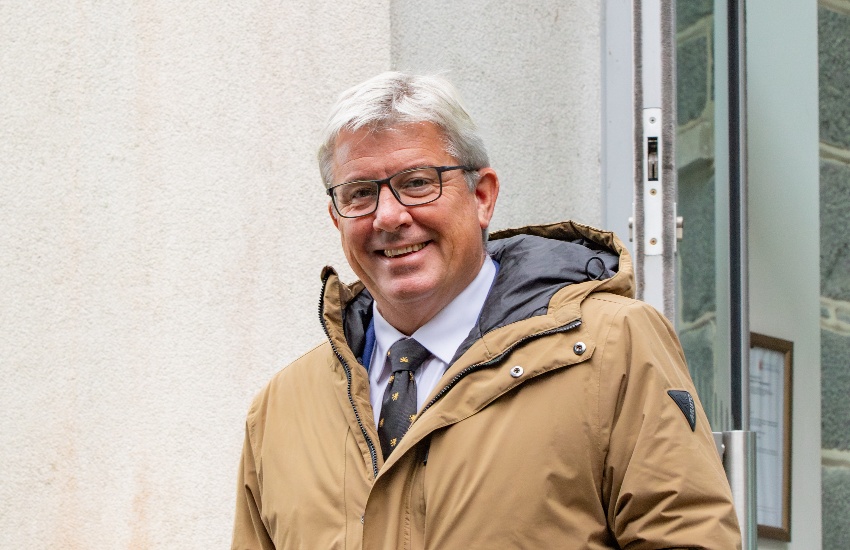
Pictured: Deputy Mark Helyar wants to reduce the size of the States by 10 members.
The report discusses a range of options, including reducing the number of members by three or five, but makes no concrete recommendations for change, instead proposing that a special States’ Investigation & Advisory Committee is set up to continue the work of reviewing government in the next term.
P&R will lay an amendment to the requete in an attempt to make that happen instead of the immediate cut, with the investigation committee under instructions to present recommendations to the States by December 2026.
In its letter of comment, P&R President Lydon Trott said: “the committee is minded to agree with SACC that the difficulties in progressing the work of government this term have their origins in behaviours rather than the structure of government and number of States members.”
He said that an arbitrary reduction of 10 members within months of the General Election would not represent good governance.
Neither the States nor its civil service had the capacity at this stage of the term to conclude work on policy responsibilities that would flow from the reduction, he added.
There was also an argument that the reduction would also mean a need to reduce the Alderney representation in the States down from two members so the ratio better represented the relative sizes of population. That would need both islands to agree and a law change.
The sub-committee was originally comprised of Deputies Heidi Soulsby, Jonathan Le Tocq, Carl Meerveld, Liam McKenna and lay member Advocate Tom Carey – but has also seen Deputies Bob Murray, John Gollop and Simon Fairclough involved as people resigned at different times.
Its “vision for the future” is a slimmed-down executive government that focuses on strategic matters, with robust scrutiny in place.
“The sub-committee recognises that there may not be sufficient political appetite for a move to executive government at this time but believes that there are steps that can be taken which would improve the current situation and could also potentially feature in an executive system, albeit they are by no means unique to such a system.”
Among its suggestions was moving back to having a senior committee that included all the major committee presidents, supplemented by a dedicated President and Treasury lead and another position which may be a vice-president role, dedicated to external relations or “without portfolio”.
“This would mean that strategic planning, scheduling and delivery, including, crucially, the resource allocation necessary to deliver government’s strategic plans, would be discussed with all key political stakeholders participating on an equal footing.”

Pictured: Deputy Lyndon Trott is President of P&R.
It said that a further option for improving the ability to set and deliver strategy would be to consider extending political terms from four to five years.
“The sub-committee’s view is that the four-year term is insufficient to enable the States to operate as effectively as possible, particularly in light of the turnover that has been seen in recent elections, with 50% of the Assembly being replaced in one fell swoop.
“There is a great deal of information for new Deputies to assimilate at the start of a new political term, meaning that, through no fault of their own, they are not fully effective in their roles for about 18 months, leaving a period of approximately two years during which they are more able to achieve their aims before the business of government starts slowing down prior to the next election.
“Given that it can take several years for policy implementation and other projects to be completed or at least substantially advanced, the four-year term is, in the sub- committee’s opinion, hindering the ability of government to deliver against its identified strategic priorities.”
It also argued that members of the senior committee should have served at least one political term.
The sub-committee set out a potential new committee structure, but said it realised there were many ways to configure a new government “which is why is has not made for recommendations in this respect”.
It has suggested removing politicians’ role in making planning decisions, moving Overseas Aid into the portfolio of a member of the senior committee instead and enhancing the scrutiny function.
How deputies are supported once in office was also addressed.
“Members felt strongly that facilities and support for deputies were inadequate but acknowledged that changing this would involve cost, which would have to be met from making savings elsewhere.”
Over time it wants consolidation given to a dedicated meeting area for the Assembly, dedicated support for members not on committees or working on areas not within the committee’s mandate like requetes, dedicated work areas for deputies and more dedicated administrative assistance for Presidents.
In its conclusion, the sub-committee said: “Early in its deliberations, it identified that the issues are primarily cultural and behavioural and therefore not likely to be solved through structural change.”
