

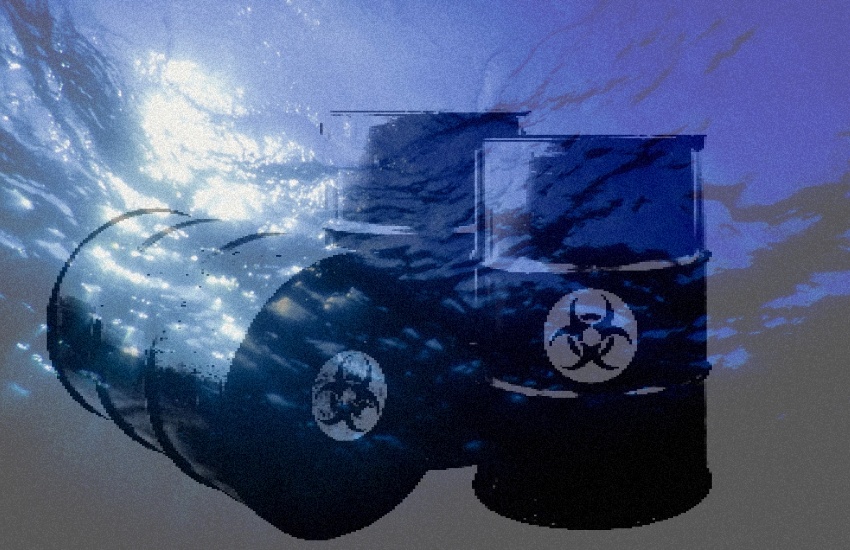
Hurd’s Deep has been the scene of a couple of maritime disasters but has also proved a useful hidden trench for the British government to dump its spent ordnance.
First it was chemicals and munitions following the Great War, then it was military equipment and weaponry recovered from the Channel Islands after the Nazis were booted out.
By the time President Truman ‘pressed the button’ to show off the latest scientific innovation on Japan a race began between nations to proliferate something new and deadly.
Britain was a world leader in adopting civil nuclear technologies and its research into nuclear weapons was at one point more advanced that the Manhattan Project. But as with every product, there’s a by-product.
For over 20-years from 1946, Hurd’s Deep was sized up and used as a dumping ground for nearly 30,000light metal drums of low- and intermediate-level radioactive waste totalling 15,000 tonnes.
This included plutonium which takes nearly as many years as total barrels dumped to halve in strength.
The practice stopped in the mid 70s leaving the underwater valley teeming with ageing and rusting drums. But until international conventions on dumping were signed the practice was viewed as routine and uncontroversial.
The legacy is that 50-years later the 150km long trench generates continual work for the Channel Island governments and UK pollution agencies.

Pictured: Greenpeace captured images of the rusty barrels in 2000.
The historic dumping of waste in the Deep came to the ire of European environmental pressure groups such as Greenpeace over 10 years ago, who sent underwater cameras to document the rusted and disintegrating containers.
German parliamentarians kicked up a stink and called on the barrels to be removed from the depths.
A documentary was aired, but was never broadcast in the UK, suggesting negative health impacts in the Alderney population from radioactive discharges into the sea including Hurd’s Deep and French nuclear sites on Cotentin peninsula
The Channel Islands then went on the offensive to kill the story.
A press release from the States of Guernsey in 2013 sought to reassure that “there is robust and ongoing evidence to demonstrate that these deposits are not presenting risk to human health or the environment”
That thanks to annual testing of liquids and solids around the islands since the 1960s.
“Based upon the type of material that was disposed of in this area and the long-standing historical monitoring data, the breaching of a barrel (or a number of barrels) would be unlikely to have a detrimental impact on the marine environment or human health.
“As the States of Guernsey continue to live with the legacy of this waste material, the most proportionate response is to continue to monitor the comprehensive array of environmental and animal indicators and to use this data to inform the States’ response.
“The Hurd Deep lies outside of Guernsey’s current territorial waters and clearance of this material would be the primary responsibility of Her Majesty’s Government.”
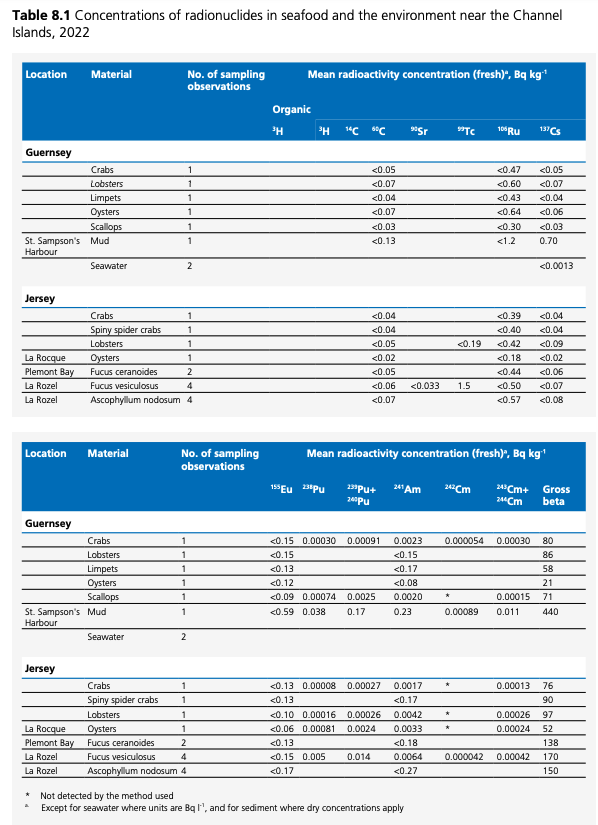
Pictured: A breakdown of the latest radioactivity levels in marine life.
The latest nuclear risks report jointly commissioned by Guernsey and Jersey builds on subsequent radiation monitoring reports and continues to say that “an ongoing programme of monitoring fish, shellfish, seawater and seaweeds has continued to find that there is no evidence of significant releases of radioactivity from the Hurd Deep site.
“Any radioactivity in the environment around the Channel Islands continues to be of negligible radiological significance.”
Local samples are collected and sent to the UK for analysis, which are detailed annually in the Radiation in the Food and Environment report produced by the British government.
The latest edition include data from 2022, with a one-year reporting lag. But in both 2021 and 2022 no samples were collected from Alderney which is the closest island to the Deep.
There are releases from the Hurd and other nuclear sources, but nothing high enough to warrant concern.
“It is generally difficult to attribute the results to different sources, including fallout from nuclear weapons testing, due to the low values detected. No evidence for significant releases of activity from the Hurd Deep site was found,” the report says.
“In 2022, the dose to the representative person, consuming large amounts of fish and shellfish was estimated to be less than 0.005mSv, or less than 0.5% of the dose limit for members of the public. The assessment included a contribution from external exposure.”
Permission has recently been granted for a French research vessel to enter Bailiwick waters to continue monitoring.
If a significant leak of radioactive materials was ever detected public health officials may advise that locally caught seafood shouldn’t be consumed while the accident is investigated.
