


Ongoing IT issues affecting the Revenue Service will not hold up the introduction of GST if it is brought in.
A final decision on bringing in a package of measures including a goods and services tax and changes to income tax and social security contributions is expected to be made this summer.
If GST+ is approved by the States, after a review of alternative measures has been concluded and presented to deputies, it is likely to come in from 2028.
Policy and Resources is suggesting that if GST does end up being introduced, then a flat rate of 5% is put on most things, including food, with some exemptions including for medical expenses.
But, with Guernsey likely to introduce a new tax, and change other well established revenue sources, some concerns have been raised about how the beleaguered Revenue Service will cope.

In November, Deputy Gavin St Pier told the States that two multi-million pound IT projects had essentially failed.
One was instrumental to updating the way staff at the Revenue Service work, while the other was concerned with overhauling service users digital experience with the States.
In November, Deputy St Pier said the Revenue Service’s “challenging and far from smooth” IT transition is “the symptom of a much wider set of problems” concerning the way major projects have been run.
The programme in question, which cost £24 million, was “formally closed” earlier last year, despite resulting in a system that is “clearly not yet complete, appears to have reduced functionality for Revenue Service staff,” and “provides poor service levels for customers”, he revealed.
The original digital government programme, MyGov, came under specific scrutiny with Deputy St Pier pointing to its price, which “cost £18 million” over four years, but “has delivered very little of what was promised” he said.
In the same speech, he also noted the failure of the Electronic Patient Record system, a project which he says is “running behind schedule and budget”.
Deputy St Pier did stress who was to blame for such failures, and it’s not the staff assisting islanders, or those filing the taxes, but those managing the projects he said.
The same staff within the Revenue Service who have been grappling with the waste-of-money IT system they’ve been given to work with, will have to deal with the changes associated with the GST+ package too.

That includes a reduced standard rate of personal income tax for people earning up to £32,400 per year, the introduction of a social security allowance, increases to pensions and benefits to compensate for the impact on prices as a result of the introduction of a consumption tax, and the introduction of a new annual Essential Costs Relief Payment to support those low-income households who do not, or can not, claim income support.
Deputy St Pier said if the States agree to introduce GST+ this summer then the Revenue Service will have to deal with it – despite the ongoing problems.
“None of us are happy with how the Revenue Service project has evolved, and the very real challenges which are there now, however, I think we have to recognise that while it is a challenging point in time the Revenue Service was not always like this and there’s no reason to think it always will be like this.
“We have to get it back to its operational efficiency that it once had. (The failures are) not a reason, or is certainly not a good enough reason to defer making some of the long term, really important decisions around how we structure our tax system for the future.
“Instinctively, it is easy to say, ‘oh, we should let them sort out the Revenue Service before we have this debate’. I understand that, but the reality is, we don’t really have that luxury.
“We know that the challenges we have are not driven by the fact that the Revenue Services has a backlog of tax returns to process. It’s driven by these other, bigger structural issues, and if we bury our head in a bucket of sand on that, those issues will still be there. So I’m afraid we’ve got to deal with both problems, but recognise that the Revenue Service’s administration problems now are short term, and we’ve got to get a grip of them, and we’ve got to get back to where we were. But in the meantime, we also need to make some of these other decisions.”
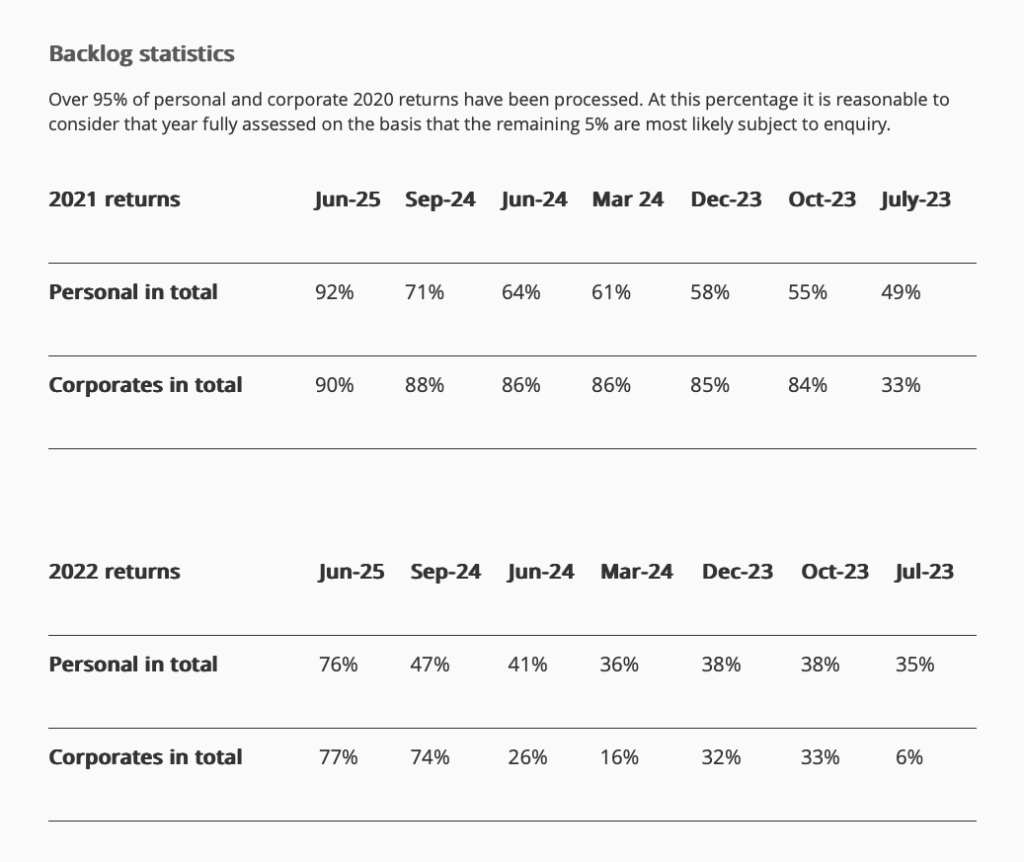
One of the problems facing the Revenue Service is the backlog of tax returns that staff are working through.
The most recently available data – from June 2025 – shows that nearly all returns for 2021 had been completed.
Around three quarters of returns for 2022 had been completed and just over half of personal returns and just under 10% of corporate returns for 2023 had been assessed.
As well as working through those assessments there is a backlog of refunds waiting to be processed – where people are owed money back due to paying too much income tax in a previous year.
The faults with the IT system caused a delay in processing those payments, which has since been rectified but has left a backlog.

A decision on the introduction of GST+ is likely to be made this summer.
A team led by Deputy Charles Parkinson are investigating alternative options to GST+ to solve Guernsey’s financial problems. Their findings are expected to be finalised by June.
Running simultaneously to that work, civil service staff have been working on the detail around the proposed introduction of GST+ so that the package of measures can be promptly introduced if that is the will of the States.
Deputy St Pier told Express that if GST+ is introduced, the current P&R will try and bind future States to only amending (increasing) the rate it is charged at by a ‘super majority’ rather than by the simple majority that is used in most States decisions.
