

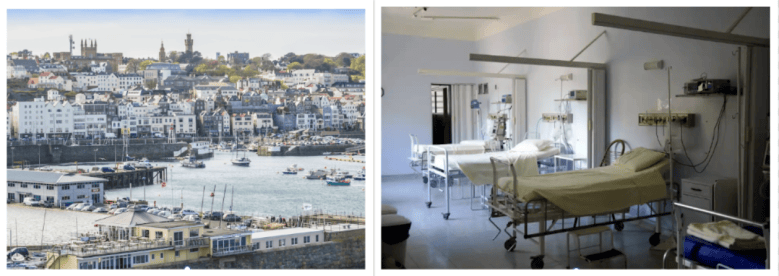
The demand for healthcare in Guernsey continues to increase, with improvements in waiting lists but ongoing challenges around ‘bed blocking’ with “11 or 12 patients every day spending a night in hospital that they don’t need to”.
The latest data came out in the 2024 Report for on Secondary Healthcare, published yesterday, that evaluates the key performance indicators of the Health & Social Care (HSC) contract with the Medical Specialist Group (MSG).
The report is intended to monitor work carried out under the contract between the two entities and to hold the MSG to account.
Dr Peter Rabey, HSC Medical Director, confirmed that there are challenges including the long term care of those people who don’t need to be in hospital.
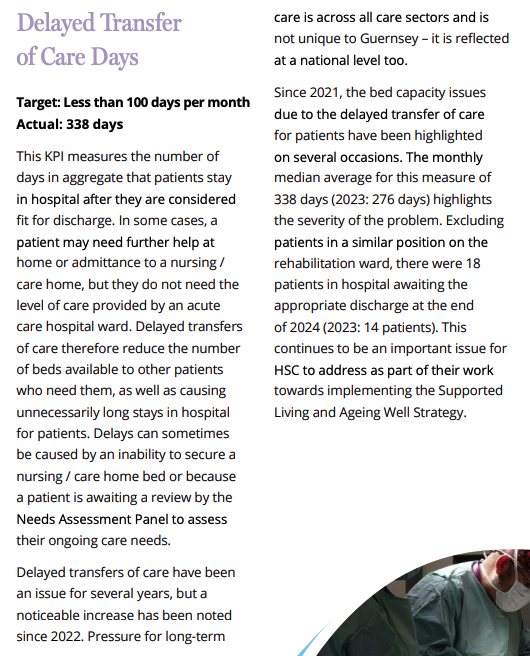
“The number of 338 patients who are called delayed transfers of care, are patients who shouldn’t be in hospital anymore,” he said.
“They are ready to be at home or in a care home. But they haven’t been able to find a care home bed or they are waiting for a package of care in their home. So it’s a problem for the patient; and this is a problem that all health care sytems are seeing.”
Dr Rabey went on to explain what that 338 figure actually means.
“338 beds per month, which if you divide by 30 days, means 11 or 12 patients every day, are spending a night in hospital that they don’t need to. It’s basically half a ward,” he said.
“This is not just health and social care, this is to do with the entire system and it includes, The Supported Living and Ageing Well Strategy (SLAWS), getting that right, it includes incresaing capacity in the care and nursing home sector and it includes recruitment of people who can deliver social care packages. Those three things can make the biggest difference for us.”
Dr Rabey went on to describe how difficult it is to find staff to offer the ‘social care packages’ that are so urgently needed in Guernsey.
“These staff are difficult to get, it’s hard to get housing licences, it’s hard to fnd accomodation, and these are difficult staff to recruit. More staff to deliver social services in the home is exactly what we are trying to to do.”
He went to explain that the solution led ideas and budget are there within HSC.
“We have budget for more people than we can recruit. Our biggest problem with recruitment at these grades is accommodation. It’s so expensive in Guernsey and hard to find. I know the States of Guernsey are fully aware of this across key workers, and they are doing what they can to address that, and that continues to be a problem.”

While highlighting the ongoing recruitment challenges and other pressure points, the report has also confirmed some success in 2024 with waiting lists starting to decrease after peaking during and post-covid.
There remains more challenges though with the report stating: “2024 was no exception to the continuous increase in demand on health services with more inpatient admissions, outpatient referrals and theatre procedures completed than the year before. “
Despite saying that the “total number on waiting list and waiting times have improved in the past year,” the report also highlights a lack of compatibility in the Emergency Department waiting times, with a target of 95%, but an actual result of 89% in 2024.
This measure looks at the time from checking in at the ED reception to the time a patient is either admitted or discharged which should take no more than four hours.
Dr Rabey said despite missing their target in this area, the situation is better than it sounds.
“Our Emergency Department only admits 11% of the patients they see, so they’re seeing you, treating you and mostly discharging you, and mostly within four hours. This is a really good result.”

He went on to say that the public can see “we don’t have people waiting on trolleys in the corridors, who don’t have ambulances waiting outside. Our emergency department is one of the things I’m most proud of in Guernsey.
“The 95% target has not been in the UK since July 2015, it’s an ambition that we would like to get people home within four hours, but it’s un achievable in most health care settings. 89% of people do get home in four hours or are admitted within four hours. That means that there are a few more people spening more than four hours in department, either waiting to be seen, or waiting for a bed, or watiing for perhaps psychiatric review. But this longer that four hours wait is to help them and get them to the right place.”

When Express asked why the target isn’t 100%, Dr. Rabey responded: “The target shouldn’t be a 100% because for some patients it’s in their best interest to be there for more that four hours.
“So if you’re waiting for a pysche assessment but you possibly need to sober up before they can assess you, it’s better to wait four hours to be assessed properly rather than rush if you’re not ready.
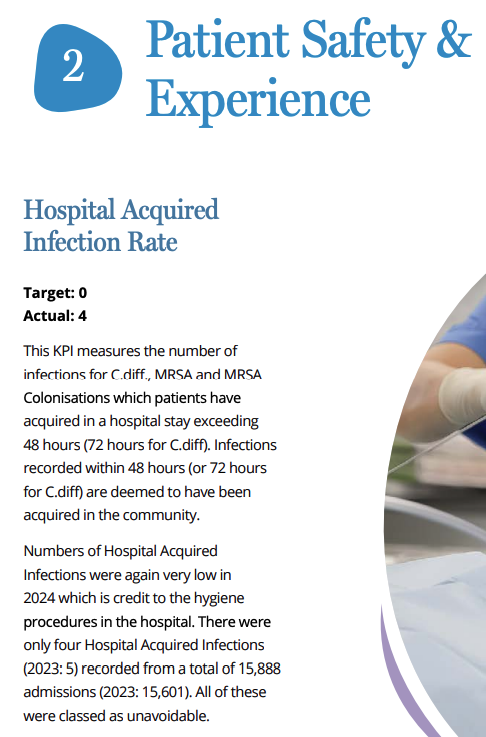
Other interesting areas of note in this latest report are the number of infections patients picked up during their hospital stay.
Cited in the Patient Safety & Experience section, numbers were “very low”, giving credit to the thorough hygience procedures in place.
Consultant physician Dr Steve Evans is Chair of the MSG. He said their team works hard to meet the KPIs set by HSC but he is also aware of the ongoing challenges and demands from the public that they share.
“I’d like to pay tribute to all our consultants and support team members and to our colleagues at the HSC for their hard work, commitment to clinical excellence and for the way they put our patients first, always. None of us want to see our patients waiting longer than they should and we are determined to continue to do all we can with HSC to continue to reduce waiting times.
“Recruiting specialists with the right experience and approach to patient care continues to be a top priority. Last year we successfully recruited three ophthalmologists, one of whom started work in February. We’ve also just managed to recruit a fourth surgeon after a three-year gap since the previous post-holder left which we have had to fill with locums.”
