


“This, this is myself. This is during the occupation with my little sister,” said Roland Duquemin as he scanned across a table full of photos taken 80 years ago.
“I was seven when the troops landed. My little sister was nearly three.”
At 92 years old Mr Duquemin has seen much in his time, but with everyone’s thoughts turning to the Occupation and the 80th anniversary of the Liberation, much of his thoughts will be on the five years of German rule that his family lived through.
He was there to see German soldiers stealing vegetables from local farmers, he was on the steps of Elizabeth College when locals were warned of minefields and the efforts to clean them away, and he was listening to the radio as Churchill announced that “our Dear Channel Islands” would be freed.
He was also there for the post-war visit of King George VI and Queen Elizabeth, and when islanders worked together to prepare for the first liberation celebrations.
Mr Duquemin and his wife Margaret were introduced to the press as they were awarded medals for what they went through during the Occupation, and Evacuation. Replicas of the medals that they and others received are now being distributed to today’s school children as part of the 80th anniversary events.
Mr Duquemin spent the entire Occupation on the island and he told some Castel primary pupils what that was like. The Germans arrived when he was just 7 years old, and they were here until he was a teenager. Mrs Duquemin, meanwhile, was evacuated to Bradford.
She had to wait even longer for the war to end and she could return home. She didn’t see her father until 9 October, 1945, having been separated more than five years previously.
Both Mr and Mrs Duquemin went through so much in their childhoods, and both have kept much of that past with them.
During a half an hour conversation with, they both moved from overwhelming joy to sadness, and back again, and I shared those emotions with them as I heard their stories.
The lessons of history aren’t so quickly lost on those who lived them, and one story impacted Mr Duquemin more than the others, and it came from a question during his visit to Castel School.
“We were invited to go to the Castel school and tell both our stories. They were so interested, and the questions they asked were so intelligent! This boy, I don’t know, he was about 10 or something, and he asked, ‘Was anyone killed?’.”
He spared the grizzly details of what happened for the children and calmly said yes.
“Bertie Jehan. He had planted potatoes in his garden, and he’d noticed some digging had been done, so he and his son, Herbert, kept a watch.
“Sure enough, this young German came, and he started digging. He had a bag, and he was putting the potatoes in the bag, and they were watching him. Then they came out and chased after him, and when they got onto the road, Mr Jehan was catching up and his son just behind him, and he, (the German soldier), fired two shots on the road.
“One of them rebounded and went towards his son behind him, but in the heel of his shoe. The third shot went into Mr Jehan. His son carried him in, but he died. He died because they were hungry as well. They were hungry.”
Anyone who has spoken with a survivor of the Occupation, Evacuation, or Deportation will know the look of sadness that envelopes them when talking through a time as traumatic as World War II. The things they saw, and witnessed as children and teenagers kept close.
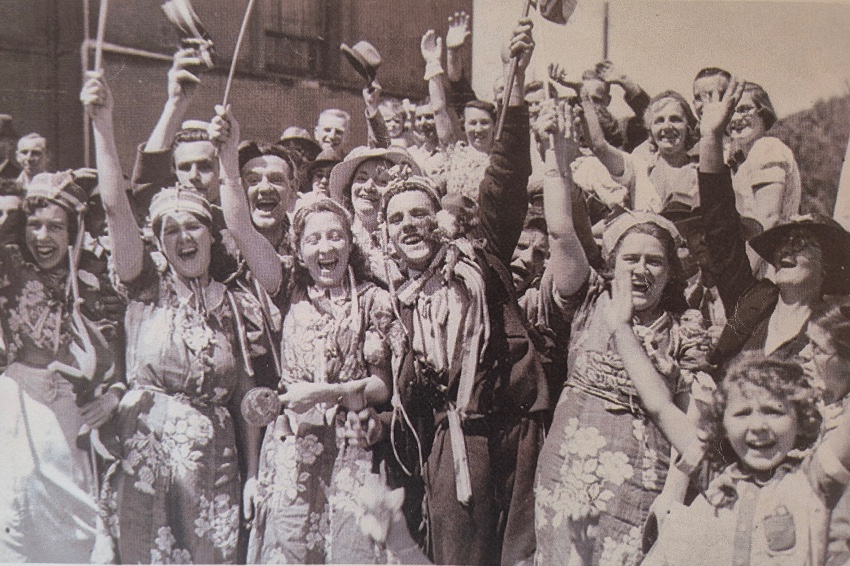
There’s one sure fire way to pull someone out of that kind of trauma spiral, ask them to talk about the celebrations that took place on the island for the first ever Liberation Day.
“The wireless came out, somehow they got the wet batteries, they always kept hold of one! Anyway, we listened, and when Winston Churchill said ‘today’, and I can hear him now, ‘our dear Channel Islands are liberated’.
“The day after, which was actually, you know, when they signed on the boat outside the harbour, it had to be on neutral land. The tractor from Mr de Garis came out, and the trailer, we got some form of seats from the Sunday school, that’s where I was educated, because they took over the junior school. We took some of the seats and forms and that, and put on the trailer, you know? It was amazing. We must have had 25 to 30 adults and children on board that trailer with that tractor pulling along.
“We went all the way around the coast, and when we got to the bottom of the Rohais, we met and saw our first British Tommy. He was there, and he greeted us, and he was throwing chocolate and sweets into the trailer.
“That was before we got to the front, and when we got to the front, oh, there were soldiers and that, and the people, oh, the crowd, and they were all finding out, and then telling the stories and that. It was so exciting.”

Pictured; Roland Duquemin as a boy at the start of the occupation, with his Mother, Sister and Father. 
Pictured; The bombing of the White Rock, another story which Roland knows well. 
Pictured; The Liberation Day arch which has long stuck with Mr Duquemin. Working men from across the island donated flowers, building poles and their time to erect the arch in time for the King’s visit. 
Pictured; Mr Duquemin’s Father put in a bid for an old Opel left behind following the end of the war. He purchased the car for £13, before finding out it had no carburetor.
As part of Liberation Day events this year, marking 80 years since the end of the Occupation, Express has been learning more stories of islanders who went through so much.
You can learn of Jill Chubb, who was deported to Biberach at the age of 3, HERE.
Tomorrow you can find out the story of Pamela Masterman, an evacuee who spent much of the war time travelling across the UK from city to city.
