


A five year strategy to tackle mental health and wellbeing in the Bailwick has had its first progress report unveiled this week.
It incorporates feedback from the two Gedze reviews conducted in 2021 and 2022, and is the first report to show ‘monitoring of progress’ made against the four Pillars of the Strategy.
The report emblazoned with the mission Investing in mental health , Investing in healthy futures on its cover was unveiled by Deputy Marc Leadbeater, at The Princess Elizabeth Hospital yesterday.
The Vice-President of the Committee for Health & Social Care is also Chair of the Mental Health and Wellbeing Technical Team.
“I am very pleased with the publication of the first full annual report on the Mental
Health & Wellbeing Strategy, which highlights our progress made since its launch in
September 2023,” he said.
“The progress to date has been good and we’ve completed actions to discharge nearly 70% of the recommendations from the two Gedze reviews, with approximately 42% of all outstanding Strategy actions are complete.”
The ‘Mental Health and Wellbeing Strategy 2023 – 2029’ was approved by the Committee for Health & Social Care in September 2023 following extensive collaboration across the States of Guernsey, Primary Care and the charitable sector.
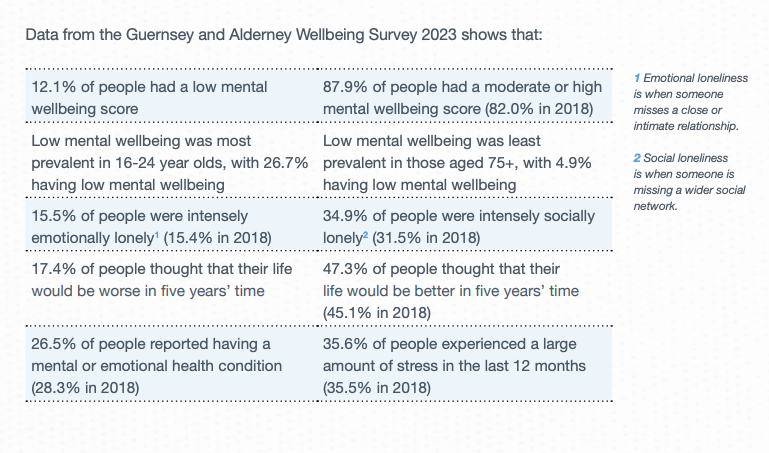
The results of the most recent Wellbeing Survey, detailed in the 2024 report, shows that low mental wellbeing was most prevalent in 16-24 year olds.
It also highlights that 47.3% of people thought their life would be better in five years time.
The survey results show that intense anxiety and fear are symptoms experienced by people suffering with their wellbeing, but often in parallel with going to work and earning a living and getting on with daily life.
The survey also highlights that 35% of respondents said work often or always caused them stress or anxiety.
This issue around workplace anxiety has been specifically recognised in the Strategy.
Guernsey Mind launched the Workplace Partnership in 2024, supporting organisations to enable good employee mental health and wellbeing in the Bailiwick.
Chief Executive, Jo Cottell said initial uptake has been promising so far.
“Partnering with Guernsey Mind as part of the Workplace Partnership makes a bold statement that an organisation is serious about mental health,” she said.

“We now have 11 partners from a range of sectors of the community who between them employ over 800 people.
“We are pleased that the report highlights the importance of prevention and early
intervention in mental health, as well as raising awareness in the community. We have also been providing Supported Self Help for over a year now. They are free, six session guided programme for people with mild to moderate symptoms of poor mental health. Clients are given materials to help them to understand and manage feelings, as well as practical tools and techniques to use every day.”
Guernsey Mind said its programme data showed impact with:
- 92% of clients reporting they had a reduction in feelings of anxiety
- 83% reporting a reduction in feelings of depression
- 84% had an improvement in mental wellbeing.
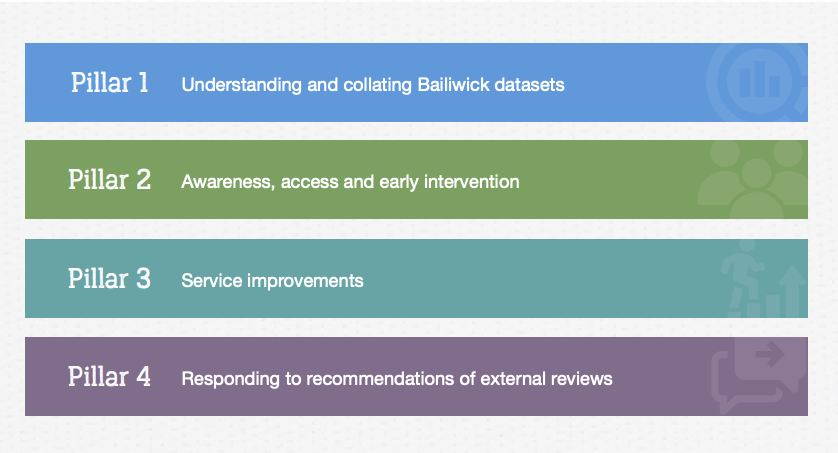
The Bailiwick’s Mental Health and Wellbeing Strategy aims to offer a more cohesive service around issues such as workplace wellbeing, and reducing stress and anxiety as examples, by focusing on ‘four pillars’ for success.
The 2024 Report shows progress in many areas including, how work has begun to develop a directory of Bailiwick wide mental health and wellbeing services, as well as a map showing an island-wide network of care pathways.
Speaking on this part of the strategy Deputy Leadbeater explained that “the directory for mental health services and care pathways is under development” and, like the strategy itself, it will be a “living document” that can be updated as and when further services become available.
Express understands that once completed, the resources will provide clear and accessible information so residents can better understand how to navigate local mental services and understand the support that is available to them.
Deputy Leadbeater said collating that data depends on how busy the individual service providers are.
“Data on timeframes will be included where possible, but as waiting times can fluctuate depending on the number of referrals received and the capacity within each service, they can be difficult to predict.”
The strategy was drawn up by experts from mental health and public health services, charities and people with lived experience of poor mental health themselves.
