

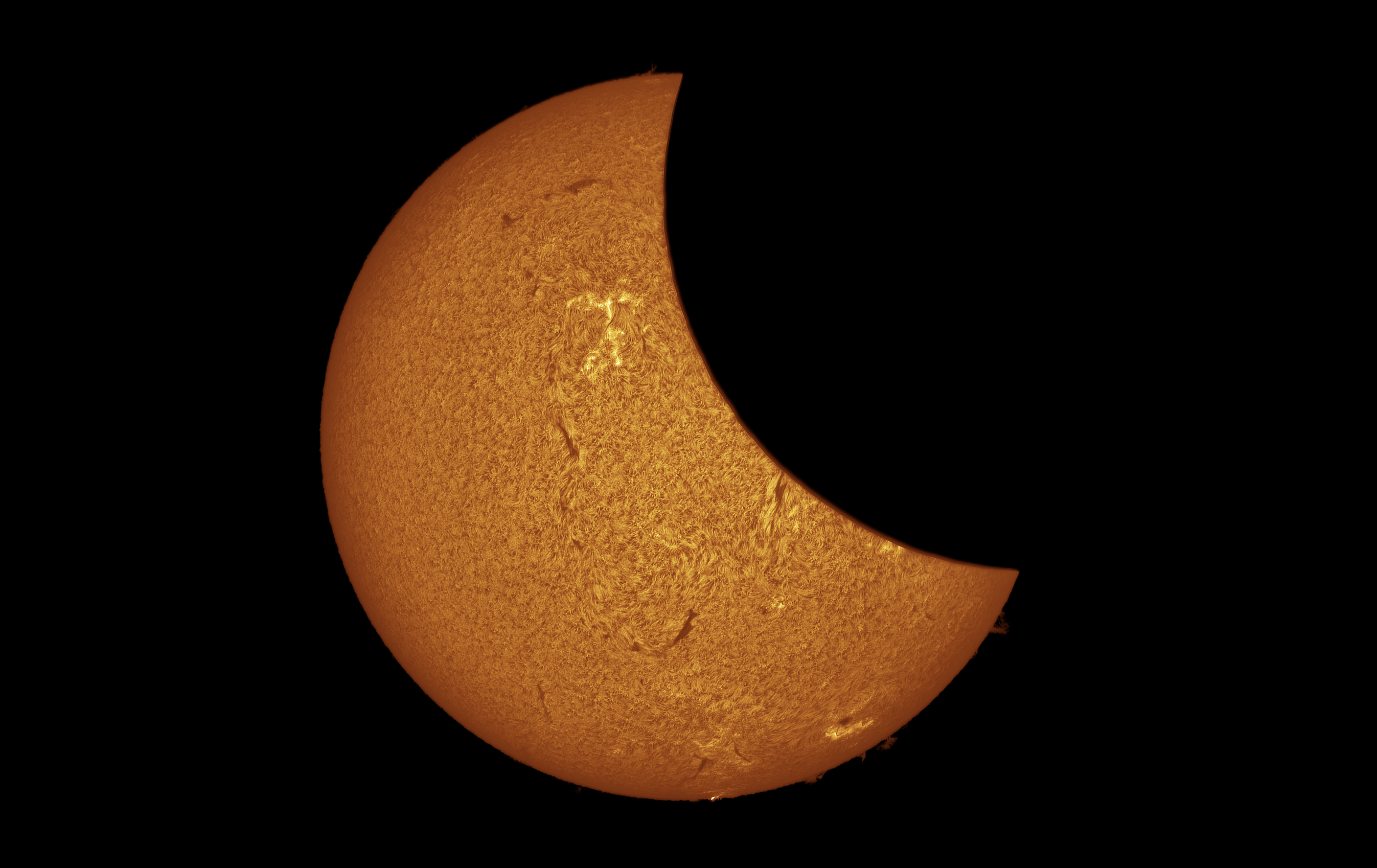
A Guernsey student captured Saturday’s partial solar eclipse sharing a timelapse of the moment the moon passed in front of the sun.
Jacques Loveridge was among a group of people who gathered at the David Le Conte observatory run by La Societe Guernesias on Saturday morning to witness the event.
La Societe said that solar eclipses happen a few times a year, but total eclipses are rare for any specific location.
Guernsey last experienced a total solar eclipse at the turn of the millennium in 1999, the next one won’t be until 2081.
Saturday morning’s partial solar eclipse saw the moon pass in front of the sun between 10:00 and 11:00.
“Many people turned up to join members of the Astronomy Section in watching the partial solar eclipse through our telescopes,” said Dr Jean Dean.
“The weather was perfect and we would like to thank everyone who came along to share the event with us.”
As well as Jacques’ timelapse, which shows the Sun’s chromosphere (the middle layer of the atmosphere) which is a thin layer of plasma, just above the photosphere, where the temperature rises from about 6,000˚C to 20,000˚C, other sequences of the phases were caught too.

Carol Vivyan’s images (above) show the Sun’s photosphere, which is the visible layer of the surface of the Sun that we are most familiar with.
“Photons of light are created in the central region of the Sun through nuclear fusion,” explained Dr Dean.
“The photons can take 100,000’s years to a million years to reach the photosphere, when they escape from the Sun and reach Earth which is 93 million distance, about 8 minutes 20 seconds later.
