

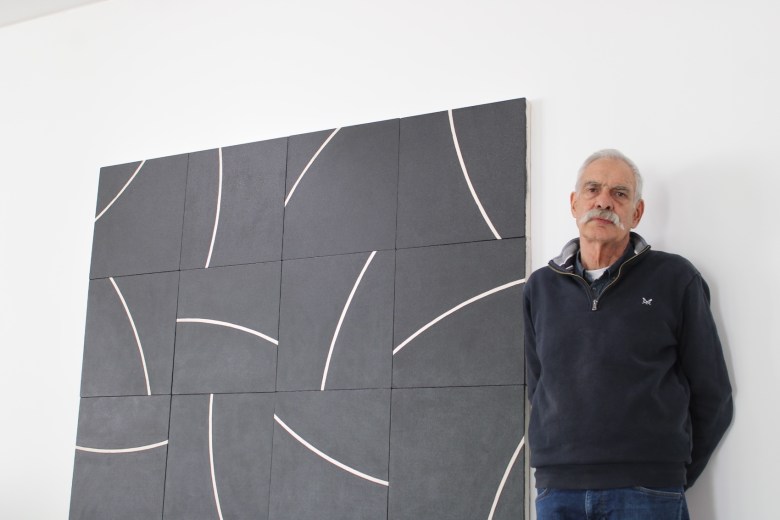
Guernsey-born artist Eric Snell returned to the island to present ‘Squaring Circles’, an exhibit at Art for Guernsey.
Though his artistic journey has taken him across the globe, Mr Snell maintains a strong connection to his home island, which he says “is with you all the time”.
The man behind the Guernsey Liberation Monument still feels a deep sense of belonging here.
“I just feel part of Guernsey. I don’t think that you ever lose that,” he said.
“The fact I’m now living in the UK…I’ve lived in the UK for a long time, I’ve lived in New York, lived in Australia, but Guernsey is with you all the time.”
He continued: “It’s nice to be back, but it doesn’t feel like in any way that I’m a visitor. It feels like I’m still very much part of the fabric of the place.”
Mr Snell is an alumnus of the Berliner Künstlerprogramm des DAAD and the Cité Internationale des Arts in Paris and he founded and headed the first School of Art and Design at Guernsey’s College of Further Education.
With years dedicated to teaching locally and abroad, he has educated hundreds of people throughout his career.
However, since his departure, the art scene in Guernsey has developed.

Art for Guernsey has grown from an idea, to a charitable institution that pairs art and finance, whilst providing opportunities regularly to educate the next generation, the oldest amongst us, and everyone in between.
Mr Snell says Art for Guernsey has continued with an ethos he spent years embedding in Guernsey.
“What resonates more, I think, is the spirit of where David (Ummels) and Art for Guernsey is, and I suppose where I stepped away from.
“I’m very pleased that that continuum is continuing. I like to be part of such an initiative, that is really important, and if I can help support and develop that program, that’s a bonus.”
The ‘Squaring Circles’ exhibition is a showcase of Snell’s unique approach to art, which is deeply rooted in process, curiosity, and a blend of the digital and natural worlds.
Three bodies of work make up the exhibition: ‘Remote Controlled Drawings’, ‘Circle Squared’, and ‘Tide Lines’.
In the first, Mr Snell uses remote-controlled cars with ink on their wheels to create abstract patterns. The resulting drawings are a physical record of the car’s otherwise unseen movement.
It came following renovations to his home, and the launch of his working studio.
“In 2021, very early ’22, I started to have a working studio. Suddenly I thought to myself, ‘what do I do now?’.
“I’ve now got the working studio. What do I do now? Do I carry on from what I left off? Or do I step out on a new journey? And it was these that were kicking around my head.
“I had not got a resolved idea in my head, and I was unpacking some of the boxes from my old studio, getting material and equipment out, and I came across this remote control car.”
Mr Snell subscribes to the “importance of play” as a tool of engaging and learning.
“I thought if I rearrange the plastic on the car and cut away some of the plastic, I can put some little sponges on the back wheels. I can then fill those sponges with ink.
“As the car moves forward, the ink gets dragged down over the tyres, and you create an automated form of drawing, which I really liked.
“So you’re in control, but you’re not in control. You’re limited by what the car can do, and it’s not sophisticated, so it’s either left or right or backwards or forwards. And you’re limited by the scale as well.”
It was during this curious creativity that a slip of paper, led to a different train of thought.

“The piece of paper themselves had to be quite big, I thought, well, one could actually work with smaller pieces.
“As I did this one of the smaller pieces of paper moved, so the car was going around in a circle, the paper moved, and the circle was disrupted.
“I could have just said, ‘oh, that’s very irritating’, and put it back in the right place, but then I thought, well, what about if I move all the other pieces of paper, and what you ended up doing was disrupting the circle and reorganising the pieces of paper, and I made them into a square.
“Immediately as that happened, I started to think, what I’m doing is, I’m squaring a circle.”
In mathematics, ‘squaring the circle’ refers to the problem of constructing a square with the exact same area as a given circle, using only a finite number of steps with a compass and straightedge.
It’s a classical problem proposed by ancient Greek geometers. The principle is considered impossible because it was proven in 1882 that pi is a transcendental number, recurring infinitely.
Mr Snell approached his neighbour, an expert in mathematics, asking about the potential combinations, following the chance slip of the tyre.
“Our next door neighbour, by complete chance and coincidence, was head of mathematics at Marlborough College. He was very much involved and responsible for writing the A-level syllabus in the 70s and 80s in mathematics.
“So I went over to Colin. I said, ‘I’ve got this crazy idea. I’ve got this circle which is drawn through 16 squares. How many permutations have we got?’ He looked at me, and said, ‘many 1000s’.”
It was that slip that led to the exhibition pieces under his second body of work – ‘Circle Squared’.
This body explores the idea of trying to solve “unsolvable problems” and reordering a drawing of a circle that was initially created by chance.
It shows the progression of the once simple idea, playing with a remote controlled car, and is a prime example of causation from curiosity, that simple idea cascading into trying to solve an impossible problem.
Whilst the first two are a philosophist’s dream, the third highlights his deep roots to Guernsey, a work connects directly to Guernsey’s coastline.
In ‘Tide Lines’, Mr Snell applies watercolour to paper and places it on the beach, allowing the tide to wash over it and create a unique, natural record of that moment in time.
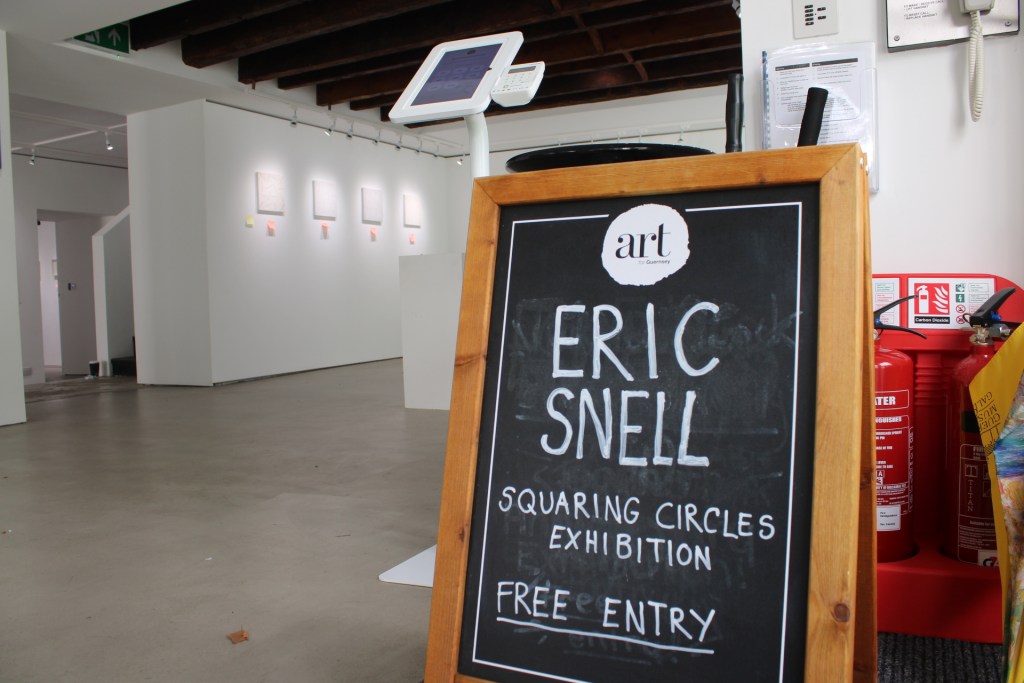
The exhibit, which runs until the middle of November, also includes ‘Under Tension’, a site-specific installation that directly responds to the gallery’s architecture.
It turns the entire gallery into an exhibition piece, further emphasising those themes of impossible problems.
Although it pushes the idea to the extreme, it was a thought process clearly prudent in the early stages.
Mr Snell provided a mini-model-mock up of the gallery, after early discussions with Art for Guernsey, with suggested lay outs, ideas, and concepts. A glimpse of the passion he places into his work-turned-play.
Art for Guernsey’s Founder and Chairman, David Ummels describes Mr Snell as a highly regarded British artist and, although he confesses that Abstract Art isn’t his specialty, Mr Snell’s inherent interest in chasing curiosity has clearly rubbed off on him;
“What’s the definition of a drawing versus the definition of a word? I feel what Eric does is in between, it’s at the cross point between maths, mark making, but also language.
“Ultimately, I hope that people are going to come out of the show saying I had a nice journey. It’s all about critical thinking. It’s all about what I make, myself, of what I see.”
Whilst Jock Pettitt, the Curation Director of Art for Guernsey, stated that the process, and working with Mr Snell, has been a pleasure.

“Working with Eric in the preparation and curation of this exhibition has been an absolute pleasure.
“From the first meeting in his studio to explore the bodies of work, it has been evident that the abstract results we observe are made with such a robust and meticulous process and narrative, which brings them to life and offers much greater depth than may at first be apparent.”
Mr Pettitt added: “More than ever, I encourage the viewer to explore the narratives, and take time to watch the film, to learn how these works are connected and to see first hand how his process has distilled complex ideas into effortlessly simple and beautiful results.
“As a first truly contemporary abstract exhibition for the gallery, I think we are in for a treat.”
This article first appeared in the October/November issue of CONNECT magazine.
