


The Network is advising all road users to familiarise themselves with the changes.
Cyclists are told that whenever possible they should ride in the middle of their lane and even when in heavy traffic they should still ride at least half a metre away from the edge of the kerb.
Drivers are told they should always leave at least 1.5 metres between their cars and cyclists when overtaking at any speed.
And a new ‘hierarchy of road users’ gives cyclists priority over vehicle drivers and gives pedestrians right of way at junctions.
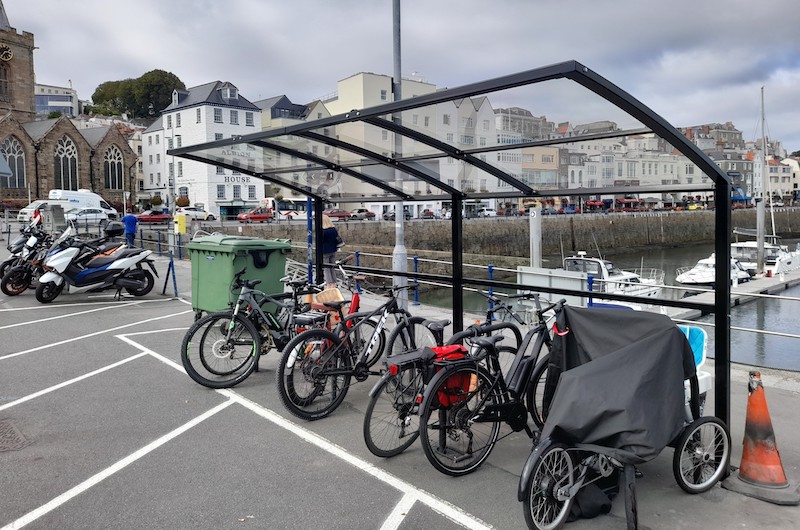
Pictured: The Highway Code now goes further in recognising cyclists as highly vulnerable road users and places more responsibility on motorists to respect their safety.
Phil Le Poidevin of the Guernsey Bicycle Group said the changes to the Code try to find “a more mutually respectful and considerate culture of safe and effective road use that benefits all users”.
“This is so important given the challenges with Guernsey’s road network and lack of active travel infrastructure,” said Mr Le Poidevin.
“Thousands of us across the Bailiwick have found over the past two years how cycling and walking are great ways to stay fit, ease congestion on the roads, do your bit for the environment, and give young people independence. Measures in the new Code are a critical step to support that.”
Alex Margisan, President of the Guernsey Velo Club, was similarly positive about the changes.
“I think it’s great that so many people are refreshing their knowledge of the Highway Code, particularly the elements such as cycling in the primary position, riding two abreast and not having to use cycle lanes which have been in the rules for many years,” said Mr Margison.

Pictured: Pedestrians are at the top of a new hierarchy of road users, including when crossing at junctions.
Dani Bennett from the pedestrian safety group Living Streets Guernsey is pleased that the changes to the Code try to protect road users who are more vulnerable.
“I welcome any initiatives which improve the safety of vulnerable road users,” she said.
“Whilst much of it may be guidance rather than law, the fact that there has been a revision to the Highway Code shows how the mindset of road users is changing and how collectively people want to make the roads safer for all.”
The positive health benefits which could be realised by simpler and safer active travel were highlighted by Alex Costen from the Health Improvement Commission. She said that safety concerns are one of the main barriers to more people using active travel more often.
“The safer people feel, the more likely they are to walk or cycle, and so we welcome the changes to the Highway Code which aim to help protect more vulnerable road users,” said Mrs Costen.

Pictured: Narrow lanes around the island can make it hard to enforce best practice on leaving enough space whilst overtaking. The increasing width of cars in recent years has made the problem worse.
Rob Cornelius from the Guernsey Motor Traders’ Association said: “From the motorist’s point of view, we would like to stress the importance that all persons using the roads read the amendments that have been made to the Highway Code and understand how this affects them depending on the forms of transport they use.”
Shaun Staples, a representative of heavy goods vehicle drivers, expressed some concern about new rules for crossing at junctions, under which pedestrians are granted priority ahead of all other road users when they want to walk across a junction.
“Normally anybody wanting to cross at a junction would wait to be signalled by the vehicle stopping. My fear is pedestrians will see a gap and start to cross before the vehicle has noticed them,” said Mr Staples.
Jennifer Merrett, who chairs the Guernsey Road Users’ Network, said: “We would urge all road users to familiarise themselves with the new rules and pedestrians not to assume that every other road user will be aware of them.”
