


They were initially offered to Sark, but Sark considered them unsuitable and now they have been shipped to the UK instead.
Sark is still looking for new ambulances to serve its unique needs. Sark’s Medical and Emergency Services Committee and St. John say they are working together where possible to ensure suitable ambulances are found.
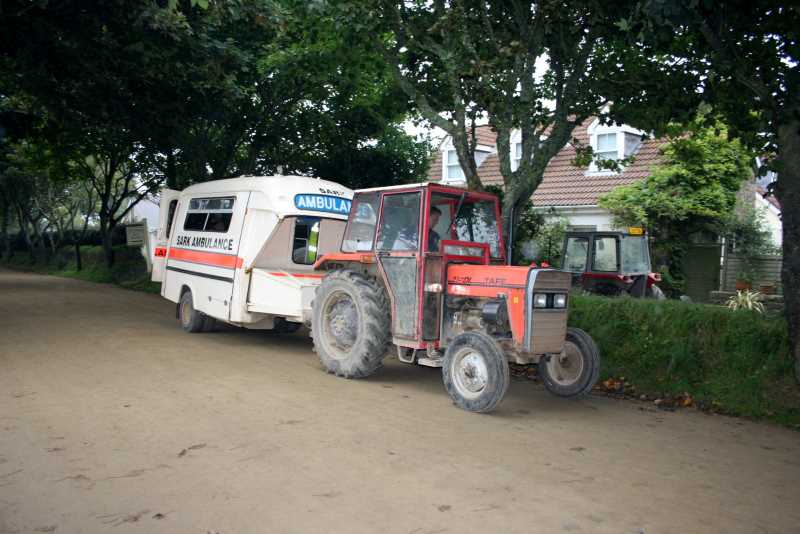
Pictured: One of Sark’s two ambulances which remain in service while a plan to replace them is drawn up.
St. John says decommissioning and replacing equipment is vital to ensure that Guernsey’s ambulances and the emergency service generally provide modern technology to support patients.
“The St. John Emergency Ambulance Service has a rolling plan of vehicle replacement,” said St. John. “As part of this programme, two ambulances which had been in service in Guernsey for more than 12 years were recently decommissioned.
“The vehicles had reached the end of their lifespan and were no longer fit to meet the increasing demands and rising daily call volume in Guernsey.
“The ambulances were offered to the island of Sark as a gesture of goodwill, but were not deemed suitable for the specific needs of the island.”
Guernsey had already replaced the two ambulances it intended to decommission when the vehicles were offered to Sark.
The two new emergency vehicles, which are designed for narrow roads, arrived in Guernsey before Christmas and were blessed by the Chaplain of St John in a ceremony attended by the Bailiff, Richard McMahon, and the President of the States’ Committee for Health & Social Care, Deputy Al Brouard.

Pictured: Guernsey’s newest ambulances were blessed in a ceremony late last year.
Speaking at the time he and his crew welcomed the new ambulances, Mark Mapp, Guernsey’s Chief Ambulance Officer, said he was “delighted” and “grateful” to take delivery of them.
“My colleagues and I at St. John thank the States for their responsive procurement efforts, which have enabled this to happen more promptly than we had initially feared,” said Mr Mapp.
“These are specialist vehicles, somewhat narrower than standard international vehicles, in order to better operate on Guernsey’s narrow roads.
“Delivery timescales can sometimes be prolonged because these specialist versions are produced in Germany, generally in change-over gaps between longer production runs. However, with the assistance of the States, we have managed to secure delivery more promptly than usual.”
The new ambulances are fitted with state-of-the-art diagnostic and treatment equipment which allows clinicians to administer urgent and emergency pre-hospital care on scene at a patient’s home or at the roadside.

Pictured: Mark Mapp, Chief Ambulance Officer. Credit: St. John.
The States provide an annual grant to St. John to support the Emergency Ambulance Service, subject to various operational performance indicators being met.
Users of an Emergency Ambulance are charged for call-outs, treatment by paramedics and conveyance to hospital. In 2022, the standard cost is £390 per call-out.
However, St. John offers an annual subscription scheme which costs £55 per adult and covers up to 50 emergency ambulance call-outs in a year. Lower subscription costs are charged for children.
Full details of the subscription scheme is available online HERE.
