

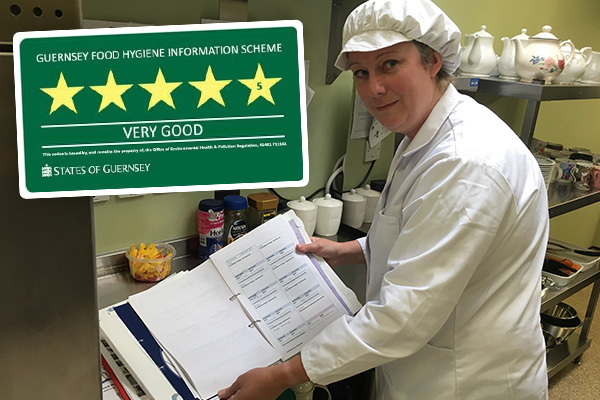
While most people may be aware of how many stars certain places might get, it is often more vague as to how exactly it is decided how many stars they get.
Express was invited to accompany Charlotte Jones; Environmental Health Officer and a 20+ year veteran of the industry, on her inspection of Les Bourgs Hospices’ kitchen this week, to see exactly what the inspectors look for and how they decide what rating to give each establishment.
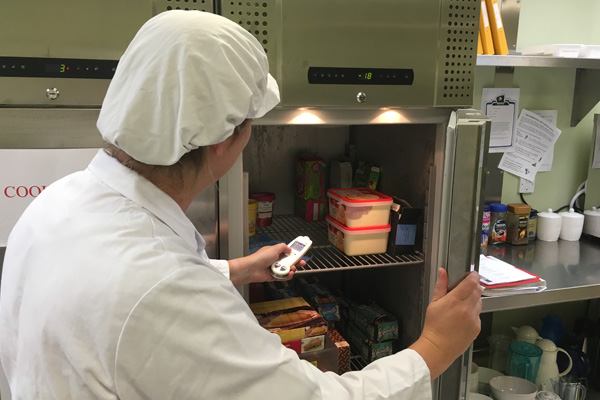
Pictured: Ms Jones at work inspecting Les Bourgs Hospice kitchen
Ms Jones said that their primary role was to protect the public by advising the businesses how to comply with the law.
“A five star rating under the Food Hygiene Information Scheme shows that a business meets the minimum legal requirements. If a business goes above and beyond the minimum legal requirements we welcome this and will support and advise accordingly, but we can only ever seek to achieve full compliance with the law,” she said.
“Businesses that get a one star often let themselves down by not having simple paperwork in place to demonstrate they have thought about the risks at their business and have simple measures in place to control those risks.
“This is called a food safety management system and we have packs called ‘Safer Food Better Business’ from the Food Standards Agency to help the majority of businesses comply.”
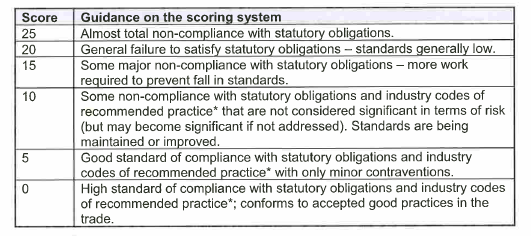
Pictured: The hygiene rating itself is calculated from three key areas which are assessed during inspections. But there are a whole range of different contributing factors. Each of the many categories is rated as above, with some, such as how high risk the user base is, being weighted to be rated highly. The overall score then determines how frequent the inspections will be.
One criticism levelled at the inspectors is often that they give poor ratings when businesses have not filled in the correct paper work, and are then rated badly, but they still claim their actual hygiene is up to scratch.
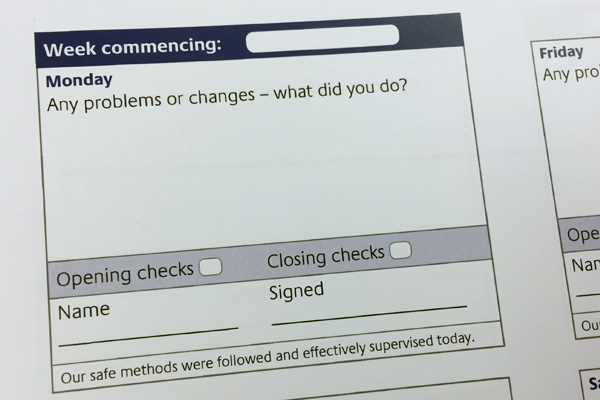
Pictured: An example of what Environmental Health expect businesses to fill in once a day. Businesses often put any poorer ratings they receive down to not having done this ‘paperwork’.
But Ms Jones said if they couldn’t fill out “two minutes” of paper work a day, it was a “reflection of how much emphasis they place on hygiene at their business”.
“All a business has to do is complete the part in ‘Safer Food Better Business’ which sets out ‘how we do things here safely’, and on a daily basis they need to make the checks they should be doing anyway, such as checking fridge temperatures and making sure food is cooked through properly, and then put two ticks and a signature in the dairy to show they have done it.
“The importance of supporting paperwork should not be overlooked but, for most businesses, daily records can be completed in around two minutes so this does not place a great burden on staff.”
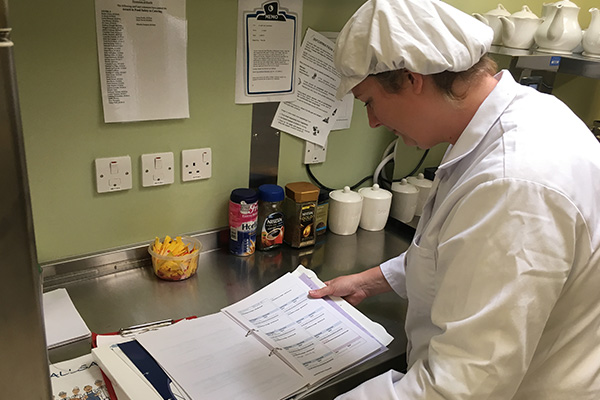
Pictured: Ms Jones let Express join her as she inspected Les Bourgs Hospice kitchen
During the inspection, Ms Jones reviewed Les Bourgs’ paperwork, which she said went above and beyond what was required. They had extensive lists of temperatures ready meals arrived at the kitchen (having been cooked off site), staff training manuals, a copy of ‘Safer Food Better Business’, menus and lists of any specific requirements from inpatients.
She also inspected use by dates on dry goods, the general cleanliness of the kitchen, the structure, the fridges and freezers and many other details.
If they had found anything wrong, she said as inspectors they had a number of tools at their disposal to help businesses improve, including verbal advice, a letter following the inspection and ensuring they have a good working relationship with the businesses. If a business does fail to respond to advice they can serve legal notices, however things that are deemed that necessary are normally done voluntarily.
But Les Bourgs, Ms Jones said, was an excellent example of how kitchens could do things, and maintained their five star rating following the inspection’s completion with near complete perfection. Along with their excellent paperwork, she said they followed many good practices, like dating when things were opened or frozen.
Jo Boyd, Hospice Director at Les Bourgs, said they always tried to use the inspections to inspire positivity and good practice.
“It is helpful because if we are doing something the wrong way we want to know about it,” she said.
“So we try with all the staff to make sure they treat it as a positive experience that we can learn from. I have found it is much easier to comply with the regulations because they have made them simpler.”

Pictured: The design and display are unique to Guernsey but the scoring system and the information that is provided are the same as the approach used in England, Wales and Northern Ireland. The redesigned webpage will go live on today and it can be accessed via the existing web address; gov.gg/fhis.
Yesterday afternoon, it was announced that Environmental Health had redesigned its ‘Scores on the doors’ webpage on the gov.gg website to make it more user friendly for islanders wanting information on the inspections.
The star ratings for all businesses – which has been the universal method since October 2013 – is displayed on there, and it is hoped the new page will help customers make informed decisions about where they shop.
In order to provide information which is accessible and in the most user-friendly format, the webpage has been redesigned and incorporated searchable information with additional features such as being searchable by star rating, postcode or a part of a name, such as ‘café’. The new web page, which will go live today, is also linked with the Office of Environmental Health and Pollution Regulation’s database and the ratings will be updated as soon as they are entered on to the system.
