

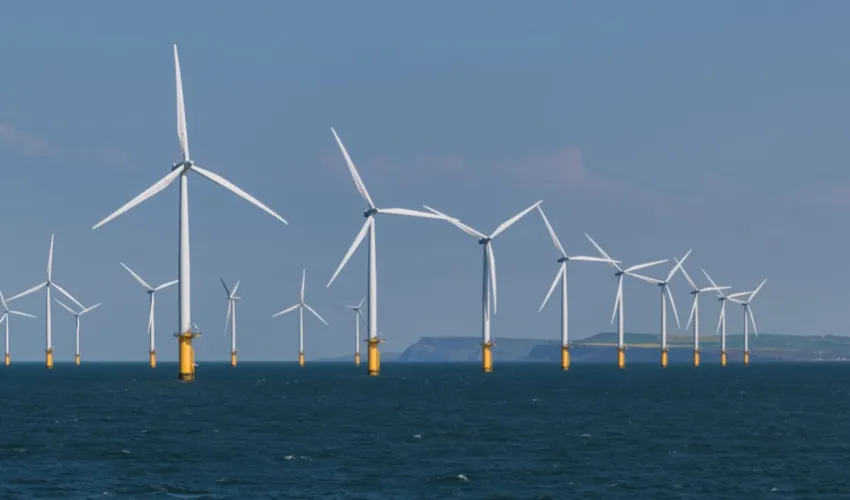
An offshore wind project would generate millions for the island, Policy & Resources has argued, as it sets out a case to make it happen.
P&R has published the results of preliminary investigations and now wants States members to agree to spending another £1.3m. to investigate the next steps in developing an approach around leasing the seabed to a developer with the power likely to be exported to the UK.
Scoping work by its Offshore Wind Sub-Committee which has involved expert consultations has found that:
- The most suitable option is based on a 157km sq site with installed capacity of 1.27GW and with a high but feasible energy density of around 8MW/km sq
- The Net Present Value (how much an asset is worth throughout its lifetime) of this windfarm could be around £300m according to initial modelling. This could be shared between a private developer and the States as an upfront payment. On a deferred basis this could be up to a total of £1.3bn over a 35-year contract, with payment shared with the developer taken annually
- There is a significant potential range for this NPV, up to a high of £707m.
As it stands, the vision would see the States paid a lease exclusivity payment ahead of the windfarm being built, rental income over up to 35 years, and tax revenue.
“Working with external expertise from PA Consulting and the Carbon Trust, who both have significant track records in these projects, we have confirmed that there is an opportunity worth pursuing further,” said Sub-Committee chair Deputy Chris Blin.

One of P&R’s representatives on the Sub-Committee was Deputy Bob Murray, who sounded a note of caution.
“There are a lot of assumptions, so I would urge against any narrative that suggests this will be the answer to our financial challenges.
“However, the initial phases of work indicate there may be substantial value in leasing a section of seabed in our territorial waters and we won’t know for sure unless we carry out this next phase of work. That’s why we’re recommending investing up to £1,300,000 to undertake that work during 2025 and next year.”
A developer would meet much of the significant future cost of developing an offshore wind farm.
The current preferred approach is to undertake a competitive process to identify a partner for long-term development of an offshore wind farm, who would meet much of the development costs, with steps put in place to ensure any lease granted is not simply “banked”.
A single entity would be set up to lead the work on behalf of the States, establishing a licensing regime, and completing a marine spatial plan.
As part of the work, export to France and a hybrid of export to either France or the UK with a connection to Guernsey will also be considered.

One key hurdle to overcome is gaining access to a Contract for Difference scheme.
A CfD is a long-term contractual agreement, typically 15 years, between a low carbon electricity generator and the Low Carbon Contracts Company, which is Government-owned.
Consultants say that deals are rarely struck without these in place to provide long-term revenue certainty and so reduce risks for investors, which in turn means the project can be built at a lower overall cost.
“Access to the UK or French CfD regime is critical to the financial viability of an offshore wind development on the seabed and it must be clear by the end of 2025 at the latest if that can be achieved,” P&R has said.
If approved, the next phases of work would happen in 2025 and into 2026.
By the end of 2026, the States would be asked to vote on a commercial agreement and proposed developer.
