


Pensioners and others needing support will pay £10,000 to access long-term care beds and much higher weekly fees.
The States has backed a package of proposals aimed at helping to prevent the long-term care sector reaching crisis point and stimulate investment in more beds as the population ages and demand increases.
But there were persistent warnings that more would need to be done to ensure the long-term care insurance fund was not eroded.
The plans
Employment & Social Security’s plans were amended to up the residency requirement to qualify for support from the fund to 20 years, it is currently five.
The co-payment which individuals in long-term care contribute each week for accommodation and living expenses will ratchet up over the next five years. For a standard bed that will be from £342 to £514 a week plus by a likely ‘inflation plus 1%’ hike. Annually, that means a rise from £17,784 to £26,728 in that time excluding inflation.
From 2027, a new user care cost contribution will come in at £10,000 for those with capital assets, excluding their home, of more than £15,000. A financial assessment will be carried out to determine who can afford it.
The number of residents who will be aged 85 plus is forecast to increase by 128% over the next 30 years.
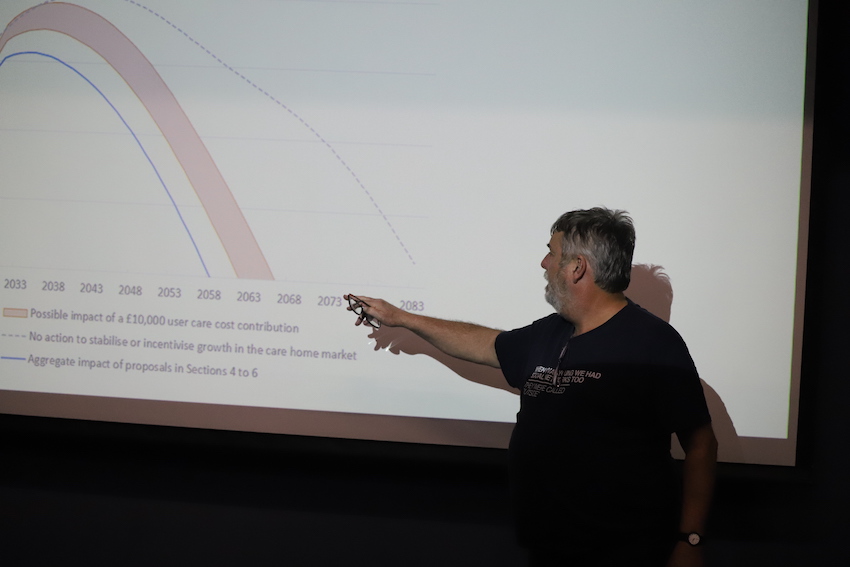
“That is not just a profound change, it is an exceptional change, and therefore it requires an exceptional response,” said ESS President, Deputy Peter Roffey.
“As a rule of thumb, that step change to the number of islanders over 85 means an increase in the requirement for social care provision of the same sort of magnitude, so demand will far more than double.
“As I say, this is a massive societal change which requires a bold and significant change in government policy to address, but just to be clear, it is not a problem which will start to kick in 30 years down the road. It is happening now. The much heralded demographic time bomb is exploding now and without decisive action to stimulate an expansion of the care sector, we will be suffering very major shortfalls in the provision of bed based social care within the next two to four years, maybe even sooner, if any further providers should exit the market.”
There was no easy way to ensure the long term care insurance fund was still in good shape when today’s young workers who are paying heavily into it come to need support, said Deputy Roffey.
“We obviously need the private care sector to flourish and expand to meet the known rise in demand coming down the track, starting now. But frankly, the current market conditions mitigate completely against such an outcome.
“In reality, the returns for the commercial part of the private care sector on the basis of the standard states rates are far too low to stimulate growth, and even the not for profit, third sector providers are struggling to make their business model stack up. That really has to change and change now.”
The States could have increased contribution rates for everyone to pay, but ESS felt this approach was irresponsible, he said.
“That leaves only one other potential funding source, which is to expect a slightly higher contribution towards their own social care costs from those recipients who can clearly afford it, and therefore that is our preferred route,” said Deputy Roffey.
“But ESS accepts this is merely the lesser of two evils. Nobody wants to pay more for anything than they currently do, and therefore our proposals are not going to be met for jubilation in the streets of St Peter Port, frankly, they are not intended to be inherently popular proposals.
“They are intended to be the sort of responsible policies that we absolutely need in order to set this crucial area of social policy on a route to sustainability.
“But let’s be clear, these proposed changes won’t of themselves make the funds sustainably financially in the longer term. Rather, it is simply a staging post. More heavy lifting will be needed in the next Assembly.”
20 years’ residency needed to access scheme
Deputy Al Brouard led the amendment which increased the aggregate residency requirement to access support to 20 years. ESS had proposed 10.
Any person who meets the current residency conditions on the day before the changes take place would remain eligible to receive care benefit.

People access support from the fund based on residency, not their record of contributing to it.
Deputy Brouard said there was no science behind ESS’s 10 year figure, but he and amendment seconder Deputy Andy Cameron felt that 20 years felt right as a balance.
“You have had to have some strong connection with the island before you access this care, which we’re talking about between £33,000 per annum up to £60,000 per annum for residential care.
“Now a family member, perhaps relocating after a career working in England, arriving in Guernsey to retire and perhaps live en-famille with their family who is here, can easily clock up the required five or 10 year residency on island, because, as the statistics show, the vast majority of those in care home are aged 85 plus.
“So if one takes a person arriving in Guernsey say post 65 on average, they will have 20 years of residency before they even reach the age of 85 when they require a care home. I think it is fundamentally fair that those who access this benefit have at least made a contribution to Guernsey, to the economy, or having made some roots in the community.”
Deputies backed that amendment by 27 votes to 11.
More work needed
They also supported an investigation into whether the scheme should be moved to a contribution model after an amendment proposed by Deputy Sasha Kazantseva-Miller.
Those arguing against ESS’s full proposals wanted the issue addressed in a much more holistic way as well as raising fears that it left the door open for attempts to be made in the future to include someone’s home in the capital assessment.
There were also questions about the administration costs of the new set-up.
A report will have to come before the States before the end of 2026 from ESS and Health & Social Care with proposals for a new Long-Term Care Model.
