


A group of maritime experts are calling on the States to separate out the harbour and airport accounts and they want the GCRA to take a much closer look at all of the States’ owned trading entities.
A statement, signed by Nick Guillemette; President of the Guernsey Boat Owners Association LBG, David Norman; President of the Guernsey Marine Traders Association LBG, David Coleman; Guernsey Marine Traders Association LBG, and Peter Lloyd; Commodore of the Royal Channel Islands Yacht Club – published in full HERE – says it is essential that the harbour is not left tied financially to the airport.
The organisations also hold concerns over the future of regulation and scrutiny in the island if the States proceed with plans to incorporate Guernsey Ports, Guernsey Water, and States Works.
Plans to allow the three organisations to operate as ‘standalone companies’ are due to be debated by the States, starting today.
“It is absurd that where every other incorporated business in Guernsey currently can come under the scrutiny of the Guernsey Competition and Regulatory Authority (GCRA), there is currently an exemption for the States own Trading Businesses,” said the maritime experts.
They claim it is “essential” that all the States Trading Companies come under the scrutiny of the GCRA, “especially in light of the fact that all the States Trading Departments are in fact monopolies and it would be very easy for them to be abusing their dominant market position”.
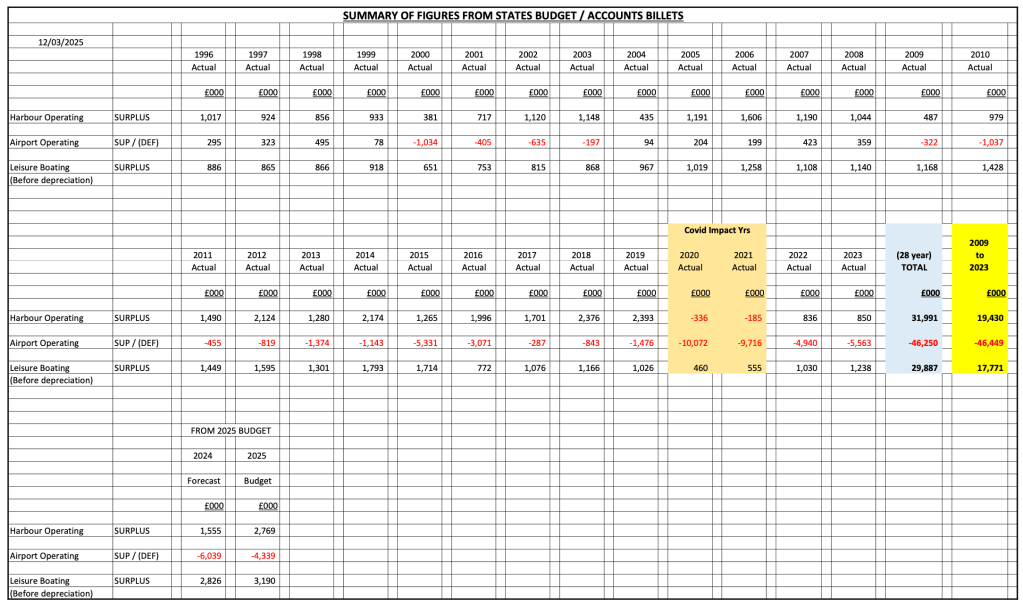
Each of the organisations has said that combining the harbours and airport financially in 2009 was done to “obfuscate the accounts of these two entities which appear to have no synergy, no shared experiences, and no obvious efficiencies”.
As well as suggesting that the GCRA scrutinises the States trading entities – including Guernsey Ports – the maritime experts say that combining the airport’s financial losses with the port’s surplus over the past 15-years means that the island’s harbours have “suffered badly”.
“Necessary work has either been avoided or suspended for many years because the funds have been unavailable due to the Harbours’ surpluses having been expended covering the airport losses, repairs or maintenance,” they’ve said.
“The Harbours need to focus purely on their operation and opportunities and to be run by the Harbourmaster and his small team of experienced marine people alone, answerable to a separate board of directors as the ‘Harbours Co.’ with no overarching Joint Management or association with the Airport in any way at all.”
In response to the open letter, States Trading Supervisory Board President, Deputy Peter Roffey has said it would not be sensible to separate the harbour and airport, and added that more work will be done before any decision is made on incorporating the other trading entities.
“Looking at the harbours in isolation, it is good to see them making a modest surplus. But it is way, way below the level required to fund the capital investment that the harbours need now and in the years ahead. They therefore still have a long way to go to reach a self- sustaining level of income.
“As for the suggestion of separating the harbours and airport, that has been considered. However the review into potential incorporation identified a number of advantages to retaining a single Guernsey Ports entity. They include opportunities that exist for a larger business to drive economies of scale, negotiate better commercial terms for activities that span both operations, and encourage talented individuals to work for them. Resources can also be shared across the ports, resulting in greater efficiency.
“Further work is required before any of the current trading businesses can be incorporated, and that would include establishing appropriate regulatory arrangements. However the States, as shareholder, will be able to provide clear direction to these businesses, as they do now. That will balance the interests of port users and other stakeholders, so independent economic regulation is unlikely to be necessary. In any event, as the policy letter makes clear any new businesses will be subject to existing competition legislation, which prohibits abuse of a dominant market position or anti-competitive behaviour.”
