


For decades, small businesses have been the backbone of the island’s economy and community fabric.
But on the steps of the Royal Court, the mood among business owners wasn’t just one of economic worry – it was a profound sense of betrayal.
Thomas Waterman, of car repair firm Express Motor Craft, didn’t hold back on politicians who stood on an anti-GST platform, only to pivot once in office.
He accused deputies of “turning their coats” adding that he was “not very happy at all” with the political about-face.
For Waterman, the betrayal isn’t theoretical; it’s personal. He recalled confronting a politician directly.
“I bumped into [Deputy] Charles Parkinson – he used to be so against it, and [look what happened now] he’s voted back in,” Waterman told Express, pointing out the stark reality of the political shift.
He’s basically been given a job, and now he’s turning his coat.
Thomas Waterman, Small business owner
Because the trust between the electorate and the assembly has worn so thin, Waterman believes the power to make this decision should be stripped away from the politicians entirely.
If he could speak directly to the chamber, his message would be simple: “Bring in a referendum – let the locals pick what they want to bring into the island.”

While the anger over broken promises burns hot outside the chamber, the practical anxiety for small business owners comes down to a much more fragile reality: the survival of local jobs.
For Emma Pang, a luxury retailer whose jewellery shop has been a fixture of the local community for 52 years, the stakes couldn’t be higher.
Operating successfully without GST for over half a century, her business – Martin & Martin – has weathered decades of economic shifts – but this new tax package poses an unprecedented threat to the families who rely on her.
“Everything that affects the bottom line obviously affects our ability to employ local people and continue with a successful local business.”
‘We won’t be able to employ as many people’
“We have lots of local families relying on us and their jobs,” Mrs Pang explained, explaining that the firm currently employs 11 people.
With an additional 3% tax looming over everything from raw materials to online sales, Mrs Pang is left asking a devastating question that many independent traders are facing: “Where does that 3% come from?
“Does it come from the salaries of our employees? Does it come from our clientele?”
It is a calculation that threatens to undo decades of community building.
Having recently relocated the shop to the High Street to help revive the town centre and foster a sense of local community, Mrs Pang feels the tax threatens to pull the rug out from under independent retail just as tourism and footfall were beginning to recover.
Back at Express Motor Craft, Mr Waterman faces the exact same grim calculus.
So will GST mean he needs to downsize this six-person team? His answer was immediate and stark: “Yeah, 100%.”
Unpaid tax collectors
Beyond the threat to jobs and the sting of political betrayal, there is another, quieter crisis facing the island’s independent traders: pure exhaustion.
For small, family-run operations, a Goods and Services Tax represents an avalanche of unpaid administrative work.
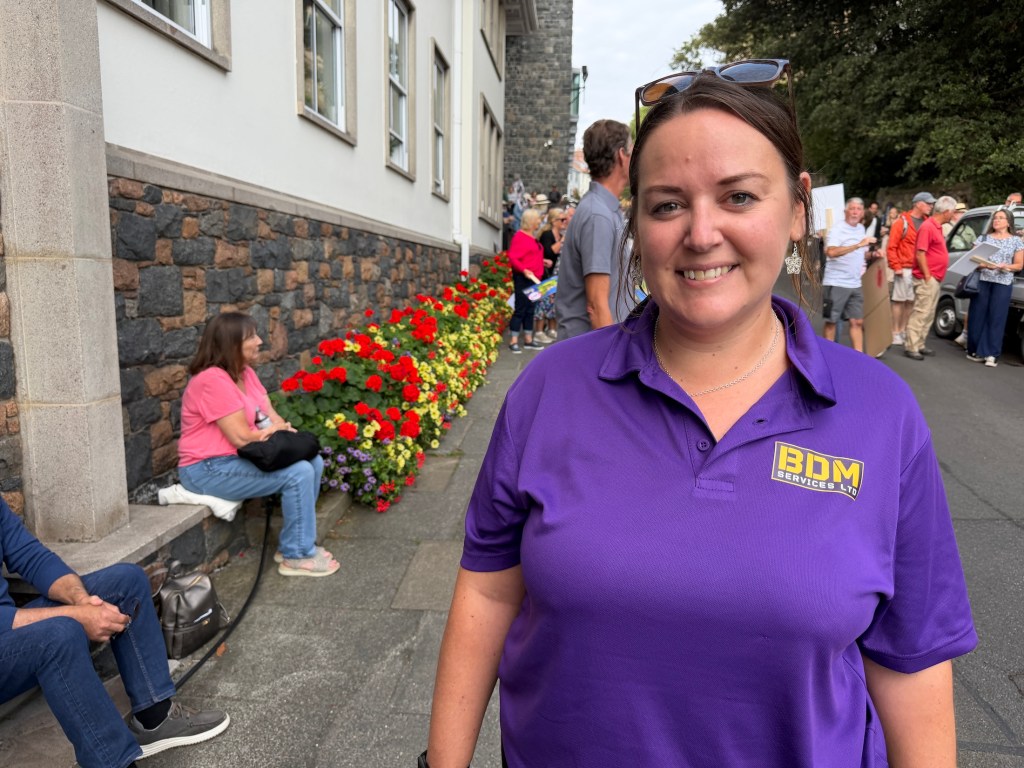
Caroline Mauger, who runs BDM Services Ltd, a recovery haulage and hire company employing four full-time staff members, explains that small business owners are already stretched to their absolute limits.
“This will greatly affect us in terms of administration costs,” Mrs Mauger warned.
“You know there is enough to do. We do HR, marketing, social media, everything that is required, and it’s just another cost which isn’t factored in.”
Like many on the march, Mrs Mauger isn’t fundamentally opposed to contributing fairly to the island’s finances – saying as a business owner she would “much rather be taxed on profits”.
What she objects to is the States outsourcing its tax collection bureaucracy onto overworked families.
Her warning to the deputies inside the Royal Court should cause serious pause. If the tax is forced through, she believes it will push many long-standing traders over the edge.
“I think many businesses will start questioning what is, if it’s worth it,” Mrs Mauger said, “Is it worth it?”
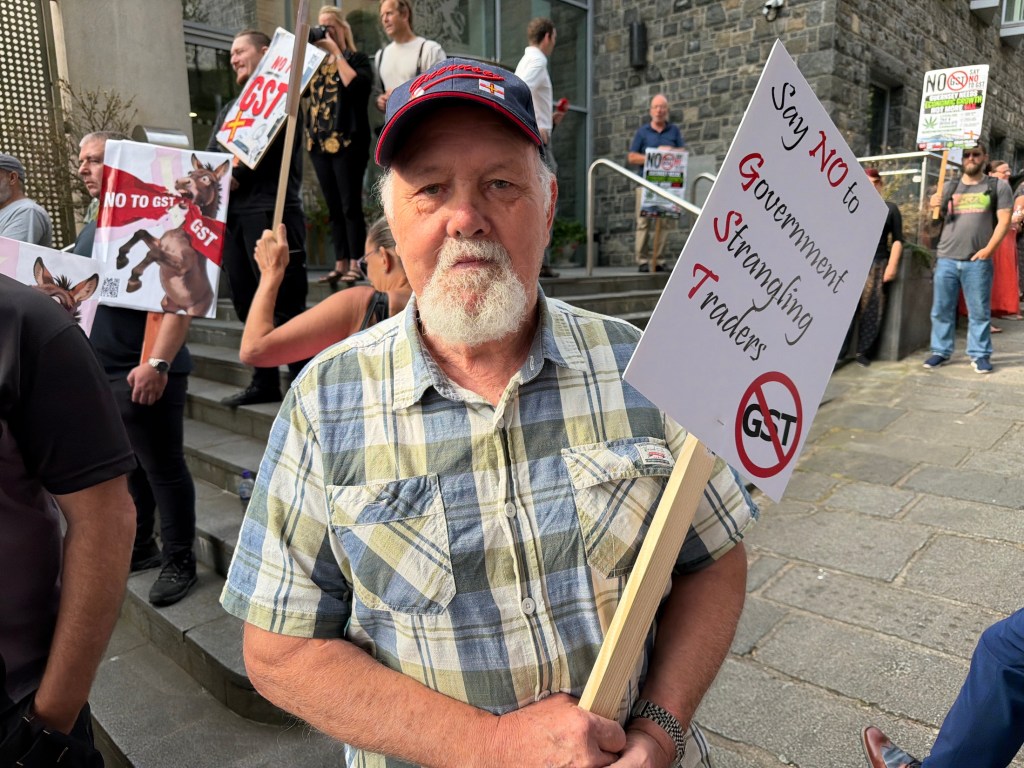
For those who have spent a lifetime working for themselves, the introduction of GST is a bitter pill to swallow.
Brian Harris, a 75-year-old housing rental director who has run his own businesses since he was 20, warns that the ultimate victims of this tax won’t be the business owners – it will be the ordinary people of Guernsey.
“I’ve not talked to anybody in business that is pro-GST,” Mr Harris told Express.
“It’s more layers of civil servants. It’s more administration for the businesses.
“And where does that end up? It ends up on the people’s pocket, and they have to pay for it.”
Mr Harris said he tries to keep his rental prices as low as possible for local tenants.
However, he said that any tax placed on a business inevitably rolls downhill, citing existing “stealth taxes” such as vehicle import duties as a prime example.
The cost would inevitably be passed on to “the little old lady who is paying to have her garden cut”.
For Mr Harris, the tax package also exposes a deep inequality on the island, questioning why small businesses and everyday residents are being targeted while other sectors remain protected.
Why can’t we all be taxed the same
Brian Harris, Landlord
“Why can’t we all be taxed the same?” he asked.
He added: “If zero-10 is good enough for trust companies, why can’t the people have zero-10?
“Or are they a privileged lot, the finance industry?”
As the debate moves from the streets to the political chamber, Guernsey’s deputies face a choice that goes far beyond simple economics.
If deputies refuse to listen, traders argue, they risk trading away the island’s unique character for a tax that those on the front line of local business warn simply isn’t worth the cost.
