


When the play Theresa, based on the real life of Viennese Jew Theresa Steiner; who was betrayed to the Nazis during the Occupation of Guernsey, was performed at St James it stirred up emotions for everyone involved.
Ms Steiner was deported to occupied France along with two other Jewish women living in the island at the time.
The trio were then sent to Auschwitz where they were gassed.
Their story – part of Guernsey’s “secret history” – had intrigued playwright Julia Pascal.

My first thought when I speak to Ms Pascal is that she’s calm. She’s measured and mercurial from the desk research I’ve done of her. It’s not lost on me that like most of her career work to date, the issues she covers are personal.
“I am Jewish. My mother’s parents came from Romania, my father’s grandparents were Lithuanian, and he was brought up in Dublin so there is an Irish element that I have also written about too.”
The subject of finding out more of the Channel Islands ‘secret history’ as she calls it, came about when she read an Observer article in the late 80s. It tiggered her.
“This is a secret history that needs revealing. Look, this is a part of British territory. The only part of British soil that was occupied by the Nazis. And look what happened. And there was a photograph of Theresa Steiner. It wasn’t a particular long article, probably about 900 words, but it’s what sets me on the trail of of trying to find out more.”
I watched the play and reviewed it, so please read that first.
This feature is about the behind the scenes of how the play was written and the reception it received. With such a sensitive subject, the reporting of the research Ms Pascal did is crucial, so after being ‘triggered’ by the Observer article what were her next steps?
“I came across people who said ‘yes’ to my inquiries, we will let you see this material. Don’t give our names and you can see the war time documents in secret, but you can’t copy, so that is how is started,” said Ms. Pascal.
The people of Guernsey were “good Christians” with a conscience she said, they had a “strong moral sense of right and wrong”.
In the early 1990’s, Ms Pascal undertook primary research through both Guernsey and UK wartime documents that corroborated the thoughts of the initial historical articles she had read.
She felt that it was evident that the Nuremberg Race Laws had been absorbed In Guernsey when the island was under occupation.
“So that’s how it came about. I made the initial impulse to act and find out more, but some doors were open and I was very happy that there were people welcomed this kind of inquiry.”
Did she endeavour to get contemporaneous accounts of people who may have known Steiner, or locals people who had worked in Castel hospital where she was working as a nurse?
This questioning is important for an author, who bases her play on, what I can imagine authorities of its time called the ‘Jewish sitiuation’ in Guernsey. It must have been an impossible situation.
The Nazis imposed their anti-Jewish laws in the island.
The play, ‘Theresa’ centres around an individual in Guernsey’s police force making a point of making Steiner stay in Guernsey due to her ‘enemy alien’ status, pre-occupation.
The German army had not actually arrived yet at this stage and Guernsey was not yet occupied. But this individual made Steiner stay, knowing full well that if the island was occupied, what the fate of a Jew would be, once the Nazis arrived.
Nine orders relating to Jewish residents or those deemed to be Jews were approved by the island’s States of the day, including a limit on the jobs they could hold, introducing a register, forcing the wearing of a yellow Star of David, and controls on Jewish-owned businesses.
Criticism has previously been made of the island authorities with regard to incidents surrounding this time in history.
Accounts show Sir Abraham Lainé; the States Controller, refused to sign the Race Relations order to no avail. Sir Ambrose Sherwill; HM Procureur, publicly stated he felt ashamed that he did not do something in the way of protest, and did not oppose the race law.
One could say it was this sequence of events that sealed the fate of so many Jews.
Documents show that they were not allowed to leave for England, but how easy was it to know how many Jews actually lived in Guernsey. After all, the existence of a register, must only have happened under occupation, as race was a ‘thing’.
“It’s a question of democracy, isn’t it?” queried Ms Pascal.
“I mean the Guernsey ruling committee had power. They decided who chose to stay in Guernsey. If we think back, evacuation boats were possible, everybody could have just quit the island. So those who chose to stay knew what was happening and had personal interests for staying there. I’m not saying that this is an anti-Semitic island. Having reflected on this for a long time, I think it was just indifference,” she said.

Fast forward to the present day, and in July 2024, fifteen stolpersteine, or ‘stumbling stones’ were laid in Guernsey, it was this act that ‘triggered’ Dr Aviva Dautch, a curator to get in touch about performing the play in Guernsey.
Helen Glencross; Head of Heritage Services, Guernsey Museum, then worked with Ms Pacal and Jewish Renaissance; a UK based Jewish arts and culture, quarterly magazine, founded in 2001, was involved in that project to honour the memory of those who were deported from occupied Guernsey.
“These stones remember eleven people who died and four who survived Nazi persecution, including the three Jewish women deported from Guernsey who were murdered in Auschwitz – Marianne Grunfeld, Auguste Spitz and Therese Steiner,” she said.
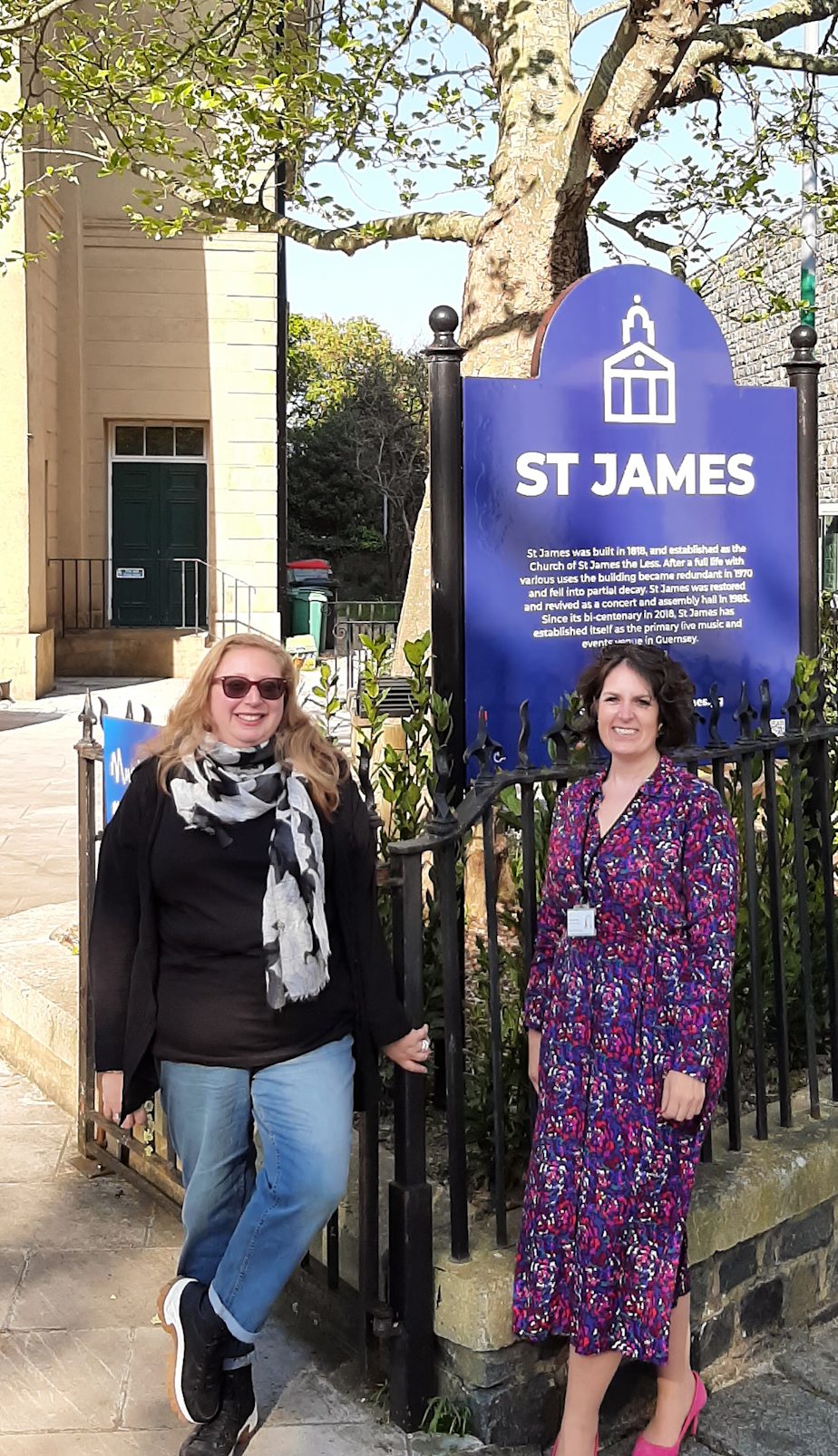
The play that came to Guernsey was part of a wider tour package offered by Jewish Renaissance, called ‘Channel Islands: A New View’, which includes Guernsey, Jersey and Alderney.
As part of their tour to the Channel Islands, the visitors saw the stones for Auguste and Therese, outside the Castel Hospital.
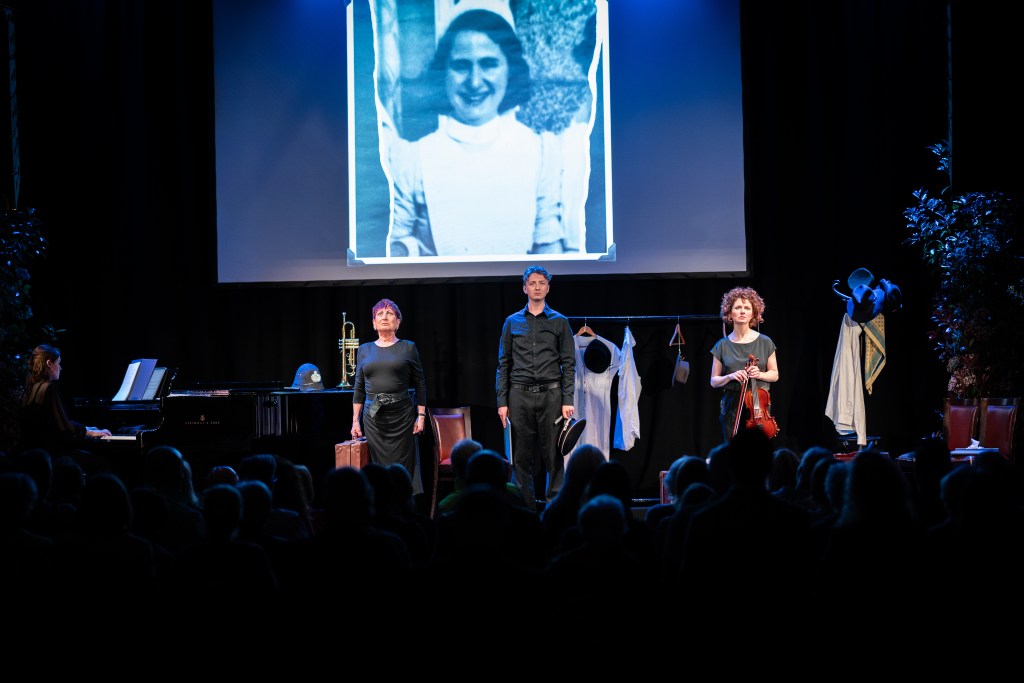
Executive Director of Jewish Renaissance, Dr Aviva Dautch said: “Unexpectedly, I found myself crying as the final lines of the play were spoken and a photograph of the real Theresa was projected above the stage.
“Although I’d read about her (Theresa), being on Guernsey has made me feel connected to her in a different way. Seeing the display at the German Occupation Museum about her and other Jews who were deported, visiting Castel hospital where she worked to see the stumbling stone laid at the gate, and meeting Sandra, a former nurse, who told us about the memories of her colleague Beryl who worked with Theresa, has brought home the reality of the music-loving young woman in her twenties, who used to play the piano at parties to entertain her friends.”
Finishing my interiew with Ms Pacal, I reflected on my conversation with her. I read the play script and then just looked out at the Little Russell – the stretch of water between the Channel Islands of Guernsey and Herm – from my office window.
So many people under occupation must have had little concept of how evil effectively had a face and a name and indeed a location…Auschwitz.
I remembered the quote by scientist and Holocaust survivor Primo Levy:
“Monsters exist, but they are too few in number to be truly dangerous. More dangerous are the common men, the functionaries ready to believe and to act without asking questions.”
That seems to sum up for me what Ms Pascal is trying to say with this hard hitting, gritty play.
