


The wife of a man who chose to end his life after being diagnosed with a terminal illness has backed calls to legalise assisted dying in the UK.
Guernsey resident, Julie Thienpont told a Public Bill Committee last week that she knows other people who live here who would also choose to die on their own terms if the law would allow them to.
Giving oral evidence among other “families with relevant experience”, Mrs Thienpont told UK MPs about her husband’s experience in Spain.
She also described the experience of a friend in Guernsey.
Last October, a bill to legalise assisted dying for terminally ill adults in England and Wales was formally introduced in the House of Commons.
As part of the process following that, Mrs Thienpont and other people with lived experience of assisted dying were invited to speak last week.
She told the Public Bill Committee that she and her husband Guido were living in Spain when he was diagnosed with mesothelioma and given three months to live.
Mr Thienpoint “opted for assisted dying”, she said.
“Guido had decided right from the word go, even before he got sick, that that was the way he would want to end his life, if there was a possibility of it. He was from Belgium originally, so he expressed a wish that if ever he needed it, he would like to go back there,” she said.
However, when the time came the law had already changed in Spain.
“It was quite a rigorous process in Spain,” she recalled. “It only came into law there in 2021, and he was one of the very first people in the south of Spain to take the opportunity of assisted dying.”
Mrs Thienpont detailed how the process worked in Spain – with both her husband and herself and his son involved.
“There were very rigorous checks. It involved much paperwork, counselling and family liaison. The difference was that it went before a board, so it was a panel that would allow or not allow the decision—it was not decided in a court. That would be the main difference, but the process was rigorous. It was slightly difficult for me, because although I can speak Spanish, the terminology was frequently more difficult, so they very kindly translated for me. They explained everything: what would happen and how it would happen, if it happened. It was a big celebration for Guy when he was actually granted this. They also told us that he could change his mind after he had made the decision, should he wish to. He did once. It was me who asked him to do that, because I did not feel he was sick enough, which sounds a bit silly, I know.”
Mrs Thienpont and her husband’s son both had to speak to the panel that made the ultimate decision over whether Mr Thienpont could end his life.
“They wanted to ensure that he had talked it over with family members,” she explained. “It was not hastened along, because he had been given a short life span, so it did not take terribly long. He had to wait about three weeks before the initial ball started rolling, and then two weeks later a family doctor and nurses from the hospital came round for form filling, reading through, translating and signatures, and again another two weeks after that. Each time, I believe it went before a panel. We did not, but the paperwork had to go before a panel. They were left in no uncertain terms that that was the way he wanted to end his life.
“It was a very peaceful, serene and beautiful death, as opposed to what it would have been like. He was able to speak to his relatives in Australia, his brothers in Belgium and other family members, and I was able to hold his hand. Guy had always been a bit of an old cowboy, and he always said that he wanted to die with his boots on. I am proud to say that that is what he did. At the end, we were holding hands, and I said to him, ‘Don’t be afraid’.
“He said, ‘I’m not afraid’, and he winked at me just before he closed his eyes.
“On the process, perhaps I should have said that it was intravenous, so he had a drip in each arm. It was quite a quick process—maybe 10 to 15 minutes, which I thought was quite quick—but we had had lots of time that morning, you know. It was a beautiful end—the wink especially. I am left with very good memories of such a peaceful death, which was going to happen regardless. He was at peace with it, so that helped me.”

After her husband’s death Mrs Thienpont moved to Guernsey and she has friends who have had similar experiences to her husband but without the ability to choose an assisted death.
“A friend of mine had a relative in the local hospice, which is excellent—it is absolutely beautiful and the palliative care and the teams are second to none,” she said.
“However, her relative who was in there saw the newspaper and said, ‘Oh, my goodness! I wish this Bill would come to pass here. I wish it would have been in time for me.’
“He said, ‘I am getting excellent treatment, but I am sitting here waiting to die. My family are coming every day to watch me wait to die.’
“He lived for five more days and he actually expressed that even though his care was excellent, he really wanted to die sooner on his own terms.”
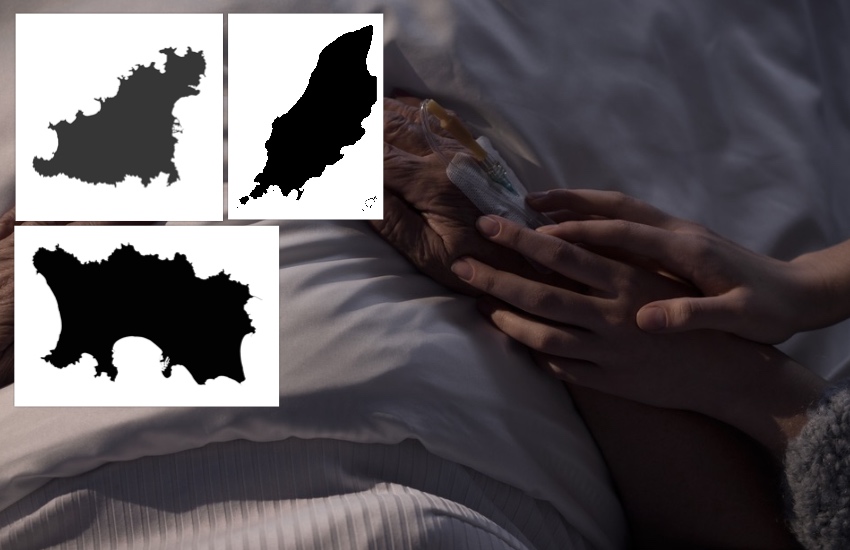
The Terminally Ill Adults (End of Life) Bill could see assisted dying legalised in the UK. Supporters of assisted dying believe that could then pave the way for a law to be enacted in Guernsey.
Efforts to bring in assisted dying legislation were defeated in 2018, when a requete brought by Deputy Gavin St Pier led to passionate debate on both sides before the States voted 24-14 against the move.
He has made clear previously that he intends to bring the issue back to the States and that he believes “Guernsey’s day will come”.
Jersey and the Isle of Man have both made steps towards legalising assisted dying in recent years with the Manx Government voting in favour of allowing assisted deaths during a Second Reading vote at its parliament in 2023, and Jersey moving into the second phase of a consultation on the matter after the island’s States backed the proposal to legalise assisted dying in principle last year.
