

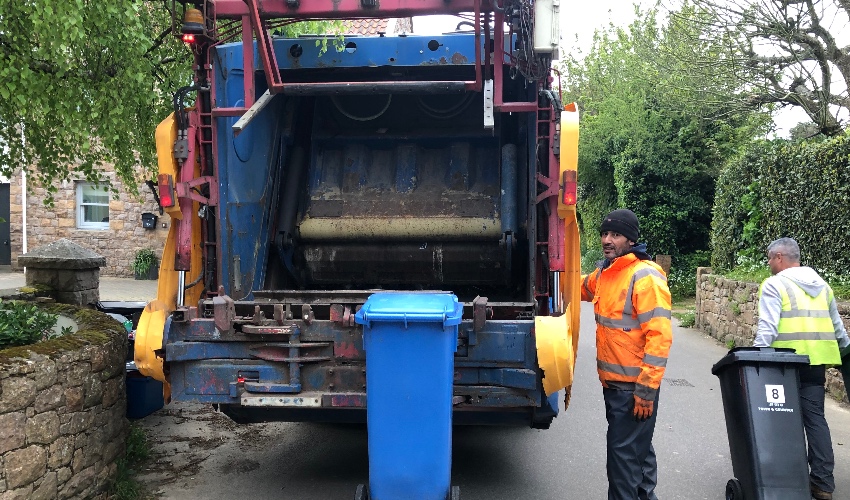
As part of its ‘Our Throwaway Society’ series this week, which has examined how the island is dealing with its growing amount of waste, Express recently joined a team from Germbusters on their monthly collection of paper, cardboard, metals, plastic bottles and glass in St. John.
While most houses in the parish had left neat boxes of tins, glass, paper and plastic bottles outside their gates and doors, the sound of the various carts would invariably prompt a resident or two to dash out in their pyjamas, apologetically delivering their wares.
Express was accompanied by Germbusters owner Basil Jeanne, who bought the firm 24 years ago. A former farmer, Mr Jeanne appeared to know most people in the parish, or at least those who came out to drop off their recycling or were simply there at the time.
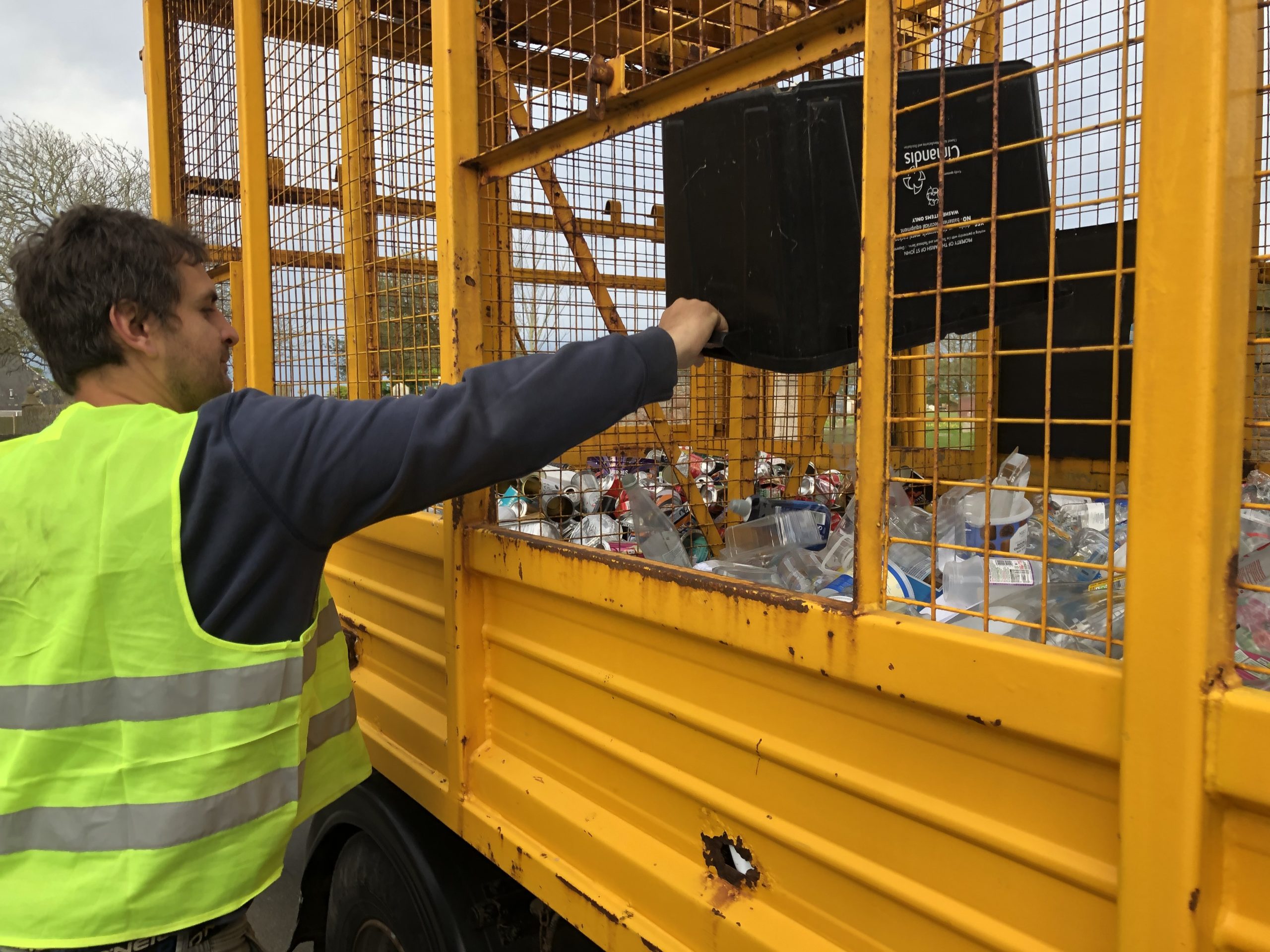
Pictured: Emil Slomba of Germbusters collects plastic bottles and metals in St. John.
Mr Jeanne employs 11 staff and has 14 dustcarts, although a number of those will always be off the road being repaired.
Germbusters serves four parishes – St. Mary, St. John, Trinity and St. Martin. For the first three, the company collects both general refuse and recycling, including glass. It also collects recycling from brink banks around the island.
For St. Martin, Mr Jeanne only collects general refuse. At a recent assembly, parishioners voted overwhelmingly to fund a kerbside recycling service but it cannot currently find an operator to do it.
Germbusters would be the obvious candidate but, driving through the leafy lanes of St John shortly after 07:00, Mr Jeanne explains: “Our problem is that to run a kerbside service in St. Martin, I would need another three to four staff. Over the last 18 months, it has been especially difficult to find and recruit people and even harder to find reliable employees.
“I would have two days of recycling in St Martin. What do I do with my staff for the rest of the month?”
He added: “If I’m a haulage contractor and short of staff, I just put the job back a day. But I can’t do that because if people don’t get their bins collected, it is a riot!”
Mr Jeanne said he thought refuse collection as a profession was undervalued.
“Because we are paid through rates, I don’t think people have an appreciation of what a fair cost is,” he said. “We have inflation at 12.7% and I’m spending £2,000 a week on diesel and north of £35 an hour in wages, double that on Bank Holidays.

Pictured: Germbusters owner Basil Jeanne (left) with Mr Slomba.
“We also have DVS introducing new checks and proposing that I need a transport manager, who might cost £50,000 a year. Vehicle Registration Duty has also increased from £3,000 to £6,100 a vehicle.
“I own my yard but an operator without their own would also be paying £60,000 – £70,000 a year in rent. It all adds up.”
Mr Jeanne turns 65 in August and would like to retire but would obviously want to find a buyer for his business first.
He could, in theory, tell the parishes tomorrow that he was giving up but that would leave them without a refuse service, something he is clearly reluctant to do.
But the possibility remains that some parishes could be left without a bin collection, if Mr Jeanne or any other operator decided to call it a day, which has prompted Infrastructure Minister Tom Binet to launch a review of Jersey highly localised but rather uncoordinated system of refuge.
The sort of questions likely to be asked include: would a centralised service – Government-run or outsourced to a contractor – be more efficient, cheaper and prompt us to recycle more? How much value do islanders place on their parish-run service?
Could and should the Government bid for parish services alongside commercial contractors?
And if refuse collection was centralised, what would that mean for the role of the parishes in island life?
Mr Jeanne does not think that a Government-run single service would be any better, even if taxpayers funded it; however he remains unconvinced that the current system is the right one.
He said: “I think we have to question the whole recycling thing. In my view, as a player in the game, we have an Energy Recovery Facility [the incinerator] that obviously needs fuel, which itself is a form of recycling. The more burnable product we divert from it, the less efficient it is.
“We run three lorries and take the recycling to Abbey Plant at Rue des Près, who bundle it and take it down the Harbour.
“We don’t know how much gets rejected when it arrives in the UK or France. We also have one truck collecting from all the recycling sites multiple times a day.
“Is that the most environmentally friendly option? It might be in the UK but I’m not sure if it is in Jersey.

Pictured: Around 30% of what islanders throw away each year is recycled.
“Also, no one is forced to separate their waste; sometimes we are collecting small amounts.
“Perhaps it would be better is we just collected glass and tin and put all burnable items in the incinerator.
“The whole system should be reviewed, just so we can confidently answer these sort of questions.”
READ MORE …
LISTEN:
As part of the Throwaway Society focus, Express spoke to the Government’s Head of Recycling, Piers Tharme. Listen to the full interview below or search ‘Bailiwick Podcasts’ with your favourite provider…
