

More than two years after under-treated sewage spilled into St Aubin’s Bay, authorities are still investigating whether any laws were broken, Express can reveal.
When asked whether the investigation into the pollution event in June 2023 was still ongoing, the Regulation Department said that “complex issues” meant that the probe had not reached its conclusion and was still underway.
The incident
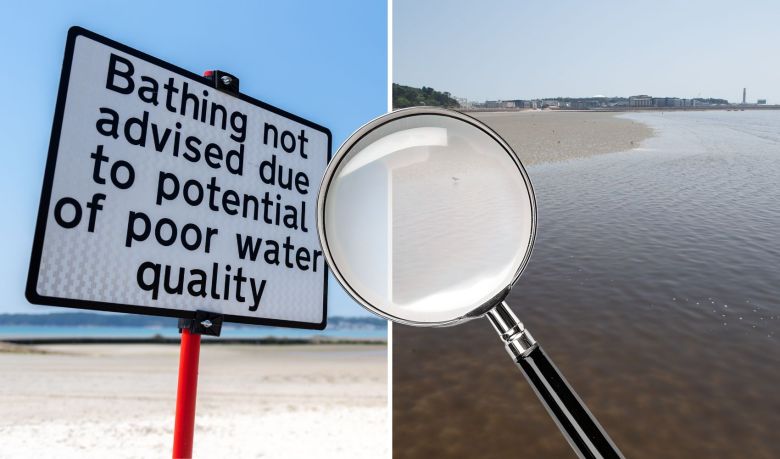
On 14 June 2023, swimmers were told to stay away from the site due to concerns about water quality.
Testing of an undiluted sample from around First Tower – the location of the Sewage Treatment Works outflow pipe – was revealed to be “poor” by EU standards.
However, the advice was lifted three days later on 17 June, with the Government stating that a (diluted) bathing water sample taken from the area on 16 June was “excellent” – so swimming resumed, allowing, for example, the Jersey Triathlon to still go ahead.
The investigation
While Sewage Treatment Works operators said the facility was running as normal after, an investigation was launched by a Regulation team into what happened under the Water Pollution (Jersey) Law 2000. Water pollution incidents can carry an unlimited fine.
In its latest update, a Regulation Department spokesperson told Express that it is “still ongoing” as it has a “number of complex issues involved” and that they “can’t comment any further”. They did not specify what these “complex issues” were when asked.
It has been understood that the investigation involves assessing the condition of the Sewage Treatment Works from both before and during the incident last year, as well as the definition of the Water Pollution Law.
Why did it happen?
At the time, Government officials said that the problem at the plant was caused by the warm weather and lack of rain, as well as insufficient “organic matter” flowing through the plant for the bacteria used in its chemical processes to function properly. This meant that the sewage was treated to a lower standard than usual, they said.
Previously, officers told Express the “blip” in the treatment process was also possibly prompted by high levels of fat from Islanders’ cooking clean-up in the sewage network, which can “upset the process”.
The Government wrote to the hospitality trade and reminded households of the importance of correctly disposing of oils and fats, such as wiping away leftover grease or fat from pots and pans with a paper towel before washing and rinsing.
Whether or not the incident broke the water pollution law is still under investigation due to a number of “complex issues”, officials told Express this week. When asked what these issues were, the department did not provide a response.
How bad was the water quality?
EU standards define ‘Excellent‘ quality as less than or equal to 250 Escherichia coli (a type of illness-causing bacteria) per 100ml, ‘Good‘ is less than or equal to 500 E.Coli, and ‘Poor‘ is above 500.
The undiluted sample taken from First Tower on Thursday 15 June 2023, tested as 630 E.Coli per 100ml (Poor). A diluted sample reading has not been provided.
The bathing water (diluted) sample taken on Friday 16 June that year tested as 55 E.Coli per 100ml (Excellent). An undiluted sample reading has not been provided.
You can find the latest water quality results here.
