


Happy hours are already back, but a ‘1970s hangover’ is still governing Jersey’s pubs and bars. But one minister is finally calling time on that… So, what’s being proposed instead? And what does the industry think?
Economic Development Minister Kirsten Morel has this week put forward a draft law aimed at making Jersey’s alcohol licensing system “modern, proportionate, and fit for purpose”.
The proposals follow the lifting of restrictions on drinks promotions earlier this year and come after 16 years of attempts to modernise Jersey’s 1974 alcohol legislation and reduce red tape for businesses.

Industry leaders have welcomed the move as “pro-business” and “enabling”, saying reform is “long overdue” and that the current framework is “outdated” and difficult for hospitality businesses to navigate.
Express has set out what the draft law would change…
Who would decide who can sell alcohol?
At present, alcohol licences are issued by the Bailiff and Jurats sitting as the Licensing Assembly.
Under the draft law, this responsibility would move to an independent regulator – the Jersey Gambling Commission – which would be renamed the Alcohol and Gambling Commission.

A report accompanying the draft law said that using the existing regulator avoids the “lengthy and costly process of establishing a brand-new” body.
The new regulator would be able to consider applications as they are received, rather than only at quarterly Licensing Assembly sittings.
What happens to licence categories?
Jersey currently has seven licence categories, including taverner’s, restaurant, club, entertainment and off-licences. Many businesses hold multiple licences to cover different parts of their operations.
The draft law would replace these with two main categories:
- On-licence (for consumption on the premises)
- Off-licence (for consumption elsewhere)
A new temporary licence for special events would also be introduced so that festivals and fairs no longer require every stallholder to apply for their own separate permit.
Will parishes still be involved?
Parishes would retain their current role in the licensing process – including holding Parish Assemblies and interviewing managers – and Constables would gain a new power to refer concerns to the Commission.
What new enforcement powers are being introduced?
New enforcement powers are included in the draft law, with the police able to issue Temporary Closure Orders for up to 72 hours where a “disturbance is causing a significant public nuisance”.
Why is reform happening now?
Business owners and Islanders have long argued that the island’s decades-old approach to alcohol is outdated and in need of review, with a string of failed attempts to reduce red tape around businesses serving alcohol.
The closest attempt to update the law came in 2017 when then-Senator Steve Pallett brought a new draft law to the Assembly, but it was withdrawn over concerns about the lack of cohesive agreement and scrutiny.
In 2020, States Members voted to allow happy hours and promotional deals to stimulate the post-Covid economy but no progress was made.
Support for an overhaul of Jersey’s “onerous” and “outdated” alcohol licensing law was underscored earlier this year by responses to a consultation on proposed updates to the 50-year-old legislation.
The majority (89%) of the 98 respondents agreed the Licensing Law should be updated, with 74% also agreeing that the process should be run by a regulatory authority, though there was uncertainty around whether this should involve the Gambling Commission.
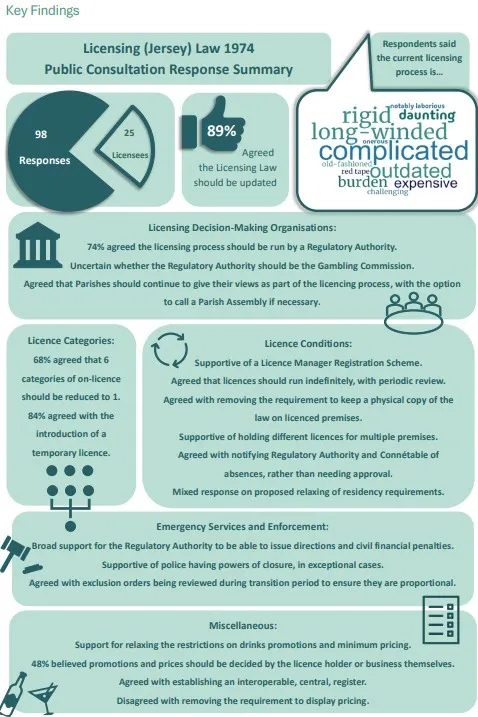
Around two-thirds (65%) of respondents agreed that the parishes should continue to give their views as part of the licensing process.
A reduction in the number of categories of on-licence also drew support from the majority of respondents, while plans for a new temporary licence for “special events” to be established was backed by 84% of those who took part in the consultation.
What have hospitality leaders had to say?
Responding to the publication of the draft law, Ana and Marcus Calvani, Co-CEOs of the Jersey Hospitality Association, said: “Reform of Jersey’s outdated alcohol licensing law has been long overdue. For years, local businesses have been held back by a system that is opaque, cumbersome and completely out of step with the needs of a modern visitor economy.
“We, along with many others, have pushed repeatedly for meaningful change because the current law has cost businesses time, money, creativity and opportunity. It is simply not fit for purpose.”

We are therefore genuinely delighted to see at long last a piece of legislation that delivers the change Jersey needs. This new framework is simple, transparent, pro-business and innovation-enabling.
“It removes the unnecessary fear, barriers and delays embedded in the existing law and replaces them with a system designed for progress, growth and the realities of today’s hospitality landscape. Credit must go to the Visitor Economy team in Government, who have led one of the most open, collaborative and responsive policy development processes we have ever been involved in.
“The result is legislation that meets the demands of the present and unlocks the opportunities of the future”
Ana and Marcus Calvani, Co-CEOs of the Jersey Hospitality Association
“The result is legislation that meets the demands of the present and unlocks the opportunities of the future. Any attempt now to weaken, delay or derail this reform would be utterly disgraceful, a step backwards that Jersey cannot afford, and wholly unjustifiable in the eyes of an industry that has waited decades for modernisation.
“We have written to our members to strongly encourage them to support it, and we hope Government will now push this excellent work through with the urgency it deserves.
“We also welcome the Jersey Gambling Commission taking on the responsibility for licensing. They are independent, experienced regulators and are clearly prepared for this role. Their forthcoming rebrand signals the beginning of a new era, a modernised, streamlined system with a single trusted regulator at its heart.
“After so many failed attempts to reform the 1974 law, we can finally see real light at the end of the tunnel.”
If approved by the States Assembly, the new law would not take effect before 2027. Time would be needed for the next government, elected this summer, to develop an Alcohol Policy Framework.
