


Hospital admissions and disease outbreaks have been a consistent part of Jersey’s history, and newly opened archival records provide fresh insights into how health challenges were managed a century ago compared to now.
From 1924…
While today’s attention is on seasonal flu and respiratory viruses, 100 years ago islanders were battling diseases like tuberculosis—a bacterial infection affecting the lungs that claimed 65 lives in 1924—and typhoid, a potentially fatal illness often spread through contaminated water, which caused outbreaks in local schools.
This information, contained within hospital admission registers 1924, was made public last week under the Freedom of Information Law.

Pictured: Newly released hospital records from 1924 reveal that past health challenges included tuberculosis, which claimed 65 lives, and typhoid outbreaks caused by contaminated water.
Among the documented cases is that of George Rolland, an 11-year-old boy whose leg was amputated due to tuberculosis.
Another story is that of 27-year-old Sarah Haynes, who died of a bacterial infection.
Contaminated drinking water at one school caused an outbreak that led to seven other infections.
Bronchitis was another reason for hospital admissions. Patients like 77-year-old Francis Airth made multiple visits before dying due to the illness.
Poverty often worsened these conditions. Families living in overcrowded, unsanitary housing were particularly vulnerable, with entire households admitted due to their circumstances.
In 1924, the hospital served not only as a medical facility but also as a place where those living in poverty were admitted.
Emily Theresa McDermott and her seven children, ranging from four months to 11 years old, were admitted simply because they had nowhere else to live.
In another case, six children of Philip John Le Maistre, aged between two and ten, found temporary refuge in the hospital due to poverty at home.
To 2024/25…
In contrast, today’s primary health concerns revolve around respiratory viruses, with influenza A currently dominating hospital admissions.
Consultant microbiologist and director of infection control Ivan Muscat – also the former deputy medical officer of health who was at the forefront of the island’s pandemic response – described the current situation.
“The primary drivers are the respiratory viruses – at the moment the major player is influenza A.

Picutred: The island’s consultant microbiologist, Dr Ivan Muscat.
“RSV is also contributing but it appears to have peaked in December and the numbers are not as great as Influenza,” he continued.
As a precaution, masks have been reintroduced in clinical areas, and islanders are urged to avoid visiting the hospital if experiencing flu-like symptoms.
Dr Muscat said: “We know that 50% of Influenza is not symptomatic – so people who don’t know they’ve got it but can still transmit it….bearing in mind of course that patients in the Hospital are vulnerable.”
The latest Public Health report on winter illnesses showed that influenza cases are within normal seasonal levels but have increased in recent weeks.
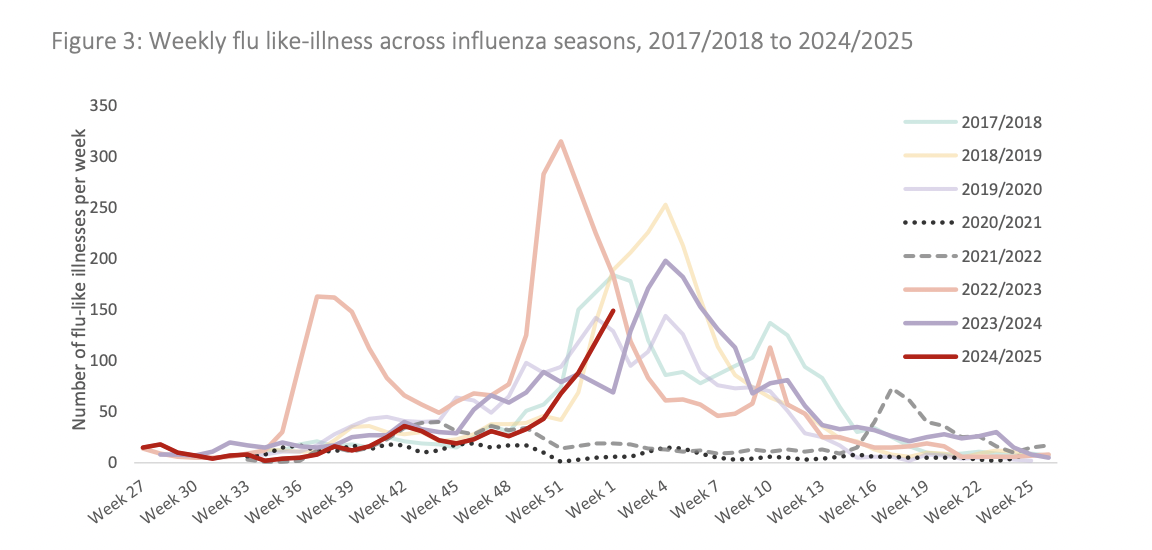
Picutred: Weekly flu-like-illness across influenza seasons. (Public Health)
There are minimal cases of covid-19 being recorded by the Government. RSV activity, though higher earlier in the season, has since decreased.
The previous flu season aligned with pre-pandemic patterns, according to Public Health Director Peter Bradley.
“Following the pandemic, as people started mixing socially in a normal way, we anticipated flu rates would be similar to pre-pandemic years,” Professor Bradley explained.
He added that while winter viruses, including flu, typically followed a certain seasonality before the pandemic, covid-19 had disrupted this pattern.
