


Over the years, more and more young islanders have packed their bags to explore what life in Australia has to offer – but what exactly is pushing them away? What makes life down under so appealing to Jersey’s youth?
This modern migration follows a historical connection between Jersey and Australia that dates back to the mid-19th century when thousands of islanders relocated during the Australian Gold Rush.
Today, the draw to Australia has less to do with gold and more with the promise of better career prospects, more affordable housing, and a lifestyle that contrasts with the challenges of living in Jersey.
What does the data show?
Data from Statistics Jersey has revealed a 7% decline in the island’s population of 20- to 30-year-olds between 2017 and 2023, with an even sharper 13% drop among those aged 20 to 24.
Over a similar period, dissatisfaction with life in Jersey among 16- to 34-year-olds has more than doubled.
What has happened to the Australian immigration rules?
Meanwhile, recent changes to Australian visa rules – which now allow UK nationals to stay for up to three years – have led to a surge in the number of young travellers moving to the country.
The agreement, which came into force last year, also raised the cut-off age for UK applicants from 30 to 35 and no longer required young UK travellers to work long periods in remote regions – often on farms – in order to extend their stay.

Pictured: Young Jersey residents are increasingly drawn to Australia, Express has learned, driven by better career prospects, more affordable housing, and a more vibrant lifestyle.
According to The Times, nearly 50,000 young UK nationals moved to Australia in 2024 – more than double the figure from two years ago.
This trend can also be seen in Jersey, where young people who have moved have said that Australia’s lifestyle and opportunities are far more appealing than staying in the island.
“Australia offers a much broader range of career opportunities”
Among them is 24-year-old Catia Vieira, who moved from Jersey to Perth in 2020 to study nursing after receiving a scholarship.
“Australia offers a much broader range of career opportunities in diverse sectors,” she explained.

Pictured: Catia Vieira is 24 years old and a former Haute Vallée student.
“The job market in Jersey is heavily centred around finance and it feels like this is the only option for young people.
“Many young people are seeking work outside of finance which can be difficult to find in Jersey.”
This reflects how Jersey’s financial and legal sectors employ 21% of the island’s population – one in five jobs.
“A laid-back, outdoor-oriented lifestyle”
While the dominance of the finance sector was a push factor in leaving the island, Catia added that the lifestyle was a key factor in drawing her to Australia.
“There is also such a laid-back, outdoor-oriented lifestyle here, and a very easy-going atmosphere which I love,” she said.
“I was drawn to the outdoorsy lifestyle that Australia offers, and I think that’s what has made me stay here for so long.
“I love that on the weekend I can drive a few hours up north or down south and drive along the beach and camp in the most beautiful spots.”
“There’s always something going on”
Someone who was also drawn to Australia’s outdoor-oriented lifestyle and career opportunities was Jake Stolte – a journalist based in Sydney who was previously employed by All Island Media, the parent company of Express.

Pictured: Jake Stolte works as a journalist and digital editor for a surf magazine in Sydney.
“Living in a city like Sydney there’s always something going on,” he said.
“I live a five-minute drive from the beach and the surf and then in a 45-minute bus journey I can be in the heart of the city where there’s hundreds of bars, and restaurants and clubs to choose from.
“It’s such a big country and there’s so many places to try and explore that you can never get bored.”
He added: “It’s a complete contrast to Jersey nightlife which seems to be on a constant downward spiral.”
“Everyone says it…there isn’t much to do in Jersey”
And it is true that the island’s nightlife has suffered with multiple venues closing in recent years – including Havana in December, ROJOs this summer, Ce Soir in 2023, WYSIWYG in 2020, and Kokos in 2017.
Between 2021 and 2023, the economic contribution of the island’s arts, entertainment, and recreation sector fell by 19%.
Despite a 2019 government decision to allocate 1% of revenue expenditure to arts, heritage, and culture, the impact of this initiative does not appear to be felt by young people.
Cinema visits by 16- to 34-year-olds fell by 28% between 2017 and 2022, while attendance at live music events dropped by 33% and art exhibitions by 38%.
This stands in contrast to the cultural scene in Australia, according to Charlotte Sweeney who moved to Melbourne after traveling through Southeast Asia.

Pictured: Charlotte Sweeney is 29 years old and went to Beaulieu Convent School.
She said: “There is something for everyone with regards to the arts, sports and culture, with internationally acclaimed artists visiting regularly.
“The is always something going on and it’s impossible to be bored.”
Charlotte added: “In contrast, there is not enough money spent on arts or sports in Jersey.
“In terms of nightlife, there is not a lot going on, especially during winter.”
The 29-year-old also praised Australia’s strong “work-life balance” and relaxed cultural attitudes.
“Australians have a relaxed ‘no worries’ attitude that’s a breath of fresh air,” she said.
When asked about the key issues driving young people away from Jersey, Catia said: “Everyone says it…there isn’t much to do.
“While Jersey offers stunning beaches and nature, young people may feel that the social scene is limited, especially for those seeking a lively nightlife or a variety of social activities.
“Living in Jersey can make it tough for young people to find hobbies, activities, and social groups that really match their interests.
“With the island being small and not having much variety in things to do, it can sometimes feel like there aren’t enough options to connect with like-minded people.”
“There is a great work-life balance”
Juliette Le Quere, another ex-islander living in Melbourne, echoed these sentiments.
“There is a great work-life balance out in Australia, everyone is always out doing something after they’ve finished work, or before work, whether it’s a run, sea swim, or BBQ,” she said.

Pictured: Juliette Le Quere is 28 years old and went to Les Quennevais School.
“A lot would need to change in Jersey to encourage me to move back, there isn’t much for the younger generation and the cost of living is rising.”
A recently survey revealed that over two-fifths of adults in Jersey felt they spent too much time working.
Half reported insufficient time with family, and 67% said they lacked time for hobbies or personal interests.
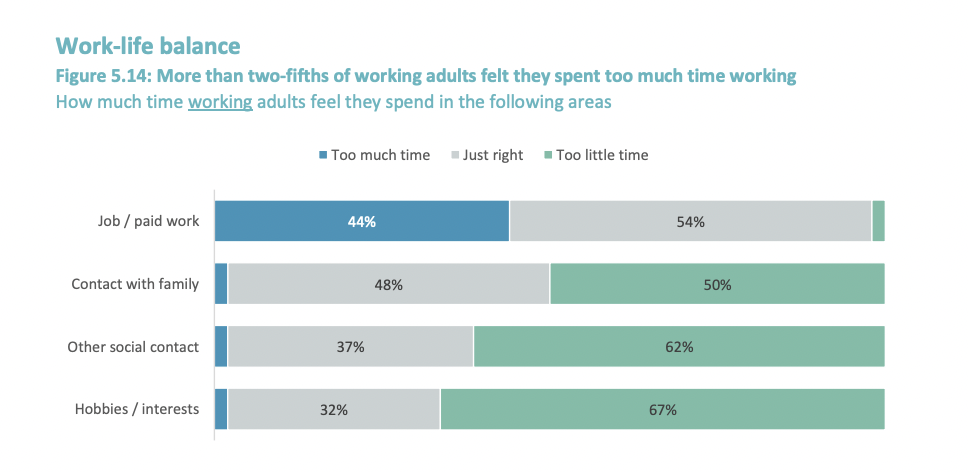
Pictured: More than two-fifths of working adults in Jersey felt they spent too much time working. (Statistics Jersey)
Australia offers an alternative, especially for tradespeople and healthcare professionals like Catia.
In fields like nursing, salaries in Australia can be double those in the UK.
“More for your money”
And for young islanders, the housing situation in Australia is also a significant draw.
Juliette said: “You get more for your money here, especially when it comes to renting.”
In contrast, Jersey’s housing crisis continues to worsen.
Between March 2022 and 2023, the cost of living increased by 12.7%, with inflation reaching double digits for the first time in decades.
Younger workers, who earn significantly less than their older counterparts, feel the strain most acutely.
As of June 2023, 20- to 24-year-olds in Jersey earned a median monthly income of £2,500, compared to £4,140 for those aged 45 to 49.
For many, the prospect of homeownership remains out of reach.
“If I return, it is more than likely that I will have to move back in with my parents as I wouldn’t be able to afford a decent rental,” admitted Catia.
“Property prices and rentals have become increasingly unaffordable, making it difficult to settle down and build a future on the island.”
Charlotte agreed, adding: “The housing market in Jersey is expensive…I don’t think that I would be able to live in Jersey due to the expense.
“Unless you’ve been saving for years or have family support, buying or renting in Jersey is nearly impossible.”

Pictured: Pictured: Catia Vieira moved to Australia when she was 19 to study nursing.
Average housing prices in Jersey peaked at £709,000 in late 2022, and while prices dipped slightly in 2023, rising mortgage rates have further eroded affordability.
By comparison, Australia offers more attainable housing options.
As of December 2024, the national median house price was AUD $812,933 (£426,000), with city-specific averages of AUD $1,196,809 (£628,000) in Sydney, AUD $776,949 (£408,000) in Melbourne, AUD $886,540 (£465,000) in Brisbane, and AUD $813,716 (£427,000) in Adelaide.
While cities like Sydney remain expensive, the average house price in Australia is 66% lower than in Jersey.
A report published by Statistics Jersey also found that a “working household with net mean income” could not afford a mortgage on “a median-priced house of any size or a two-bedroom flat” in 2023.
Statistics Jersey also found that 82% of people living in private rentals in 2022 were deemed as being in “rental stress” – spending more than 30% of their income on housing costs.
Why is this trend a problem?
The continued outflow of young, skilled workers poses significant challenges for Jersey, with the Government already having acknowledged skills shortages in certain areas of the economy.
The pattern also relates to longstanding concerns about how Jersey will care for its older population in future without a large enough working population – with the data revealing that the number of over 60s increased by 15% between 2017 and 2023.
The latest census found that the ‘dependency ratio’ in Jersey had risen to 52%, meaning there were fewer people working than the number dependent on public services paid for by taxes.
Deputy Kirsten Morel maintains he is “absolutely committed to the aim of delivering an economy and therefore a society in which Jersey’s young people can see themselves living for their whole lives”.
Last autumn, Deputy Morel changed the name of his Ministerial portfolio to ‘Sustainable Economic Development’
“This is an important change, as the overall priority for the economic development of our island is that the economy should flourish long into the future,” he said at the time.
Just days later, Deputy Morel released the Future Economy Programme – a strategy document outlining his plan to enhance innovation, productivity, and skills development in Jersey, while addressing the challenges brought about by an ageing population.
The framework for this strategy includes almost 100 actions, spanning short, medium, and long-term goals, to drive sustainable economic growth.
Deputy Morel added that the Council of Ministers are also working to attract young people to return to Jersey, bringing with them the skills and knowledge they have gained while away.
As part of this, the government has launched a new website that allows those with ties to the island to stay in touch, share stories, and learn about Jersey-based opportunities.
READ MORE…
Jersey may need 4000 extra care workers by 2040 (June 2024)
EXPLAINED: How much more housing does Jersey need? (March 2024)
New stats highlight continuing ‘Bean drain’ (Nov 2023)
FOCUS: Could a ‘Bean’ drain be Jersey’s next big challenge? (June 2023)
Is Jersey making it too “painful” for local talent to return? (July 2023)
DIGEST: What will Jersey’s population look like in 2080? (Dec 2023)
Jersey’s Oz-based ‘gold seekers’ reconnect with Island past (July 2017)
