


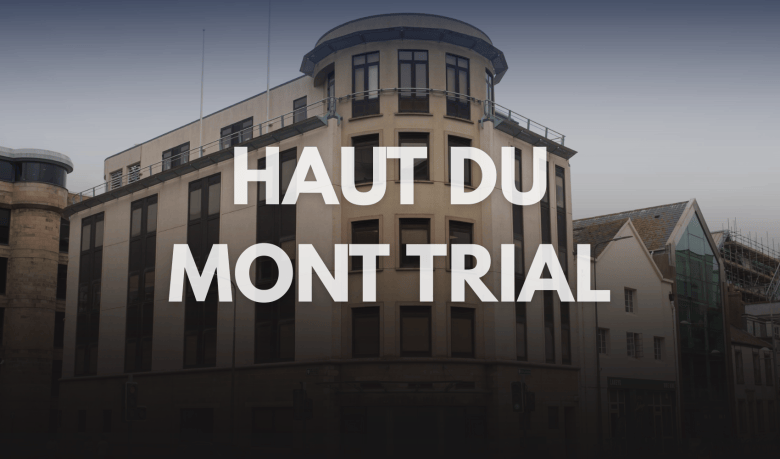
Mistakes do not amount to manslaughter, a supervisor’s instructions left one worker in an “impossible” position, and a third was a “perfect employee”, defence lawyers have argued as the Haut du Mont trial nears its conclusion.
In closing speeches yesterday, lawyers for the three Island Energy engineers accused over the explosion urged jurors to find their clients not guilty as they highlighted the “toxic culture” at the utility company.
Neil Armstrong (58), John Wright (60) and Lee Ward (59) each deny ten counts of gross-negligence manslaughter relating to the blast on 10 December 2022. Their employer, Jersey Gas, trading as Island Energy, denies two alleged breaches of health and safety law.
The prosecution alleges that the engineers’ work the previous day was “exceptionally bad” and that they made the “utterly reprehensible” decision to restore gas to the flats without conducting a pressure test to check for leaks.
In his closing speech on Monday, Crown Advocate Simon Thomas argued that the men had ignored a “serious and obvious” risk of death.
Armstrong: Mistakes do not necessarily amount to crime
Representing Mr Armstrong, Advocate Rui Tremoceiro urged jurors to distinguish between negligence and criminal conduct.
“The law recognises an important distinction between human error and crime,” he said.
“Tragic consequences do not by themselves transform mistakes – even bad mistakes – into criminal offences.”
He argued that his client’s actions were informed by years of mismanagement and excessive workload pressure at Island Energy. Mr Armstrong’s last formal training on managing public-reported emergencies had been in July 2009, more than 13 years before the explosion, he said.
Advocate Tremoceiro also challenged the prosecution’s argument that responsibility for the open valve which led to the gas leak lay with Mr Armstrong.
Three valve plugs were missing, he said, but his client had only referred to leaving one valve unplugged.
“Experts agree that plugs D, E and F were absent before the explosion, but there is no forensic evidence as to who removed them or for what purpose,” he told jurors.
He suggested that someone else with access to the gas cupboards could have opened a valve, referring to evidence that Andium Homes had no reliable record of how many keys existed or who held them.
Advocate Tremoceiro accepted that Mr Armstrong had failed to conduct a pressure test and then lied to two senior colleagues about it. However, he argued that these failings did not meet the threshold for gross negligence.
“He can be properly criticised for these failures, but there is a significant difference between negligence and gross negligence.”
Wright: “What Neil says goes basically”
Advocate Mark Boothman argued that Mr Wright had been left in an “impossibly difficult” position by inadequate training, supervision and procedures, and a working environment witnesses had described as “toxic”.
He maintained that Mr Armstrong had failed to close and plug the valves at Haut du Mont – an account disputed by Mr Armstrong’s defence.
Turning to the reconnection, Advocate Boothman said Mr Wright had been instructed to restore the supply amid a “panic” after the works also cut off gas to St Helier Yacht Club before an evening event.
In his police interview, Mr Wright described asking whether a pressure test was needed.
“I asked the question, ‘test?’, and because Neil was panicking, he said ‘just get it on’,” he told investigators.
He also recalled being told: “Forget the test, get it on.”
Mr Wright said he was unhappy but believed the decision belonged to his supervisor: “I can’t make that call; that’s down to my supervisor. If he says ‘don’t’, I don’t. What Neil says goes basically.”
Advocate Boothman argued that his client felt unable to challenge Mr Armstrong. He also cited evidence that Island Energy’s “red card” procedure, allowing staff to stop unsafe work, was ineffective in practice.
“Mr Wright was not management; he was not the one making the decisions,” he said.
Ward: A “meticulous” worker
Advocate Olaf Blakely argued that Mr Ward played only a small part in the work and should never have been put on trial.
Mr Ward arrived at around 4pm to help reconnect a gas main mistakenly cut by his colleagues. Although normally a team leader, he was acting as an assistant, preparing materials and handing over tools, his lawyer said.
The prosecution alleges that his 14 years of experience working with the company meant he should have recognised the danger and intervened.
However, Advocate Blakely argued that key decisions predated his arrival and there was no evidence he knew managing director Clive Doyle had instructed Mr Armstrong to conduct a pressure test.
He highlighted descriptions of Mr Ward as “meticulous” and safety-conscious given by colleagues called as prosecution witnesses, his previous use of the red-card policy, and a retention bonus paid in January 2023. Mr Ward remains employed by Island Energy.
“When you return your verdicts, they should be not guilty,” he concluded.
The trial continues with Island Energy’s closing speech, followed by Commissioner Andrew Oldland’s summing-up.
The jury is expected to retire to consider their verdicts on Thursday.
