


A slight fall in the rate of inflation has been announced, but islanders have been warned that an upward curve may be imminent as a result of the war in the Middle East.
With the current phase of the military conflict in the Gulf having signalled when the US and Israel launched joint airstrikes against Iran on 28 February, economists have warned that the impact will not be fully reflected in the data announced today – which only covers the period from 1 January to 31 March.
The figures from Statistics Jersey show that prices were 2.7% higher at the end of the first quarter of 2026 than at the same point a year ago, with the rate dropping by 0.1% compared with the 2.8% headline figure for the final quarter of 2025.
The data comes from the latest Retail Prices Index report, published this morning, which is the main way inflation is measured in Jersey.
The analysis tracks the prices of goods and services bought by households and is often used as a measure of the island’s cost of living.

Inflation has been fairly steady in Jersey since the figure of 3.0% was announced for the third quarter of 2024, with the rate fluctuating between 2.3% and 2.8% over the next six quarters.
However, the report includes context from Statistics Jersey pointing out that prices were collected over the period from 27 February to 15 March and that the inflationary potential of the conflict had not been realised by the end of this analysis.
Statistics Jersey said: “This conflict has resulted in a number of economic impacts, including observed changes in the price of energy products such as heating oil and petrol.
“However, the timing of the RPI price collection has meant that only some of these impacts will be reflected in this quarter.
What’s gone up over the past year?
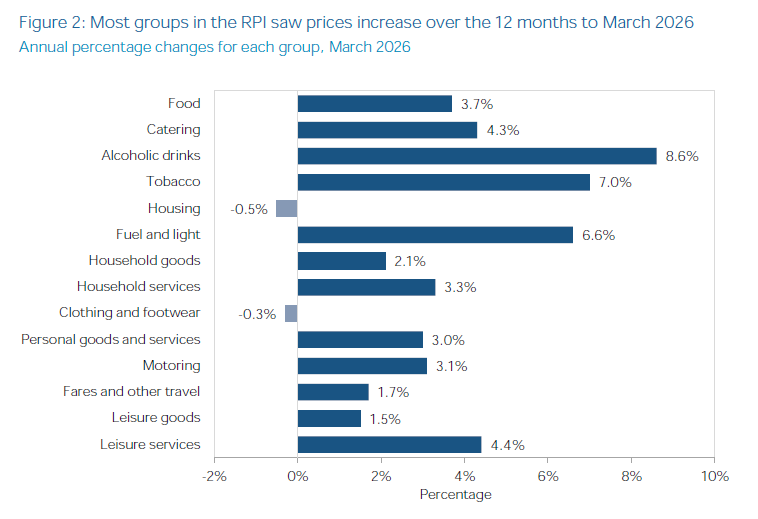
- Tobacco: up 7%
- Fares and other travel: up 1.7%
- Leisure services (e.g. entertainment, sport, holidays): up 4.4%
- Fuel and light: up 6.6%
- Catering (e.g. eating out, takeaways): up 4.3%
- Personal goods and services (e.g. toiletries, dental/medical/beauty treatments): up 3%
- Food (e.g. shop bought): up 3.7%
- Alcoholic drinks: up 8.6%
- Motoring (e.g. vehicles and petrol): up 3.1%
- Household services (e.g. school fees, phone bills, subscriptions): up 3.3%
- Leisure goods (e.g. books, games, gardening items): up 1.5%
- Household goods (e.g. furniture, appliances): up 2.1%
- What’s gone down?
- Housing (e.g. rents and mortgage-interest payments): down 0.5%
- Clothing and footwear: down 0.3%
What’s driving the change?
The decrease in the annual rate of inflation by 0.1 percentage points compared to December stemmed from increases of between 2.1% and 8.6% in 12 of the 14 categories, with housing and clothing/footwear the only headings to record falls.
The report notes that three groups gave upward contributions to the change:
- Alcoholic drinks had an 8.6% increase compared to a 5.1% increase over the 12 months to December 2025, contributing +0.2 pp
- The household goods group saw an increase of 2.1%, whilst over the 12 months to December 2025 this group decreased by 1.3%, contributing +0.2 pp
- Fuel and light increased by 6.6%, compared to an increase of 5.6% to December 2025, contributing +0.1 pp
Four groups gave downward contributions to the change, with housing, motoring, fares and other travel, and leisure services groups all contributing -0.1 pp to the change.

Impact on vulnerable islanders
The report also looks at how vulnerable islanders – such as pensioners and those on low incomes – are faring.
It does this by looking two specific measures of inflation: RPI Pensioners and RPI Low Income.
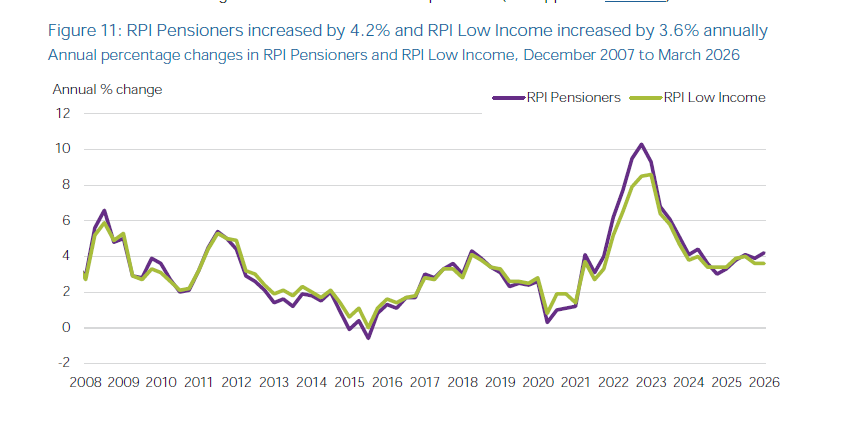
These are calculated based on the different spending patterns of pensioner households and the lowest-income households in Jersey.
Over the past 12 months:
- RPI Pensioners rose by 4.2% (up from 3.9% in December)
- RPI Low Income rose by 3.6% (the same as in December)
How do we compare to the UK?
The rate of inflation in Jersey, as measured by the RPI, was 0.7 percentage points lower than the UK’s comparable CPIH figure (Consumer Prices Index) of 3.4%.
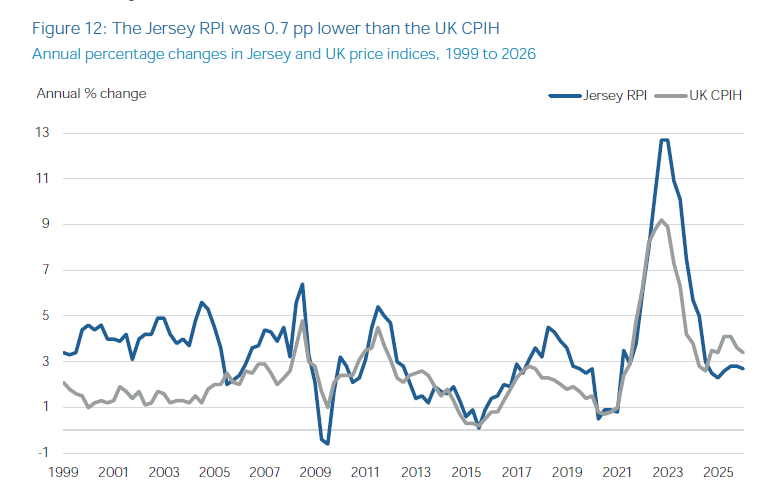
Differences in how housing costs are measured and the impact of interest rates account for part of the gap.
