
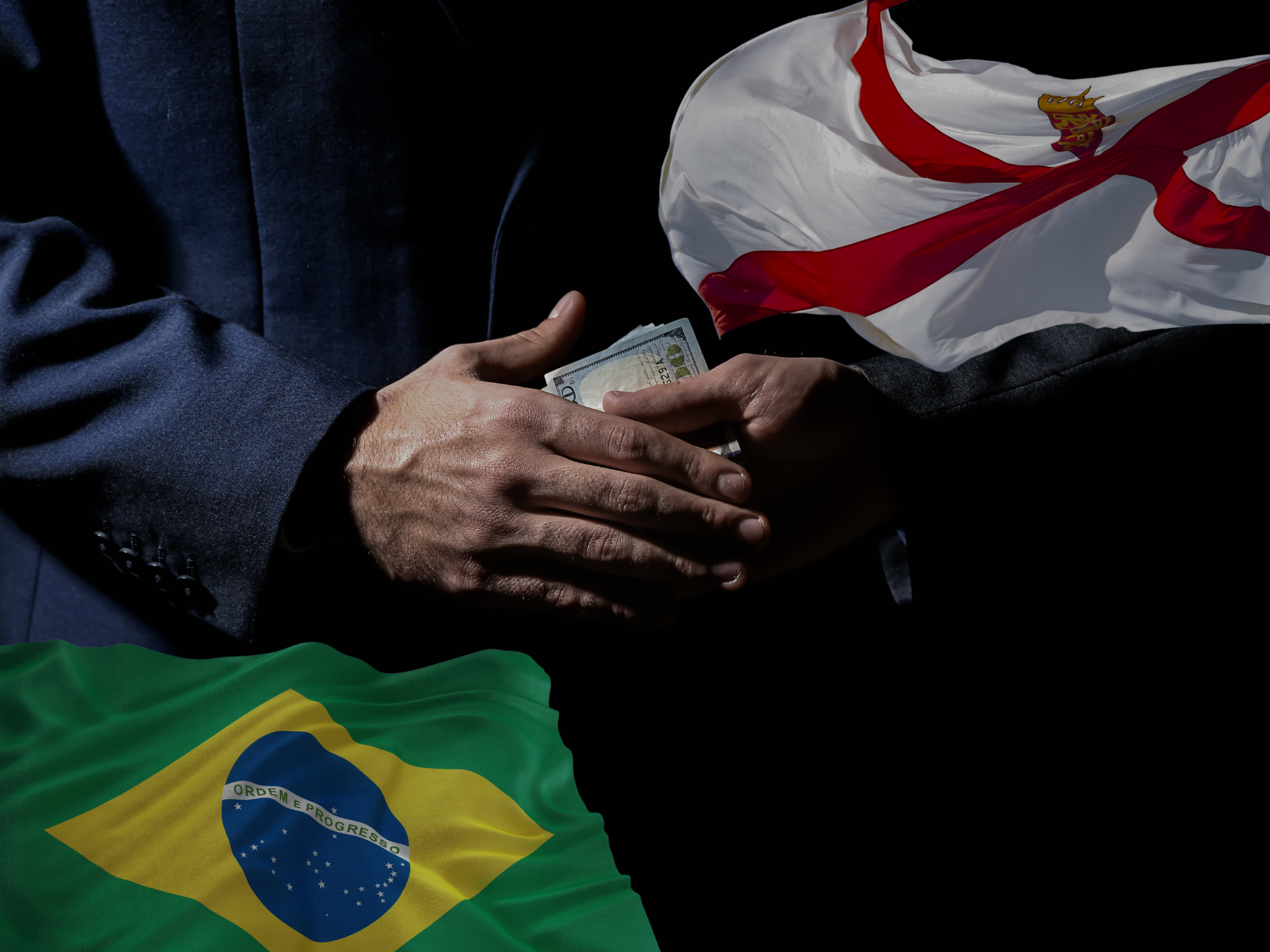

Jersey authorities are handing back more than £725,000 linked to one of the biggest corruption scandals in modern history after the Royal Court ruled the money represented the proceeds of bribery tied to a Brazilian politician.
The Royal Court ordered the forfeiture of £725,783 held in Jersey bank accounts connected to Brazilian national Expedito Machado.
According to Jersey’s Economic Crime and Confiscation Unit (ECCU), the money originated from bribes paid to Machado’s father, José Sergio de Oliveira Machado, a former chief executive of Brazilian state oil transport company Transpetro.
Investigators say international shipping and shipbuilding firms paid tens of millions of dollars in bribes in exchange for lucrative contracts with the company.
Some of that money was allegedly funnelled through Switzerland before being routed into Jersey trust structures and companies that were then used to purchase UK property.
The Royal Court found the funds held in Jersey were “tainted” by criminal conduct and ordered them forfeited under Jersey’s civil asset recovery laws.
The money will now be returned to Brazil after Jersey deducts the costs of recovering it.
It’s linked to large-scale corruption which was uncovered by Brazilian authorities in an investigation called Operação Lava Jato – or Operation Car Wash.
What was Operation Car Wash?
Operation Car Wash – known in Portuguese as “Operação Lava Jato” – was a massive anti-corruption investigation launched in Brazil in 2014.
It began as an inquiry into money laundering at a car wash and petrol station in Brasília, hence the name of the operation.
But investigators soon uncovered a far-reaching bribery network centred on Brazil’s largest oil and gas company, Petrobras – unveiling illegal payments of more than $5 billion to company executives and political parties.
Executives at Petrobras and its subsidiaries were accused of accepting kickbacks from construction, engineering and shipping firms in return for inflated contracts.
Billionaires were jailed, a president was dragged into court, and the reputations of some of the world’s biggest companies were damaged.
Those implicated included Expedito’s father, former politician José Sergio de Oliveira Machado.
He received over US $40 million in bribes while working at Petrobras. The payments were made by Brazilian, Greek, German and Norwegian companies to secure contracts for ship-building and other shipping services.
At its peak, Operation Car Wash was regarded as the largest corruption investigation in Brazilian history.
The investigation exposed how global financial systems could be used to move and hide illicit wealth.
Funds linked to the scheme travelled through multiple jurisdictions, including Switzerland, offshore finance centres and property markets abroad.
That international dimension meant authorities in different countries had to cooperate through mutual legal assistance treaties and cross-border financial investigations.
How did Jersey become involved?
Expedito laundered some of the bribe money that was paid to his father between 2007 and 2013 through a complex structure that involved Jersey trusts.
They were first paid to Switzerland, where the funds would be distributed to other Swiss accounts to disguise them as legitimate commercial bank transfers.
Four Jersey trusts – funded by bribe monies transferred from Switzerland – were used in the scheme, and the money was used to buy property in the UK.
The Economic Crime and Confiscation Unit of Jersey’s Law Officers’ Department was able to show that money used for the acquisition of these properties, held by the underlying companies of Jersey trusts, originated from the payments received abroad as bribes which were first deposited in Switzerland.
While the Jersey court did not make any findings, Expedito Machado pleaded guilty to money laundering offences in Brazil and Switzerland and cooperated with both authorities in identifying the proceeds of crime.
He also cooperated with the proceedings in Jersey by confirming the underlying facts to the Attorney General in an affidavit.
What will happen to the money now?
Now that the forfeiture totalling £725,783 has been granted, the Attorney General will liaise with Brazilian authorities to return the funds to Brazil, minus the costs to the Law Officers’ Department in recovering the funds.
Attorney General Matthew Jowitt KC said: “ECCU and our Mutual Legal Assistance Team (with support from the Jersey Financial Intelligence Unit) have worked in close partnership with the Advocacia-Geral da União and the Swiss Public Prosecutor to recover tainted property on behalf of the people of Brazil.
“The Royal Court’s order concludes a complex and long-running asset forfeiture investigation by ECCU.
“This is further evidence that the 2018 Forfeiture Law is a vital tool in recovering the proceeds of corruption and restoring that money to victims of international financial crime.”
