

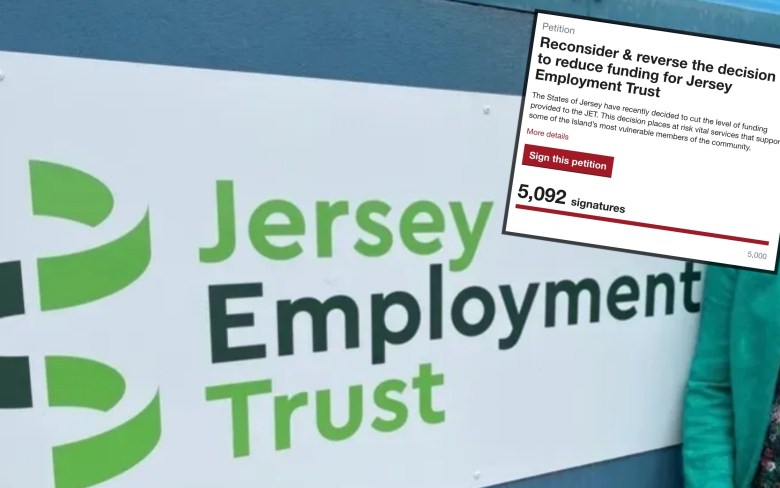
A petition calling on the government to reverse its stance on funding for the Jersey Employment Trust has now passed 5,000 signatures – as ministers confirmed emergency funding to keep the charity afloat and acknowledged a breakdown in talks over data-sharing.
The petition surge, which may trigger a States Assembly debate, came just as Social Security Minister Lyndsay Feltham said she had secured short-term “stabilisation funding” to support JET, using money originally allocated to disability and inclusion initiatives in this year’s Budget.
The decision follows intense pressure on government after it emerged last week that JET would not receive a repeat of a £785,000 top-up grant which helped sustain its services in 2024. Without further funding on top of its £1.9m “base”, all 38 staff at the charity were told their roles were “at risk” of redundancy.
Details of data clash emerge
Taking the unusual step of sharing a statement on Sunday afternoon, Deputy Feltham sought to clarify the key issues in the row.
She explained that, at the end of last year, government identified £200,000 to support JET, but this fell well short of the previous year’s top-up.
Deputy Feltham said the £785,000 paid in 2024 had come from departmental underspends and was always intended as a one-off.
“I made it clear to JET that it was just fortuitous that I was able to offer this, and that we could not guarantee it on further occasions, because underspends will always vary,” she said.
She also revealed that the charity and government had been in negotiations for some time over a longer term funding position, with Deputy Feltham stating that the arrangement was “out of date” and “clearly needs to be updated”.
She said that she needed to build a business case for JET funding, which would require the charity to share data with the government.
Such data would help the government “understand the scale of support provided by JET to its clients, and what other support each of them was receiving, which would ensure we could provide the best coordinated approach across all appropriate agencies” – but an agreement could not be reached with the charity, the Minister explained.
How is JET funded?
The charity is contracted by the Social Security Department to train and help employ Islanders with disabilities and long-term health conditions. The agreement sees them get £1.9 million, a sum that increases with inflation.
The States Annual Report in 2024 broke this amount down into two – a £1.069 million grant “for people with a disability or long-term health condition, including training, employability skills and help during their induction period, and a further £831,000 for those with a learning disability or on the autistic spectrum.

A further £785,000 were a “one-off payment to support cost of living increase”. This was introduced in 2024, and the charity said that they would need the same amount in 2025.
According to its own accounts, the charity gets more than £200,000 from donations, and makes some income from bank interest.
While a solution is sought, Deputy Feltham said that the government had identified money which could be used as “stabilisation funding” and could go towards developing the business case.
The money, she said, was originally supposed to go towards “the delivery of priority areas agreed by the Disability and Inclusion Advisory Group”, and that she hadn’t intended to give it to JET. Express has asked for the total being provided and is awaiting a response at the time of writing.
Long-term solution sought
Responding in a statement sent late on Sunday night, JET’s Board said that it had noted the Social Security Minister’s statement and had sought further clarification on a number of points raised, including the reference to “stabilisation funding”.
However, the board contended that the information-sharing impasse was a data protection issue.
“…The Board wishes to make clear that it continues to support the
Minister and her department in identifying a sustainable, long-term funding solution,” the statement read.
“As part of this co-operative approach, the organisation has shared, on an ongoing basis for a number of years, all information and statistical data it is legally permitted to provide
regarding the clients it supports. Current data protection legislation prevents the
sharing of clients’ personal data, a position of which the department is fully aware.”
Supporting his fellow Minister and Reform Jersey colleague, Housing Minister Sam Mézec said this morning that the additional funding was the result of individuals who “worked hard over the weekend to find the best way of making this possible”.
“Now it is clear that the arrangement between government and JET is no longer fit for purpose and needs to be refreshed for a new long-term arrangement with sustainable funding built in to stop this from happening again,” he added.
The comments came just as a petition calling for the government reverse its original funding decision surpassed 5,000 signatures this morning.
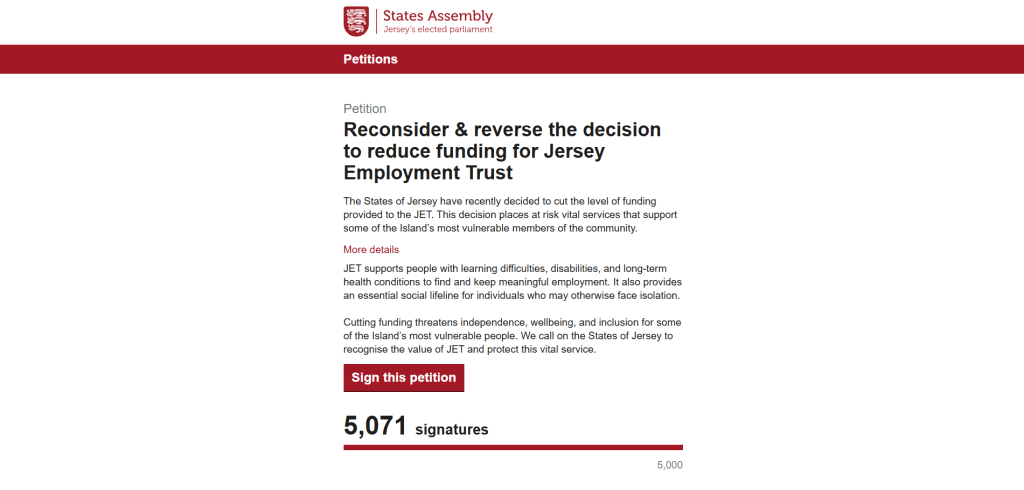
Passing the 5,000-signature threshold means that the topic will be considered for a debate in the States Assembly.
JET is yet to acknowledge the petition.
IN FULL…
Read Deputy Lyndsay Feltham’s full statement below…
Just to be clear from the outset, I have not cut base funding to JET, nor would I ever consider doing so, as it would go against everything I believe in and would be in contradiction with the strong disability inclusion agenda that I have pursued as Minister for Social Security.
JET supports an average caseload of 336 people. They are operating on an old and out-of-date funding arrangement which, given the difficulties JET have raised, clearly needs to be updated so they can continue to provide their services on a sustainable footing for the future, as well as play their part in an overall coordinated approach to ensure all Islanders with disabilities are supported.
Last year, I was able to offer a one-off top-up grant to JET of £785,000 (on top of their £1.9m baseline funding), due to the underspends we had achieved in the departmental budget which we were able to be reallocated. I made it clear to JET that it was just fortuitous that I was able to offer this, and that we could not guarantee it on further occasions, because underspends will always vary. In providing that funding my aim was to use 2025 to work collaboratively with JET to produce a new contract for 2026 that provided appropriate baseline funding and ensured that service provision is coordinated across JET, Social Security, CYPES and Health.
A key part of this work would involve a data-sharing agreement so we could understand the scale of support provided by JET to its clients, and what other support each of them was receiving, which would ensure we could provide the best coordinated approach across all appropriate agencies. This would have put us in the best position to develop a business case which, if necessary, I could submit to Treasury for extra funding for an enhanced baseline funding budget for them (with future-proofing safeguards included).
Unfortunately, despite ongoing dialogue, this work was not completed during the year, in large part because the JET Board did not come to an agreement with us to share data. This year, I do not have the flexibility with underspends that I was able to enjoy last year. Nonetheless, my Chief Officer has worked extremely hard to find anything we could offer, and we have been able to provide a top-up grant of £200,000, plus an RPI uplift on their baseline funding. This funding was paid in December.
Within this year’s Budget I also secured more funding for disability and inclusion initiatives and my intention was to use that money to make meaningful progress on the delivery of priority areas agreed by the Disability and Inclusion Advisory Group. Whilst it had not been the intention to use this money for an additional top-up for JET, I am also conscious that the Group has cited the need for data sharing between Government and partner agencies as one of the best ways to ensure that people have access to services in the most efficient way. Therefore, I intend to use this money to provide stabilisation funding for JET in 2026 to enable us to continue to work in a collaborative manner to develop a business case for a sustainable future funding model.
My team and I (along with our colleagues in CYPES and Health and Care Jersey) are eager to work with JET to produce a business case which we can submit to Treasury to put all JET funding on a permanently sustainable footing, so we can all focus on what matters here which is ensuring all Islanders with disabilities have the support they need to help them reach their potential.
