


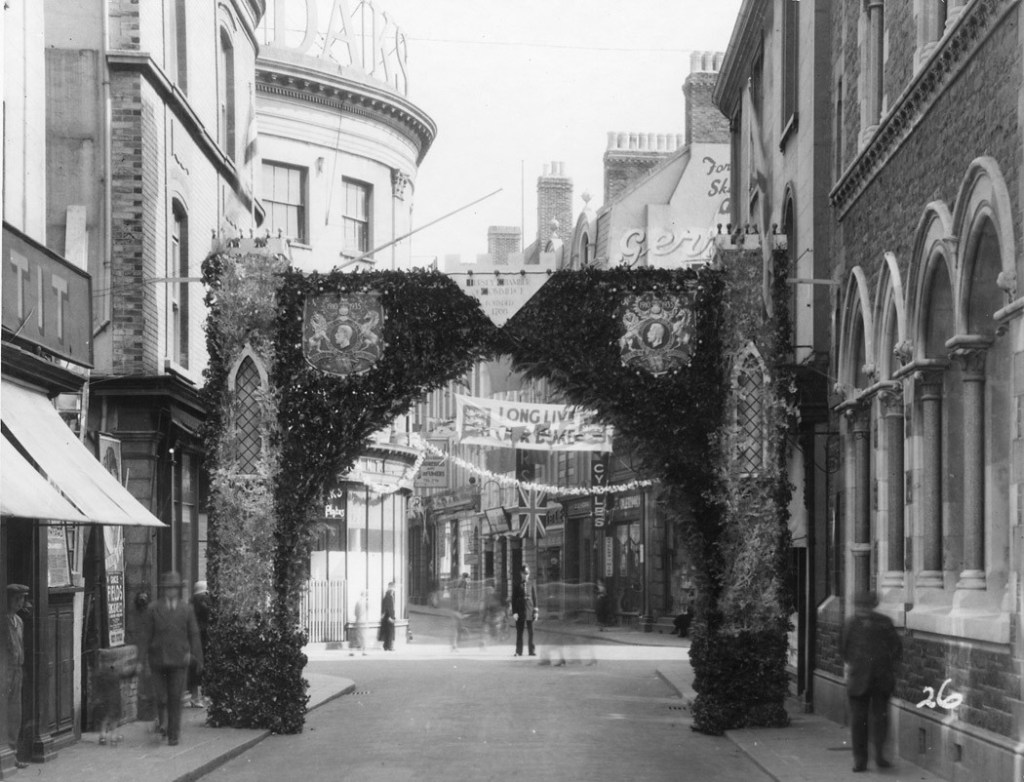
Premature celebrations are never a good thing as four St Helier workmen found out when they got themselves in trouble during preparations in the island for the Silver Jubilee of King George V.
The men had been tasked by the Parish to go to a farm and cut greenery to decorate Jubilee arches that were being erected for the celebrations on 6 May 1935.
Clearly unable to contain their excitement about the upcoming festivities, Raymond Le Gros, Winter Matson, Cyril Le Masurier and William Thomas Breen instead decided to spend their time toasting the King’s 25 years on the throne.

It was on 30 April, a week before the Jubilee, that they were driven to the farm of Jean Baptiste Larose at La Ferme, Rozel and left there to undertake their work.
By the end of the day, they had been arrested for breaking into the farm’s cider press and stealing Larose’s cider, damaging potatoes and refusing to work and therefore causing a breach of the peace.
They appeared in the Police Court – now known as the Magistrate’s Court – to answer for their crimes on 2 May.
The Silver Jubilee was a big event in the island’s calendar 90 years ago and in introducing the case, the Magistrate said: “They drank Larose’s cider, did they? If they had waited until the 6th, they might have been given some.”
Giving evidence, Centenier Journeaux told the Court that the men had been left at the farm to cut ivy decorations for St Helier, but that when no one was about, they entered the cider press. They were spotted by Mr Larose’s sister, who called her brother. He turned away the men.

Mr P N Richardson, a member of St Helier’s Decoration Committee, confirmed that the men had been sent to cut greenery at Larose’s farm. They were taken there on a lorry and told to be careful not to tread on any potatoes. They were later picked up in a car by Richardson’s son.
The Parish’s foreman, Mr Behoe, told the Court that he had chosen these men for the job and that “he would have sent these men on any job. They were as good as they had on the Parish”.
Also appearing as a witness in Court, Miss Larose complained that not only had the men stolen cider and damaged her brother’s potatoes when dragging the greenery over them, but “the amount of work they had done any decent man could do by himself”.
The Laroses also testified that no-one had given permission for the men to have any cider.
But Le Gros and his fellow accused denied this. They said that when moving the greenery, some of the branches were so wide that they couldn’t prevent them from dragging on and damaging some of the potatoes.
He also claimed that Larose’s sister had invited them to have a cup of cider once they had finished their work. At the time, she was knocking shoots off potatoes, he said.

Miss Larose once again refuted this claim saying that she did not even speak to them and that it was a servant who was working with the potatoes. There was then some confusion as to whether the servant was in court and whether she had, in fact, given permission.
The Magistrate offered to hold over the case but the men’s counsel decided against it, saying: “If they are not believed now, they will not be believed in a week’s time.”
In summing up the case, the Magistrate left the Court in no doubt about his opinion.
He said: “You men were sent to do a certain job. You were taken there in a motor like gentlemen, yet according to the evidence you did not earn your wages but only got thirsty.
“Your conduct as regards the Parish which employs you is disgraceful. I remember in my younger days workmen used to walk from one end of the island to the other and then do a day’s work and walk back. Now you are treated like gentlemen. Your conduct is disgraceful.”
The men were fined 10 shillings each or told they would have to go to jail for 48 hours in lieu of payment. The fines were paid.
LEARN MORE…
This story has been told as part of a series in collaboration with Jersey Heritage.
To uncover more stories like this, visit Jersey Archive or search its online catalogue HERE.
