

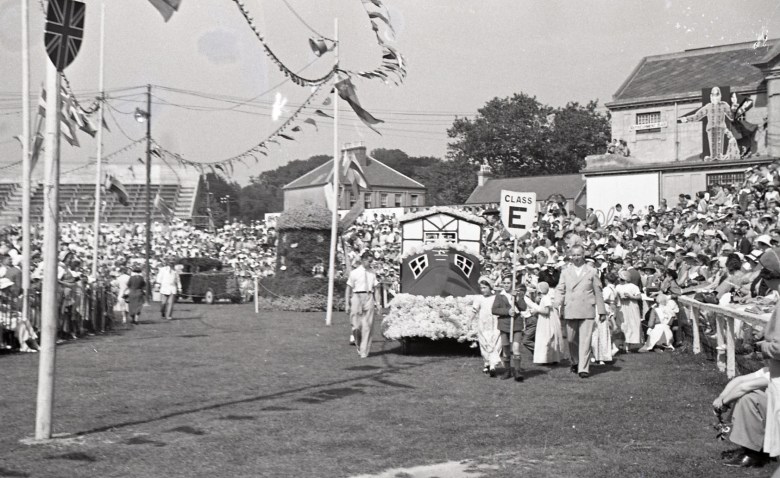
Would you take a seat on a new spectators’ stand if there was a chance the concrete had not set properly?
This was exactly what 200 Islanders were asked to do 90 years ago when the States of Jersey needed to test out a new stand at Springfield ahead of several big public events.
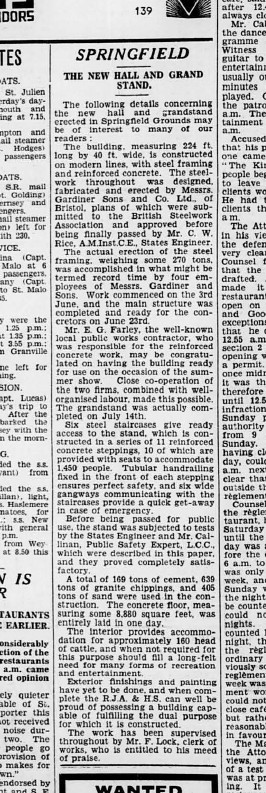
The rather unusual test followed the completion of the reinforced concrete stand in 1936 by Messrs Farley, with steelwork undertaken by Messrs Gardiner Sons and Company Limited of Bristol.
It was declared by the Evening Post as “certainly the finest structure of its kind in Jersey. The top deck can seat nearly 1,500 people and underneath is a large hall”.
The stand was completed on 14 July and it was thought that its first test would be for the Battle of Flowers, which was taking place a couple of weeks later on 30 July 1936. However, the authorities examined the structure and decided the concrete had not had sufficient time to set and would not be safe for a large number of spectators.
The next question was whether it could be used for the Royal Jersey Agricultural and Horticultural Society’s (RJAHS) Summer Show, which was due to take place on 19 and 20 August. The States Engineer’s Office carried out a test to see if it would withstand a crowd.
How was this achieved? About 200 men from the Parish of St Helier and Messrs Farley’s company were asked to come to Springfield. A newspaper report at the time mentions that some of Farley’s employees arrived via lorries and “they were greeted with ironical cheers from those who had already taken up their position on the stand”.
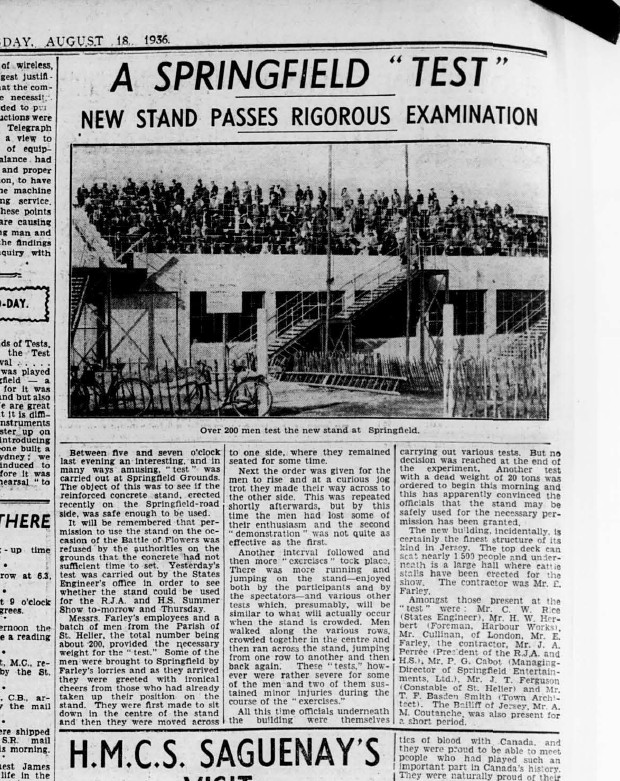
As they gathered, the small crowd were put through their paces to test the structural integrity of the stand. They were initially asked to sit down in the centre of the stand and they were then moved across to one side, where they sat for a while. They were then instructed to jog to the other side. The newspaper reported: “This was repeated shortly afterwards, but by this time the men had lost some of their enthusiasm and the second “demonstration” was not quite as effective as the first.”
The group were asked to jump up and down and run in an attempt to stimulate what may happen if a crowd was watching an event. There was obviously a little too much enthusiasm for this part of the test as two men “sustained minor injuries during the course of the “exercises””.
Among those present to watch the spectacle was the States Engineer C W Rice, the Constable of St Helier J T Ferguson, and, for a short time, the Bailiff, Alexander Coutanche.
Meanwhile, officials were underneath the building to watch for any issues and carry out various tests. More checks were ordered for the following day, using a dead weight of 20 tons and it was eventually deemed as safe by the inspectors.
The Evening Post dubbed it “an interesting, and in many ways amusing” test, but not everyone was as entertained. A letter written to the newspaper the following day by an anonymous correspondent calling themselves ‘Progress’, said the report and photograph were “more reminiscent of a Heath Robinson cartoon than an actual photograph of a test being conducted under the supervision of a competent (?) engineer”.
They went on to say that the humour could have turned into tragedy if something had happened and that “any borough surveyor in England would have satisfied himself from the plans and steelwork drawings that the stand would be satisfactory and have its proper margin of safety before authorising its erection”.
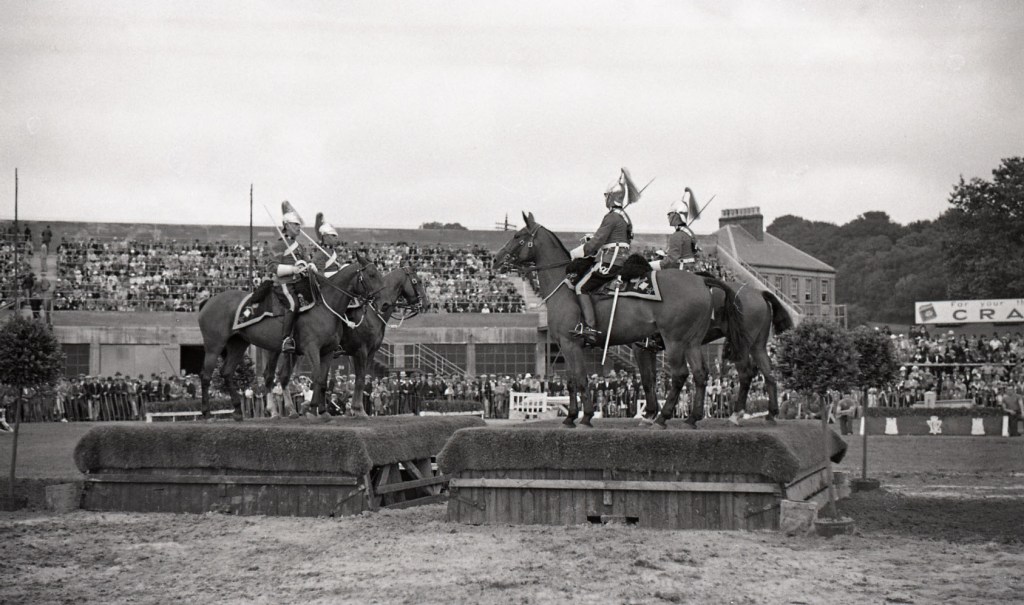
As it was, the RJAHS Summer Show went ahead without a hitch. It featured a busy spectators’ stand of people who watched the judging of livestock and flowers as well as displays of horse riding by the 5th Royal Iniskilling Dragoon Guards and traditional Normandy dances by La Societe Normande of Cherbourg.
For more stories from the archives, take a look at the Jersey Heritage Online Catalogue at https://catalogue.jerseyheritage.org/
