

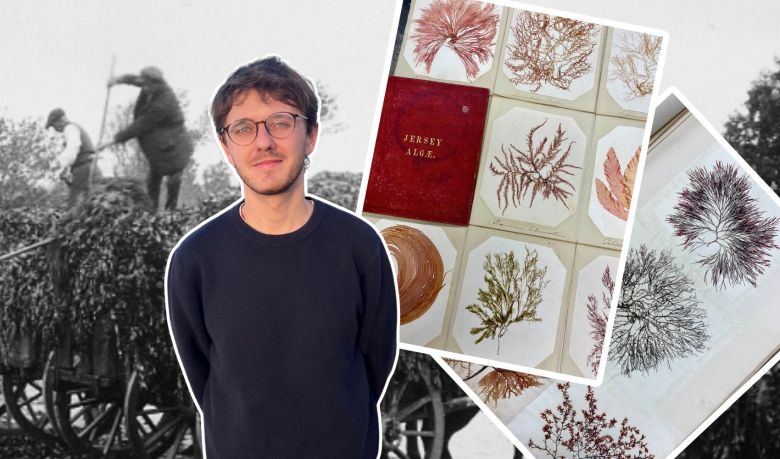
Seaweed washing up on Jersey’s beaches might look ordinary, but for generations of Islanders it has inspired a surprisingly rich vocabulary.
Over the years, each different type has been named in Jèrriais based on its different characteristics or uses.
It’s something that fascinates Ethyn Maki, who has researched the more than 50 Jèrriais names for seaweed and aquatic plants.
As an ethnobotanist – someone that studies how people interact with plants – Mr Maki has produced an interactive English-Jèrriais guidebook to try to encourage readers to connect with Jersey’s seaweeds and the language that has been used to describe them.
Speaking with Express, he explained that while he lives in England he has a “personal connection to Jersey” as his family lived on the island in the 1980s for about a decade.
Because of this, he said they would visit during the summertime, and throughout his life he would be told stories about Jersey, and that “the seaweed was something they’d always talk about”.
He said: “One day it sort of came to me; with my background – why have I not looked into seaweed yet? And that was it, and about three years ago I started this project.”
While he encourages people to read either the physical guide which can be bought from the Société Jersiaise Bookshop in town or the digital version that will be available online from 28 May, he shared a sneak peak into the fascinating history behind it…
The intriguing backstory to the most common name for seaweed
The Norman language Jèrriais which has a “very long history” has “a lot of peculiarities and characteristics that you don’t find in other dialects or languages” because it developed on an “isolated” island, he said.
Because it was “cut off from the mainland France”, he said, “it has features that aren’t found in maybe standard French or the standard language that they speak in the mainland Normandy”.
He added that the general word for seaweed in Jèrriais – vrai or vré – originates from a legal concept regarding who was entitled to what washed ashore, whereby the Seigneur was entitled to things that washed up on the shore such as valuable items from ship wreckages, like casks of wine.
Eventually, he explained, it was used to refer to seaweed, becoming one of the most popular names for it in Jèrriais.
The names developed through sensory interactions with seaweed
Many names have arisen “through people interacting with seaweed every day” so “a lot of them relate to sensory interactions with them”, from the sound they make when slapped on the ground to when their bubbles are popped, he said.
For example, he said that one name comes from “a common feature that you find on a lot of seaweeds” known as “air bladders” which are “rounded, pockets on the tips of seaweed” that give them buoyancy to stay afloat.
This was a “very noticable feature” for past Jèrriais speakers, so they have developed a lot of names that refer to these air bladders, such as bédaine which is the name for bladderwrack seaweed.
They can be quite “humorous”
“When you look at the history of that word and what it means, it actually comes from another word that means fat, sort of protruding punchy stomach. This is sort of a humorous comparison”, he said.
There are also these air bladders which were called chérise dé mé, also known as “cherries of the sea” because people looked at them and went “oh, it’s round, it looks like a cherry, let’s call it cherries of the sea”.
Meanwhile, the thin, translucent seaweed called sea lettuce that grows a lot in St Aubin’s Bay got its name – cliaque – because of the sound it makes when you pick it up and throw it onto the ground, he added.
Similarly, he said another, cracot, got named from a sound, after people discovered it makes a “cracking sound” when its air bladders are popped between their fingers, or stomped on it with their feet.
“They really capture experiences with seaweed that I think anyone can relate to so even though these these names might change, you can still experience them today and they’re very easy to understand,” he said.
It brings together “environment, language and heritage”
Rebecca J Bailhache, chief executive of Société Jersiaise said: “It is particularly pleasing when a project brings together so many threads of what the Société exists to champion — our environment, our language, and our heritage.
“The Jersey Seaweed Field Guide is a wonderful example of how research can be transformed into something that invites everyone to engage more deeply with the Island around them.
“By reconnecting readers with both our shoreline and the Jèrriais words that describe it, this project strengthens the bond between people, place and culture in a truly meaningful way.”
In a final note, Mr Maki, who encourages people to explore outside while reading it, said: “Going for a walk on the beach after learning even just a few Jèrriais words for seaweed will change how you notice what’s beneath your feet.
“Suddenly, even the wrack line, where seaweed gathers after the tide has gone out, takes on new meaning and helps you understand how generations of people used seaweed and made sense of the place around them.”
The production of the guidebook has been funded by the Société Jersiaise’s Millennium Grant, which will support its development and printing.
