

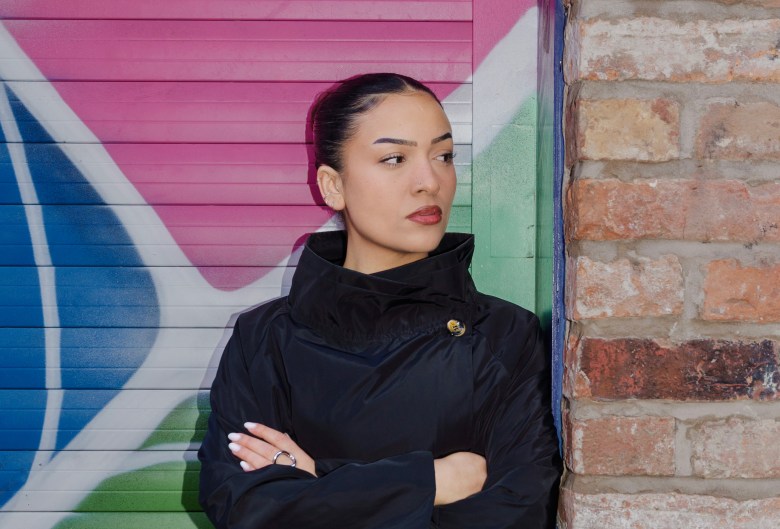
“Can’t sing like I used to” is the opening line of Jersey singer Nina Rosa’s debut single, 16. After surgery on her vocal cords, the 26-year-old had to relearn how to speak before she could get back to singing.
Now based in Manchester, the former Beaulieu and Hautlieu pupil draws on that experience for a song about a familiar contradiction – spending your teenage years wishing you were older, then growing up and wishing you could go back.
With her second single out next week, Nina sat down with Express to talk about the three months she barely spoke, the ArtHouse Jersey funding that helped get her first EP off the ground, and how five years of songwriting captured the changes in her voice…
What is the story you’re telling with the song? Why is it called 16?
16 is a song about exploring the contradiction of wanting to be older when you’re young, only to later wish you could be younger again.
It delves into the pressures of wanting to look better, sound better and become a different version of yourself.
Drawing on memories that shaped my childhood, as well as my experience of finding my voice again after vocal surgery, the track reflects on how our formative years influence who we become and the thoughts that continue to stay with us.
I felt that 16, as an age, was so key to our development as teenagers. A lot of the wordplay surrounding my younger memories came from experiences I had at that age, hence the creation of the song and its title.
What other artists and genres have inspired you?
I’m heavily influenced by so many artists, but my top three would have to be Lianne La Havas, Cleo Sol and Jill Scott. I also love a lot of instrumental artists, who have heavily influenced the harmonies in my writing.
I grew up loving old soul and jazz. I was always so fascinated by the richness in their voices and how that helped tell the stories they were portraying through their lyrics. It felt more intentional and passionate. Frank by Amy Winehouse was a firm favourite.
On the other hand, I also loved exploring a multitude of genres, from indie rock and more Latin-inspired artists to traditional Portuguese music.
Could you explain what happened to your voice and how it impacted you?
In October 2021, I noticed that my voice had changed. Songs that I had previously found easy no longer felt effortless, and a lot of my higher register had disappeared.
I went to see an ENT specialist, who told me I had vocal nodules, and that was the beginning of a really tough couple of years for me.
I was told I needed to go on prolonged vocal rest and, for three months, I rarely spoke. Instead, I communicated through my phone or a whiteboard that I carried around with me.
Nothing seemed to help, and I felt really unhappy with my diagnosis. I always knew that it wasn’t correct. The way I was feeling and what I was experiencing felt nothing like what I’d been told and taught about nodules.
I decided to get a couple more opinions, and two years later, I was finally seen at the hospital by a couple of specialists who confirmed that it wasn’t, in fact, nodules. However, they couldn’t work out what it was.
I was told I would need surgery to get a closer look at the issue. This was described to me as a kind of ‘seek and find’ surgery.
I was given two options: surgery to investigate the issue, after which they would wake me up, explain what they’d found and decide on the next steps; or I could give them permission to do as they saw fit based on their findings.
I was told this could mean operating directly on my vocal cords, which came with its risks. As a singer, someone who relies on their voice, this could mean things would change.
However, by that point, even speaking felt effortful and painful. I gave them permission to do as they saw fit. I was prepared to move on from singing. It had been two years of hell, really, as singing was all I’d ever known. Eventually, the surgery was booked.
When I came round, I found out that the issue was with my oedema, which turns out to be a rare condition to develop, and I was told I was particularly unlucky to have developed it, especially as a singer.
It turned out that I had been struggling with silent acid reflux for many, many years, which had caused a lot of damage, burning and inflammation that was made worse by singing on top of it. I received steroid injections into each of my vocal cords to help with the swelling.
From there, I began working on managing my silent acid reflux and finding ways to reduce it in order to avoid this happening again further down the line. Then came the vocal rehabilitation and therapy.
I even had to relearn how to speak, as I had unintentionally been using my false vocal cords to compensate over the years of having the condition. It was finally time to break that habit.
What did you have to do to get back to singing?
Lots of vocal therapy! It was a long process, and I sounded super squeaky at first, but eventually things started to piece together again.
I was able to return to the Royal Northern after having to defer because of everything that was going on.
From there, my incredible vocal tutor, Soyeon, and I began the process of getting back to singing and tightening up my technique again. I wouldn’t have been able to do it without her.
The funding from ArtHouse Jersey was also critical in getting the ball rolling with my EP.
I was incredibly lucky to be awarded funding for the first three singles, something I will be forever grateful for.
Had I not received this funding, I’d still be saving up as we speak, and nothing would have progressed.
There was a five-year delay in putting the song out. What happened during that delay, and did it change the music?
Well, for starters, my vocal injury pretty much hindered everything. Then there was the issue of securing further funding. People don’t realise just how expensive it is to be an independent artist.
In order to finish the EP, I still had a further two songs to fund, and that’s not including all the extra fees you get hit with along the way. So I had to start saving up, and that takes time too.
As far as the music goes, this EP is about my journey, both vocally and emotionally. It will feature songs written before my diagnosis, during my recovery and after my surgery.
Through that, you can hear how my voice has changed. Some of the melodic lines I wrote years ago are ones I’d struggle to get through now, and as time goes on, you can hear my melodies accommodating the voice I have today.
These songs span over five years of writing, so even stylistically, you hear changes. You hear me trying to figure out what I like best and what I want my sound to be.
‘Can’t Sing Like I Used To’ is the opening lyric of 16, so, essentially, 16 is my title track, and it only felt right for it to be the introduction to my listeners.
It’s also the most recently written song, so it’s closer to the sound I have now, before we journey backwards to where it all began.
I wanted the first line people hear to sum up the overarching theme of this EP: change, and how that change is reflected in my music.
And finally, what are you working on next?
Hopefully a second EP! But I try not to get ahead of myself and instead just enjoy the release journey for this first project.
I’ve waited so long for it to form and come together, and I want to enjoy this process before diving immediately into something else.
I also don’t think I’m mentally ready to start the process of seeking funding again for a second EP, so for now, I’m just grateful for what I have and where I am.
I will say that I didn’t have a choice when it came to change and what happened to me vocally, but I wouldn’t change what happened to me in a million years.
I truly understand the meaning of the word ‘change’ now and how powerful it can be. I intend to keep changing with every new project I do.
I want to keep myself on my toes just as much as I do my listeners, so be prepared for more experimentation in future work.
I’m still figuring out my sound, as much as the next person, and that’s the most exciting thing about it all.
