


A Jersey ceramicist has described how learning from master potters around the world has shaped her practice – and why she believes hands-on creativity should play a bigger role in the island’s education system.
Heather Barrette has spent the past few years travelling from Tuscany to Copenhagen and South Korea to develop her skills, learning traditional techniques and working with internationally recognised potters.

Now back in Jersey, the 26-year-old teaches at Highlands College, creates her own functional and sculptural pieces, and is part of the island’s growing community of makers during one of the busiest times of the year.
She spoke to Express about her artistic journey, the role of hands-on craft in schools, and what the festive season looks like inside a pottery studio…
What first brought you into the world of ceramics?
I was just out of A-levels and a bit confused about what path to take. I had explored ideas of art, textiles, and fashion, and I loved them all, but I wasn’t super passionate about any of them. I did this painting for my mum’s friend to go with a Jane James commission they had. When Jane [a local ceramic artist] was installing the commission, she got in touch, and I had an interview that same week.
I ended up working for Jane and learning a lot from her – mainly glazing, then moving on to moulding and fettling. Jane and Mark now feel like a second family to me.
My boyfriend saw how excited I was getting about the glazes and signed me up for a course at the Philip Mourant Centre, which is now part of Highlands in Trinity. I was just obsessed with the wheel. The wheel is one of those things that you can’t be good at straight away, and it’s so rewarding every time after you finally get the hang of it.
What was your experience like at school?
I knew I was a creative, but I wasn’t quite sure where I fit into it all. I loved design, photography, textiles, and painting, but they weren’t my main path. In secondary school, art at Les Quennevais was mainly acrylics and watercolours. Then, when I got to Hautlieu School, I was so excited by the different options I could try.

However, unless you were at a private school, textiles wasn’t a course you could take, but you could incorporate it as part of your art. Up until I left school, I’d only done ceramics once – at primary school – making a tea house.
When I speak to my parents’ generation, pottery was part of the curriculum, but due to its high material costs, it’s been taken out of schools. I think it’s a shame pottery is taken out of schools, and I’d love for it to be something they offer even as an after-school activity.
What do you think young people in Jersey are still missing in terms of creative opportunities?
Nowadays, with ArtHouse Jersey supporting the island, the opportunities are so much greater. I think they’re such an amazing charity.
I’ve been part of their You, Me, and The Sea project throughout the summer. This project is offered to primary school children, giving them the chance to explore the woods and the beach to gain sensory experiences, which they then develop into art.
I’ve also participated in their MAPS (Making Art in Partnership with Schools) project a couple of times. In this programme, artists visit primarily primary schools and some secondary schools to teach art classes. Once the classes are completed, there’s a big exhibition where the students get to celebrate their work. This collaboration is incredible, and students work on sculptures, pottery, photography, illustration, and much more.
Currently, I’m at Trinity School making Ancient Greek pots with the students, and the work they’re producing is exceptional.
Where have you done your training?
I started at Jane James Ceramics and then moved on to the Philip Mourant Centre. This eventually led me to take a course in Vienna, which in turn opened the door to training in Copenhagen and an apprenticeship in London with internationally renowned reclaimed ceramicist Tortus.
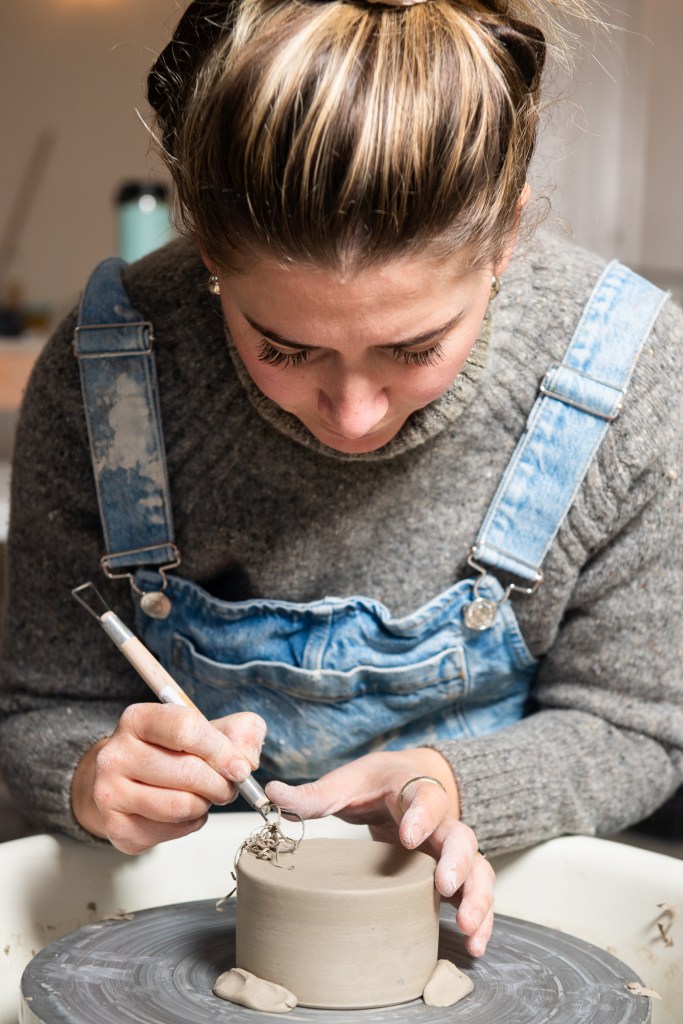
After the apprenticeship, I travelled to La Meridiana in Tuscany to work with wild clay – digging and processing my own clay in the Tuscan countryside, along with a woodfiring and wild glaze course.
I then completed a three-month intensive course in Barcelona with Corrie Bain Ceramics, where we had the opportunity to work with visiting artists like Juan Orti. I’ve also explored alternative firing techniques in Devon, such as saggar, raku, and pit firing. Additionally, I attended a Nerikomi workshop at Tokobo Studio in London.
My main adventure this year was spending a month in Icheon, a famous pottery town in South Korea, learning Onggi with Master Kwak Kyungtae. This experience was made possible thanks to some funding from ArtHouse Jersey.
My last adventure was a three-day course in Berlin with Austin Coudriet. He makes large-scale furniture and sculptures, and I learnt how to make internal supports to help support weight. It was so interesting and had lots of connections to the Onggi technique.
How would you describe your style today?
My main influences come from Scandinavian and Korean pottery and design. This is why I travelled to these places to learn. I am passionate about embracing the colour of the clay and different textures.
In the past, I was often preoccupied with making my work perfect, but I realise this mindset originates from the Industrial Revolution, which emphasised mass production and uniformity.
Ultimately, I want my work to look handmade and authentic, not machine-made, because that’s what gives it its true charm.
How did you get into teaching?
When I was doing my apprenticeship in London, I was a teaching assistant for Eric Landon. Whenever a student would be excited about overcoming a challenge, and I thought, “Oh, I helped them get there,” it was really rewarding.
I love helping to break down barriers so people can achieve their creative goals. I also enjoy working at Highlands alongside my colleague Ray Ubsdell, who is an outstanding production potter. I learn a lot from him, as well as from my students!
Has working with clay helped you personally?
I think clay is a wonderful material because it’s so sensory. Interestingly, if I go into the studio in a bad mood, I never end up producing anything good. The clay can feel the energy, and it makes me check myself. It gives me a moment to pull myself together before carrying on. I believe it responds to your energy through your movement, which makes you more reflective and in your head – in a positive way.
Once, a student said to me, ‘Heather, the only two-and-a-half hours when I don’t check my phone or look at any screens is in your class’
heather barette
Once, a student said to me, ‘Heather, the only two-and-a-half hours when I don’t check my phone or look at any screens is in your class’. I think, in today’s world, we’re meant to be so accessible all the time. Allowing yourself time to get creative and disconnect from screens is incredible, and it helps you be present in the moment.
Additionally, the beautiful thing about my workshops is that they nurture a sense of community.
Tell us about the Christmas Makers Market – what are you showcasing?
The Makers Market was actually curated during one of my pottery classes at the Philip Mourant Centre. Hollie Startup, an illustrator from London, and Beth Picken from Sip + Paint had both recently moved to the Island and came to my class to meet people and get creative. We then started the Maker Markets at The Yard in St Helier. We then started the Maker Markets at The Yard in St Helier with owners Liam Montgomery and Selda Kumcur, who were so supportive.
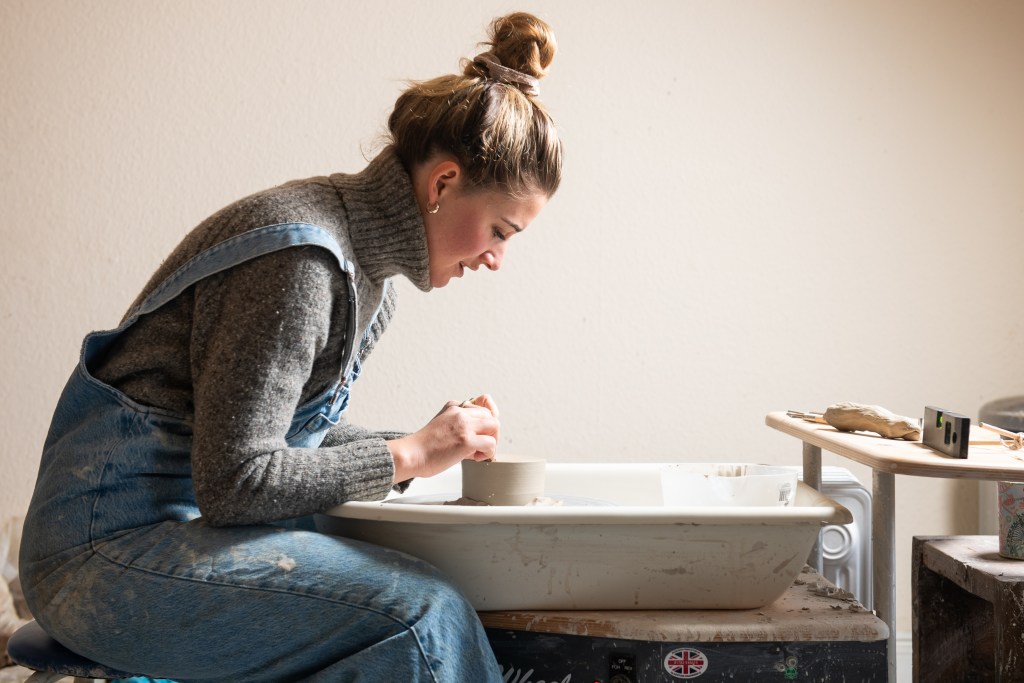
We wanted it to feel like a place where you could pop in, have some coffee, and browse. It resembled a European courtyard, and we aimed to keep the prices accessible for younger creatives or those just exploring a business idea. To be fully honest, we couldn’t have even imagined the outcome. We have been so supported by the community and watched makers thrive. We even decided to host a Christmas market too.
Loose n’ Lazy, the clothing brand, got in touch about sharing a space, and we’re so excited to be there. I’ll be at the pop-up shop from 10–21 December, with platters, bowls, cups, and candlesticks – lots of little pieces that would make great stocking fillers.
What does the festive season look like inside a pottery studio?
This season, it has been very busy preparing for the pop-up shop after my trip, as I haven’t had much time. So lots of coffees and late nights in the studio.
What’s next for you?
Gigi Cooke, a local contemporary furniture and wood design maker, and I have been in talks about doing an exhibition together and collaborating on some pieces. I love Gigi’s style, and this is something I’m very excited to work on – to work on some bigger pieces!
And where do you hope your practice will take you over the next few years?
Constant growth as an artist/maker is very important to me. Along my travels, I’ve met some cool people who work in incredible studios around the world. I have some trips in my head that I’d like to do.
One of them is Driving Creek Pottery in New Zealand, and the other is a studio potter in Japan, and my friend owns Tao of Clay in San Diego. I’d like to do a residency at all of these places.
Until I get there, I want to keep developing the Onggi technique and ceramic furniture making. People will always push the university route, but I prefer learning from lots of different pottery/ceramic masters and getting the perks of seeing the world too!
