


More than 27,000 Islanders voted in Sunday’s election – the highest raw turnout for more than a decade… but beneath the figures lies an fascinating picture of where Jersey engaged with the election, and where it didn’t, and also how a major change to voter registration has rewritten the rules for measuring participation…
Express explores…
The turnout ‘contradiction’
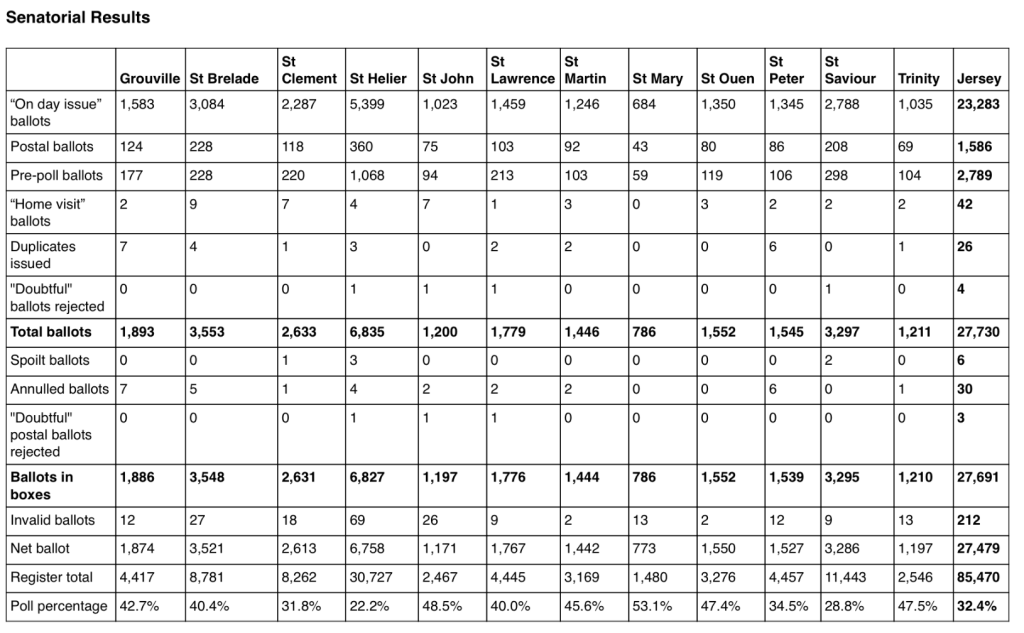
According to figures released this evening by Vote.je, 27,691 Islanders voted in Sunday’s election, up from 25,264 in 2022 – an increase of 2,427 voters, or 9%.
So why did turnout fall from 41.6% to 32.4%?
Had your daily Bailiwick Express-o?☕
Your free daily news email – freshly brewed every day with Jersey’s latest news, breaking stories and essential updates.
Sign up for freeThe answer lies in a major change introduced earlier this year: automatic voter registration.
This dramatically increased the size of the electoral register, with the number of registered voters jumping from 60,701 in 2022 to 85,470 in 2026 – a surge of more than 24,700 people, or 41%.

Because turnout is calculated by dividing the number of voters by the number of people on the electoral register, that expansion has had a significant impact on the percentage.
“Whilst this definition means turnout fell by 9.2 percentage points since the 2022 election, as the number of voters on the register increased by 41%, it is difficult to make a like for like comparison,” the election body said.
Where did turnout vary most?
As is usual, the country parishes’ turnout trumped the more urban ones.
Had your daily Bailiwick Express-o?☕
Your free daily news email – freshly brewed every day with Jersey’s latest news, breaking stories and essential updates.
Sign up for freeThe highest turnout was recorded in St Mary, where 53.1% of registered voters cast a ballot.
Other strong-performing parishes included:
- St John – 48.5%
- Trinity – 47.5%
- St Ouen – 47.4%
- St Martin – 45.6%
At the other end of the scale, St Helier recorded turnout of just 22.2% despite accounting for the largest number of votes cast.
That reflects the capital’s much larger electorate, with more than 30,700 people on the register.
How were people voting?
Traditional polling stations remained by far the most popular method.
Of the 27,691 ballots counted:
- 23,283 were cast in person on election day
- 2,789 were cast during pre-poll voting
- 1,586 were postal votes
- 42 were home-visit ballots for Islanders unable to attend a polling station
What do the figures tell us?
The figures paint a mixed picture.
On one hand, more Islanders took part in the democratic process than four years ago.
On the other, the expansion of the electoral register means fewer than one in three registered voters ultimately cast a ballot.
Results in full…


More analysis to follow next week…
