

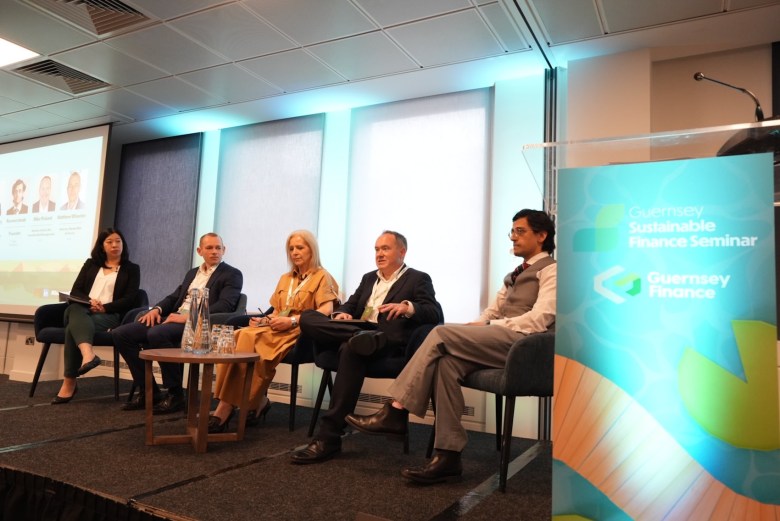
Industry leaders discussed shifting insurance from a reactive payout tool to a proactive resilience strategy at the recent ‘Sustainable Finance in Action’ seminar, hosted by Guernsey Finance.
Gus Majed, CEO of Paratus, opened the event in London by highlighting the systemic risks posed by geopolitical fragmentation. “Hesitation is paralysis,” he said, arguing that failing to adapt insurance mechanisms risks leaving critical exposures unaddressed.
“What we’re seeing is a genuine change and breakdown of the order that has been governing the energy markets. I would say, geopolitical fragmentation since the 1970s – the institutional architecture itself has begun to unwind in real time, and that’s starting to create systematic risk.”
Mr Majed believes insurance must enable growth rather than just providing backward-looking protection.
“Being able to price risk and create resilience is paramount, and to have insurance as less of a backward-looking protection, but rather, more than anything, enable for growth and development.”
Panellists explored using existing structures to address emerging threats.
Mike Pickard, Director at Aon, commented: “We’re connecting this to capital using existing techniques, using existing structures and solutions. We’re just applying to different risks and trying to find solutions to the problems.”
One approach involves captive insurance structures to incubate risks that are currently difficult to insure.
However, Matthew Wheeler, Director of Climate Risk Advisory, noted the difficulty of the “protection gap” in high-risk regions like Asia,
“Maybe there is an argument to be made for if we all pool the risk together, and those who need it most can still get it at an affordable price, and we all pay a little bit more as a society in order to help those setting up those mechanisms in a profitable way.”
Raveem Ismail, Founder of Trigger Parametric, added that risk capital remains conservative when domains are not static.
“The trouble is that risk capital sometimes suspects that the domain isn’t static,” he said, continuing, “and when that’s the case, we become very conservative… so we have to find creative ways which don’t become pure volatility, but also include some of the infrastructure that are available to solve these problems.”
Guernsey’s regulatory flexibility was cited as a key driver for innovation.
Caroline Bradley of the Guernsey Financial Services Commission explained their sandbox approach: “It might be limited in duration, it might be limited in scope, it might be limited in how much business you can write, for example, so that you can pilot something, knowing that… this is a way to give people comfort that actually things may go wrong in the sandbox. And that’s the whole point of it, to work those things out.”
Stephanie Glover, Director of Strategy and Sustainable Finance, concluded that a reactive approach to climate risk ensures the industry remains “one step behind the problem.”
Guernsey Finance will host its next funds-focused seminar in October.
