


Jersey’s business community has issued a stark warning to politicians ahead of the next election: the island is at a “pivotal moment” – and without coordinated, long-term reform, its economy and quality of life risk falling behind.
A joint manifesto published this week by the Chamber of Commerce and local branch of the Institute of Directors (IoD) ahead of the June election has set out a wide-ranging blueprint for the island’s future, spanning everything from housing and skills to tax reform, economic diversification and government leadership.
Its key message is that the island’s challenges “cannot be solved through isolated actions or siloed decision-making”, with the document instead calling for what it describes as a “system-wide blueprint” designed and driven forward by politicians and business leaders working together.
A “call to action”
The manifesto frames itself not as a traditional “list of aspirations” but as a “call to action” to build a “resilient, inclusive, and future-ready island”.
Central to that vision is a shift in how Jersey is governed.
The business groups argue that decisions must be “data-led”, go beyond political cycles, and move away from “individual political agendas” in favour of a shared ‘national direction’.
“Good governance must be at the heart of Jersey’s future… The challenges ahead require unity, not fragmentation,” IoD Jersey Chair Alex Ruddy said.
Talent: the “new currency” Jersey is struggling to retain
One of the clearest pressure points identified by the groups is recruitment and retention of “talent”.
Touching on the island’s ageing population and ongoing ‘Bean Drain’, the manifesto warns that Jersey’s “working age population is shrinking” and that “too many of our brightest minds leave and too few return”.
Skills shortages are already evident across various sectors, including construction, digital, hospitality, health and finance, the group says. Meanwhile immigration and housing constraints are limiting the island’s ability to attract workers from outside, they argue.

“Without reform, productivity will continue to stagnate, public finances will tighten, and social inequality will deepen,” the report states.
To address this, the manifesto calls for a joined-up approach linking immigration, housing and education – including fast-tracking visas for key sectors, expanding STEM education, and delivering more affordable housing for key workers.
Among their ideas is to “expand access to lifelong learning and digital upskilling ensuring islanders are equipped for the industries shaping our future”, focusing on “return-to-work” initiatives, and creating a “retiree mentorship network”.
The overall ambition, according to the manifesto, is that by the time of the next election in 2030, “Jersey will be recognised as an island where talent grows and stays”.
A visitor economy facing a “crisis of imagination”
The manifesto also highlights concerns about Jersey’s tourism and visitor economy, which it says has “faltered”.
Visitor numbers fell by 13% in the first half of 2025, with industry leaders pointing to infrastructure, cost and brand clarity as key barriers.
But the report argues the issue runs deeper, stating that it is “not a crisis of numbers; it is a crisis of imagination and vision”.
To reverse the trend, the group proposes repositioning Jersey as a “world class events and business destination” and launching a unified ‘Jersey Experience Economy’ brand to bring together tourism, culture, sport and enterprise.
Cost of living, childcare and inequality
Beyond economic performance, the manifesto repeatedly returns to quality of life, and the risk that rising costs are undermining it.
High housing costs, pressure on healthcare, and limited access to childcare are all identified as barriers to both wellbeing and economic participation.
In particular, the document highlights the impact on women and families, noting that childcare costs are “among the most cited reasons for workforce withdrawal or part-time working”.
It argues that improving access to childcare, increasing flexible provision, and boosting inclusion for underrepresented groups are not just social priorities, but economic ones.
“Equality, inclusion, and childcare access directly underpin participation in the workforce and long-term growth of the economy,” it states.
Making Jersey “a hive of entrepreneurship”
The business community also sets out an ambitious vision for entrepreneurship – but warns that current systems are holding the island back.
Starting a business can take weeks, opening a bank account is slow, and regulatory complexity discourages innovation, particularly in fast-moving sectors like tech.
The manifesto calls for sweeping changes, including a single online registration platform, faster licensing, and temporary permissions to allow businesses to start operating more quickly.
It also highlights the need for greater support for research and development, and for a shift in culture.
“Innovation is not the exception, but the norm,” is the stated ambition.
Tax reform and long-term revenue sustainability
On taxation, the manifesto acknowledges that Jersey’s existing system has helped maintain competitiveness – but argues that change is now unavoidable.
Global reforms, including OECD rules, and domestic pressure for fairness mean the island must adapt.
Proposals include maintaining tax neutrality for key sectors, expanding the corporate tax base in targeted areas, and introducing more progressive personal taxation.
The overarching goal is to “develop and implement a modernised, resilient revenue framework” that balances competitiveness with fairness and long-term stability.
Reducing reliance on finance
Another major theme is economic diversification.
Jersey’s reliance on financial services – which account for around 40% of overall economic output – is described as a key vulnerability, particularly in the face of global instability.
The manifesto calls for the development of multiple new “exportable pillars”, including digital and tech, tourism, agri-tech and clean energy.
“Concentration risk remains acute,” the manifesto warns.
Time to end the “infighting”
While policy is important, the document suggests that leadership and governance remain some of the most pressing issues for the island to resolve.
Hitting out at “political infighting” and individualistic, short-term thinking, and calling for a more unified, evidence-based approach to decision-making, the group argues that the next political term will be decisive.
“This is a moment that demands collective leadership, not individual positioning. It demands a Council of Ministers who operate not as independent actors with fragmented priorities, but as a unified team committed to ensuring the sustainability of Jersey. It needs a Council of Ministers who understand the intrinsic link between Economic and Social policy.
“It needs a Council of Ministers which recognises the need to increase revenue through economic growth and decrease public spending through targeted reform. The island needs a Council of Ministers who understands the need for data-driven policies, and which contemplates the unintended consequences.
“We cannot let ideology overrule economic sense. Agree to the expert advice provided by advisory panels including the Fiscal Policy Panel.
“The next Council of Ministers cannot afford the lost momentum of political infighting, leadership churn, or any other internal governing distraction. The island has already experienced the cost of stalled progress, and a reshuffled Council of Ministers. We cannot repeat that cycle.”
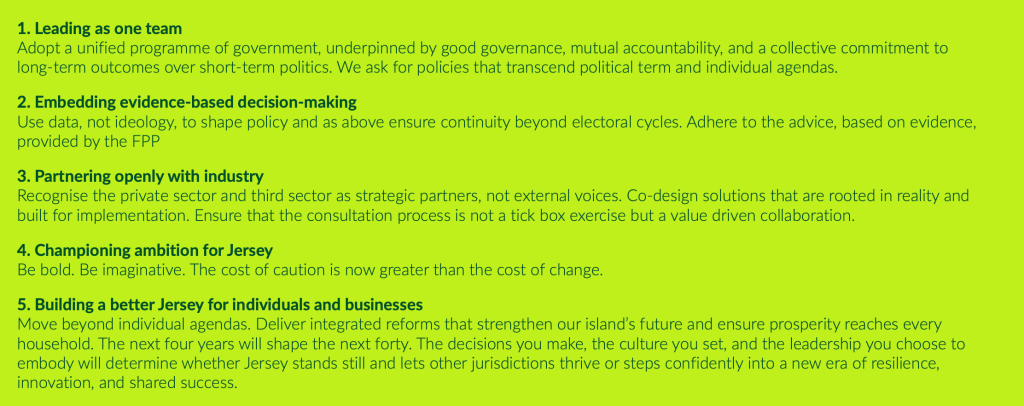
“The next four years will shape the next 40,” the manifesto states, urging leaders to “be bold” and to work in genuine partnership with industry.
The new “blueprint”
Concluding, the manifesto asks the island’s incoming leaders to commit to five key principles.
“…Talent, visitor experience, sustainability, entrepreneurship, revenue resilience, diversification, and regulatory reform, are not standalone ideas. They succeed only when delivered together, through an integrated, cross‑government approach anchored in shared goals and shared responsibility,” they explain.
“This is what makes this manifesto different: it presents a system‑wide blueprint that requires, and depends on, a system-wide response. And that response starts with you – the incoming political leaders of Jersey. We need you to work with the business community.”
“Businesses need clarity, stability and ambition from Government,” said Chamber of Commerce president Lee Madden. “…Now is the moment for bold, decisive leadership.”
Read the full manifesto here.
