

Nearly two decades after it was introduced on a trial basis, one of Alderney’s democratic instruments could be scrapped.
A plebiscite is currently held every two years to determine which two members of the States of Alderney serve in the States of Deliberation in Guernsey.
Amid a wider conversation about changing democratic policies in Alderney – including reducing the number of States Members by a fifth and electing them all at the same time rather than half of them every two years – the plebiscite itself is now under the spotlight.
The Policy & Finance Committee – Alderney’s most senior States committee – is asking the public if they want to keep the election or not.
It’s been held every two years since 2006, and although it was intended to be reviewed just one year after being launched, in 2007, no formal review ever took place.
That means the plebiscite has been run informally under a trial policy for nearly two decades and is not established in law.
The States of Guernsey (Representation of Alderney) Law, 1978, actually states that Alderney’s Guernsey’s representatives should be selected from among the States of Alderney Members between themselves. That is how it used to be done before the trial plebiscite was introduced in 2006.
Since then, with the Alderney representatives serving two years in the States of Deliberation, the plebiscite has now been run a total of 10 times, with some Alderney representatives serving their island in Guernsey more than once.
With the trial election having been run for two decades, P&F is asking the public if it should end, or if it should stay “on a permanent legal footing”.
“After reviewing the previous work undertaken on this issue and considering feedback on earlier Good Governance proposals, it is clear that there are strong and legitimate arguments on both sides regarding the best way forward for the Plebiscite,” said Jeannie Cameron, Chair of the Policy & Finance Committee and Political Lead for Government Reform.
“In favour of continuing the Plebiscite there is the emphasis on the benefits of direct democracy, enhanced public accountability, and the mandate provided to elected representatives. However, there could be concern for persistently low voter turnout for the separate election, duplication of responsibilities, the plebiscite’s informal legal standing, and the financial implications of maintaining a non-statutory- process every two years. Conversely, returning to the legal process would mean the Guernsey representatives are chosen by and from among the elected members, with accountability to the States of Alderney.
“Given these factors—and alongside the ongoing government reform workstream—the States considers meaningful public engagement on the future of the plebiscite essential before bringing forward any proposals for change.”
What is Alderney’s Plebiscite?
A ‘plebiscite’ is not a uniquely Ridunian event.
It is “a vote by the people of an entire country or district to decide on some issue, such as choice of a ruler or government, option for independence or annexation by another power, or a question of national policy”.
Since 2006, it has been used in Alderney, every other year, to select two States Members to serve in the States of Deliberation in Guernsey.
The current incumbents are Alex Snowdon and Edward Hill. Mr Hill is in his first term of office in both Alderney and Guernsey while Mr Snowdon has been in the States of Alderney since 2016 and has been one of the Alderney representatives in Guernsey since 2020 meaning he is currently in his third term in the States of Deliberation.
Previous Alderney representatives have included William Walden, Richard Wilmott, Boyd Kelly, Paul Arditti, Louis Jean, Neil Harvey, Graham McKinley, and Steve Roberts.

Through their individual success at the 10 plebiscites that have been held since 2006, they have each spoken for Alderney on important matters debated in Guernsey, including taxation, regional services, infrastructure, and inter-island policy.
One of the most pressing matters for Alderney remains the condition of its airport runway and buildings, with schooling, healthcare, and taxation also high on the priority list.
The Alderney representatives can also elected to roles within the States of Deliberation with Mr Hill sitting as a member of the Transport Licensing Authority and Mr Snowdon currently serving on the committees for Environment and Infrastructure and Home Affairs.
Public survey
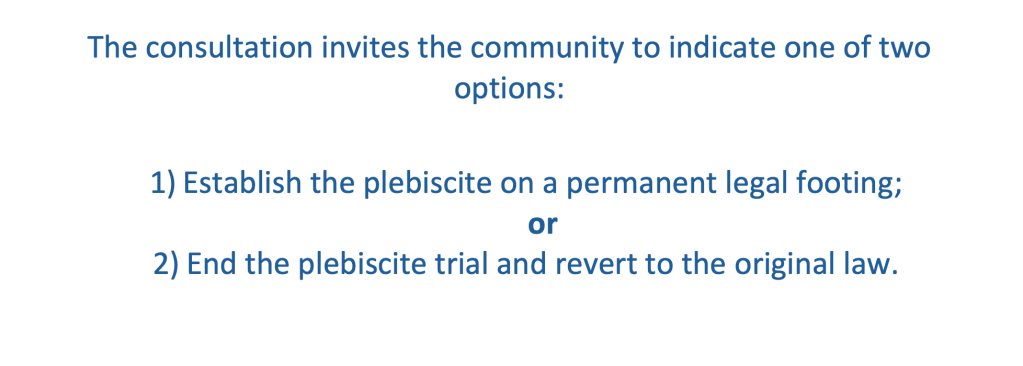
Alderney’s community are being asked to choose between two options: Establish the plebiscite on a permanent legal footing or end the plebiscite trial and revert to the original law.
