

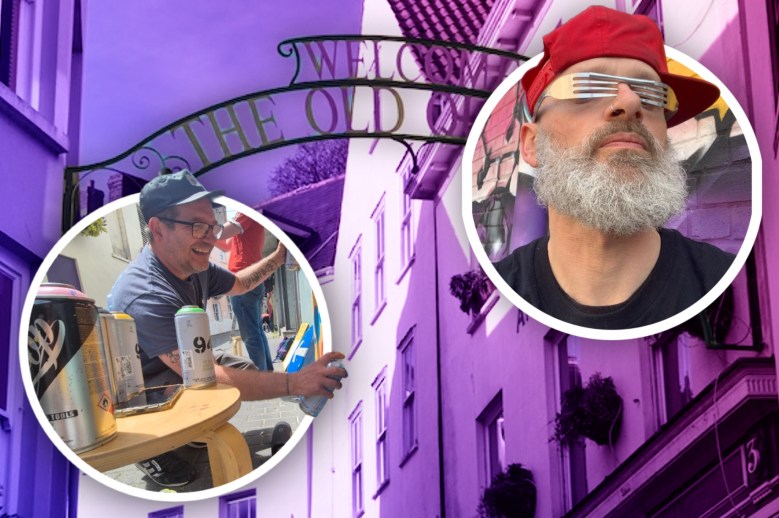
UK Artists Charlie McFarley and Teddy Baden agree that Guernsey should establish somewhere for artists to learn the craft of street art and murals.
The duo have been involved with the Guernsey art scene for some time, with the former being instrumental in Art for Guernsey’s debut exhibition, and the latter being responsible for the Liberation 80 mural on the Vivier Bunker.
They both shared their views in the Express podcast ‘A Place to Paint’.


Charlie McFarley
Growing up in Islington in London, street art and graffiti surrounded Charlie from a young age, he’d seen older children messing around with spray cans, and quickly adopted it as his medium of choice.
“There were a couple of kids in my school who were active graffiti writers, even at the age of 12! Their big brothers would come and pick them up from school, and they would go out tagging on buses and trains and stuff like that.
“One of the kids, I used to buy sketches of him, and then copy his letters and his characters. I used to buy them in school for like, five pence or something.”
Admiration turned into dedication, and soon he was on his own artistic journey, one that’s tought him a lot, and given a lot back,
“I have got a lot out of Street Art and Graffiti. It’s been ingrained in me since I first started walking around the inner city. It was everywhere in the 80s, and I came in contact with it a lot.
“First of all, I didn’t really know what it was, and it took me a while to understand the dynamic of it and how it works between different artists and different graffiti writers. What I’ve learned from it is that if you practice something long enough, you start to be able to do the things that you want to do.
“I’m still not completely happy with my artwork. Every time I finish a piece of art, I always look at it and think, ‘What can be better?’, but I’ve learned that if you practice and you hone your skills, you can achieve the things you want to go for.”
Since plying his trade in Guernsey, Charlie has pushed his creativity further, and found a joy in the responsibility of educating the next generation,
“I feel kind of privileged that I’ve been able to take my artwork over there (Guernsey), and show people how we do it in the UK, and sort of drop that in the middle of the Channel Islands.
“I’ve been really sort of lucky to be able to work with schools in Guernsey and give them some of my skills, and start their journey with learning about street art and learning about contemporary urban culture.”
He also noted the desire of artists to paint publicly, and in using the medium to raise questions.
“With street art being an outside of the gallery art form, and generally, it’s done without permission. It’s done off the artist’s back. There’s no immediate gain for the artist, apart from putting their artwork in the public space.
“When you see a street you walk through regularly, and then suddenly there’s a piece of artwork, no matter how big or small it is – sometimes the smaller artworks are more noticeable because it leaves you questioning who did it, and why did they do it – it has a positive effect generally on people, because it creates a question, which is always good.”
He was asked if Guernsey should further adopt street art, and establish a place to paint locally.

“I think it’s very important for artists of all abilities to be able to express themselves in the public, because with street art and graffiti it’s kind of all about your interaction with the public.
“There’s no point sitting at home on your kitchen table doing beautiful artwork if no one’s going to see it, and that’s the same with graffiti and street art. It’s all about trying to engage with the public.
“Using a spray can, which is the sort of common medium to use, is quite a skilled art in itself, and it’s not something you can just pick up. You need to be able to practice on walls, and you need to be able to make mistakes, and you need to be able to keep doing it. So having an open space which is legal, I think, will encourage artists of all ages to to get involved.
“I think it’s very important for Islanders, as much as any other place, to have that opportunity. Street art, graffiti, it’s not going anywhere. It’s only getting more and more focussed in life. It’s a big movement, so I think it needs to be embraced.”
Teddy Baden
As an artist, Teddy’s work will be known locally. He worked on the Vivier Bunker piece for the 80th Liberation Day Celebrations, and was a major player in the work to rejuvenate The Old Quarter.
Between himself, Leo Boyd, and Charlie MCFarley, the trio of visiting artists helped curate the Diversion exhibition earlier this summer, providing an expert eye over the injections of vibrancy and splashes of colour.
A student of Arts who studied in Bristol before plying his trade in London, he’s an experienced head, who knows what it takes to make it in the art world.
“I feel very lucky to have such a relationship with Art for Guernsey, it’s opened up doorways for me in the way that I’m treated as an artist. They actually value you as an artist, and create opportunities for me to come there, or for students to come to me.
“It’s just been a really beautiful, open, mutual respect. Whereas perhaps in London, you’re a bit more ten-a-penny as an artist, and you go in with a price to do something, some other artists will knock you out the park, or come in cheaper, you know, or it’s a lot more hustle, whereas Guernsey is a lot more mature and contemplative and respectful.”
Teddy found his footing in the art world whilst rallying against elites in the London Art Scene, and claimed his space in the street art movement.
It was a difficult time, but one that Teddy says allowed him to grow,
“I think in a sense, that really good things come out of hardship and having a bit of angst and something to say for yourself. You might split up with a girlfriend or partner and all of a sudden you have these emotions where you’ve just got a plow into something, you know.
“If you’ve always had a silver spoon you might just waft about a bit, whereas, if you’ve had a life with turmoil and challenges, you have a wealth to bring to your practice. You’ve got more to say than other people. You have more experiences, you’re more worldly, and you’ve had to cope and deal with many different things.
“The whole DIY culture as well is fantastic, you make do with what you have. Don’t have every tool at your disposal. You have a stick and a puddle and some pigment, and you see what you can do with it. Making do with what you have. Good creative things come from those places.”
He’s experienced street art at its most raw, when it’s illegal, unplanned, and exposed to all, but he now says it’s time to away from the criminal aspect of street art,
“There’s something very vulnerable about being out there in the elements, in the public or at night. Cars go by, drunkards are about. The wind will blow and mess up what you’re doing, and you’re stood by a bush. So many factors that aren’t always in your control. You are at the mercy of so many things. You’re out of your comfort zone of the studio and behind closed doors, it starts to rain and your paint starts to run.
“That’s very much how I saw it back then, although I think things are a bit more organised and planned nowadays, the whole outdoor art, public art, street scene is a lot more accepted.
“You can get away with not being demonised. Having somewhere safe to paint and legal? You shouldn’t be criminalized for being creative, and I think that was what was happening back then, which was cool, because it had the energy and the ethos and all that, but it’s about time you had a good space for for people to feel comfortable and do the work to the best of their ability.”
He too agrees Guernsey should have a legal space to paint, a place for artists to practice their craft, and join in on the movement.
“I 100% think Guernsey should have a legal place to paint. I’m sure there’s a lot of choices of where that could be.
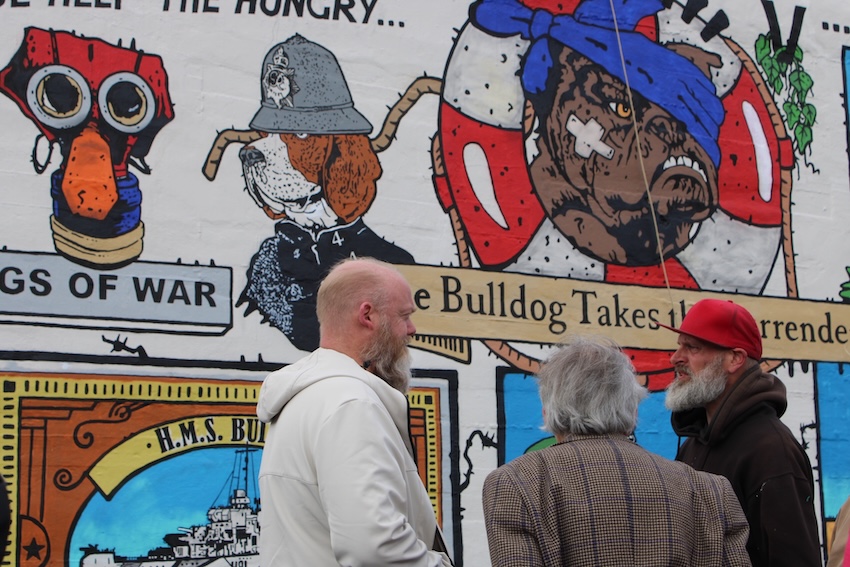
“It would help to rejuvenate as well, and dare I say, and draw attention to wherever that is. It would be another place on the tourist map, and for people on the island to come past and say, ‘Oh, that wasn’t there last time I was here. That’s a banging piece’. You know, ‘I like the way they’ve done that next to that’, or ‘last time it was this, and now next to it’s come this’.
“There’s a whole language that goes on whereby people will feed off other people.
“I do 100% think Guernsey should have a legal art wall. I think it’s good for the youth coming through as well, somewhere to sort of target their creativity towards. Most places have these facilities now.”
Guernsey
Both Artists had kind words to say about the island which has welcomed them and their art.
“Thank you for looking after us when we were there,” said Charlie. The project was such a success because we were doing it in the midst of peoples walk to work, walk home from work, and everybody interacted positively.
“I don’t think anyone had anything bad to say about the artwork, and we managed to liven up a dowdy end of the street.”
Teddy added: “I’d really like to say, thank you for having me. I love coming over there. Every time I come out, I work really, really hard, you know, I think we all do.
“It’s up in the morning to the wall, going against the elements, get things done and then finish, eat, go to bed, get up the next day. It’s lovely. It’s a livener for me. I feel very lucky to be invited out there.
“I’ve made so many good friends out there, and people are very gracious and very helpful. People bring me sandwiches when I’m out painting, or people will stop by and say hi, or they’ll grab me a beer from the shop or something, or I’ll have a great chat about the history of the island, and i’ll find out something new.
“I go down to the coast, I use the outdoor bathing pool and the sauna, I’ve bombed around the island on a little scooter, you name it. I’ve been all around, it’s a beautiful place, so I feel lucky.”
At Express, we are currently exploring the idea of street art, murals, and what the future could look like for Guernsey.
Last year, our reporter Luke Webb published an opinion piece seeking a greater adoption of the art form, and called for a space to be established which allows Guernsey’s Artists to practice, learn and develop.
Throughout this week we’ll be hearing from Art for Guernsey, local Artist Tim Gaudion, and the Guernsey Arts Commission.
Tomorrow we’ll focus on the Art for Guernsey side of things, hearing from Founder, David Ummels, and General Manager, Caitlin Grupping.
