


Guernsey’s tax debate has become dangerously one-sided, with political spin doctors and politicians “so consumed by their own spin that they misrepresent the truth”, according to the President of Scrutiny Management.
Deputy Andy Sloan has launched a scathing attack on Policy and Resources’ (P&R) tax reform package, saying P&R and top civil servants will do “anything to sell GST” – even creating new welfare payments to “buy people off” instead of tackling spending.
He told Express: “During Covid spending went up… but it hasn’t then come back down afterwards.”
He argued P&R was only looking at ways to raise money through tax, without looking at the other side of the equation – spending less.
Deputy Sloan said: “It’s asymmetric – it’s all about revenue; it’s not about spending control.”
‘They’ve forgotten what good looks like’
The PhD economist, who is a former civil servant himself, said the States had had lost the ability to manage its finances effectively.
He said the States had been “doing things poorly for so long, they don’t know what good looks like anymore”.
He argued the States had treated GST as “part of the solution” for nearly 20 years.
As a result, civil servants and politicians were now focused on justifying its introduction rather than questioning it.
“Ask the same people the same question and you get the same answer every time,” Deputy Sloan said.
He argued that the widely publicised £50 million “black hole” was not down to a failure in the island’s tax system, as P&R is arguing.
Guernsey ran surpluses of around £75m between 2018 and 2020 before pandemic spending surged, he said.
The problem since then had been failing to rein spending back in.
Deputy Sloan said P&R’s own forecasts showed there would “still be a shortfall as big as it is today” by 2030, under the proposals.
He stopped short of calling for a complete States’ hiring freeze, but said a pay freeze for public sector workers would be an “appropriate response”.
‘A bunch of mates’
Beyond the numbers, Deputy Sloan took aim at the current nature of Guernsey’s government, describing a system captured by self-interest and social ties rather than rigorous policy debate.
“What’s the tragedy of Guernsey politics is it’s not really political at all,” he said.

He claimed a core cohort of 20 to 25 deputies consistently vote together based on personal relationships rather than the merits of the proposals.
“It’s a bunch of mates that manage to get [their own way]… almost like a coup d’état – they’re in control.”
“Their personal income depends on P&R carrying on… they can’t get another job,” Deputy Sloan asserted.
Suppressing debate
Deputy Sloan argued the lack of rigorous oversight reflected a decade-long shift in the culture of the civil service itself.
Drawing on his experience as the States’ former Economist, he argued that the civil service has moved away from “robust” debate towards systematically suppressing internal challenges.
“There’s been a lack of thinking from the staff for over 10 years,” he said.
Without anyone in the room able and willing to question the numbers, he claimed policies have sailed through for over a decade without anyone on the inside pushing back.
‘An insult to our intelligence’
Deputy Sloan argued that the current strategy rested on a “duplicitous” decision to introduce GST at a lower rate of 3% simply to get the tax framework through the States Assembly, knowing it would have to go up to 5% later.
“Don’t pretend that there’s anything else other than that,” Deputy Sloan warned. “I mean, it’s an insult to our intelligence”.
He claimed the underlying economic modelling behind the package “is just not very good” and suffered from a total lack of technical depth.
“Lindsay clearly doesn’t understand statistics,” Deputy Sloan said, referring to P&R President Deputy Lindsay de Sausmarez.
“That sensitivity analysis of the underlying modelling hasn’t been done – it just doesn’t exist”.
Civil servants driving policy
Deputy Sloan argued that because many senior politicians’ lacked of understanding of economics and statistics, this created a vacuum allowing civil servants to dominate policymaking while politicians rubber-stamped the results.
Another Deputy told Express anonymously that many civil servants had taken to preparing policy papers that only contained their preferred option, for fear deputies would choose the “wrong” one.
It is a dynamic that directly mirrors Deputy Sloan’s own questions regarding how much of the current tax strategy was actually devised by P&R’s political leadership.
“How much tax policy thinking do you think Lindsay [de Sausmarez], Steve Falla, and Yvonne Burford have come up with themselves?” he asked.
Because politicians frequently lack the specialised background required to critically cross-examine complex financial data, he claimed that major proposals were published without any real political oversight.
“There isn’t sufficient knowledge to be able to challenge – and challenge critically,” Deputy Sloan said.
“Therefore, none of the assumptions in the policy letter really get properly reviewed or scrutinised before it’s published.”
Deputy Sloan also criticised the civil service for jumping into complex analysis, taking weeks, before doing “back of the fag” packet analysis.
He argued the current civil service fails to grasp a basic rule of economics, invoking Warren Buffett’s famous maxim: “It is better to be approximately right than exactly wrong.”
The States, he claimed, simply “doesn’t understand” that.
“There are a lot of things the States doesn’t really understand in terms of the expertise,” he added.
‘Straight answers’
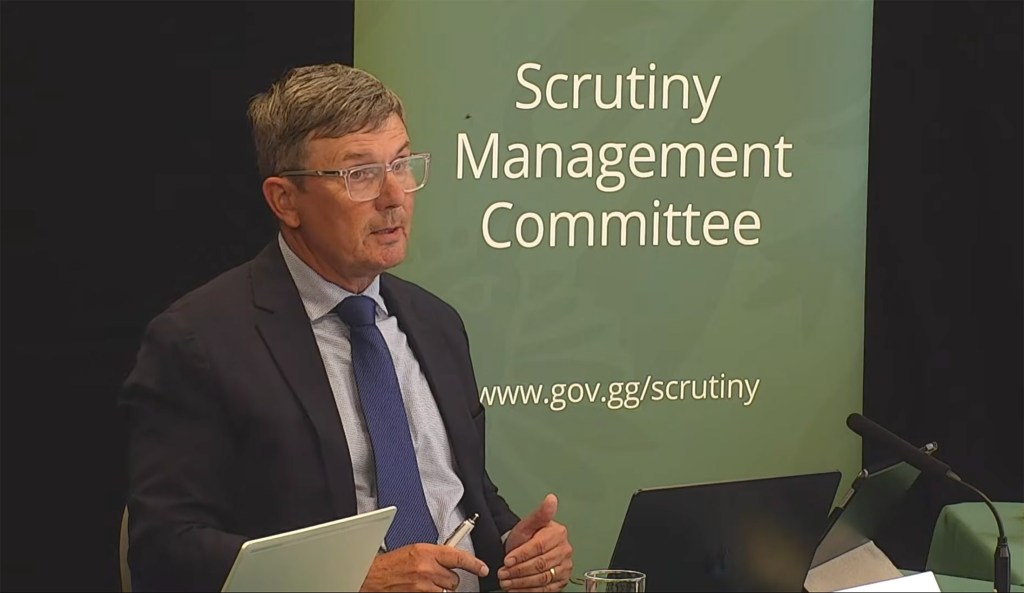
Deputy Sloan’s criticism followed a bruising Scrutiny Management hearing earlier this month, where he accused the Chief Minister of “arguing black is white” over data showing working families with children would be hit hardest.
The intense hearing drew sharp criticism from some people, with Deputy Mark Leadbeater saying it was “too Judge Judy-like for me and nothing like any scrutiny hearing I’ve ever been involved with or seen”.
When asked about the backlash, Deputy Sloan was unapologetic: “Tough – that’s how I do it.”
He argued that challenging policy on behalf of the public was incredibly difficult due to political spin and weak underlying assumptions.
“Because so much policymaking is poor… you’ve got to challenge it,” he insisted.
“If it takes a bloody robust challenge to get some straight answers to some straight questions, that’s the way it’s going to be.”
‘P&R have got to go if they don’t agree to cap spending’
Deputy Sloan, along with Deputy Mark Helyar, has proposed capping public spending increases at inflation.
He sees P&R’s response as a litmus test ahead of the historic debate, adding: “We’ve got to sort out the States spending first.”
He warned P&R members that if they refused to support the amendment he would support a vote of no confidence, as it would show there was “absolutely no discipline or control accepted by this P&R”.
If that’s the case “they’ve got to go”, he added.
