


The number of people living in Guernsey who say they never drink alcohol has increased over the past few years – with nearly a fifth now describing themselves as teetotal.
This coincides with a decrease in the number of people who say they drink alcohol multiple times per week, according to data released by Public Health.
The Guernsey and Alderney Wellbeing Survey has been carried out every five years since 1988, and was most recently carried out in 2018 and 2023.
Between those two years, the number of people who say they never drink alcohol increased from 11.4% to 17.7%.
The same survey showed that the number of people who drink alcohol each month or each week has dropped slightly.
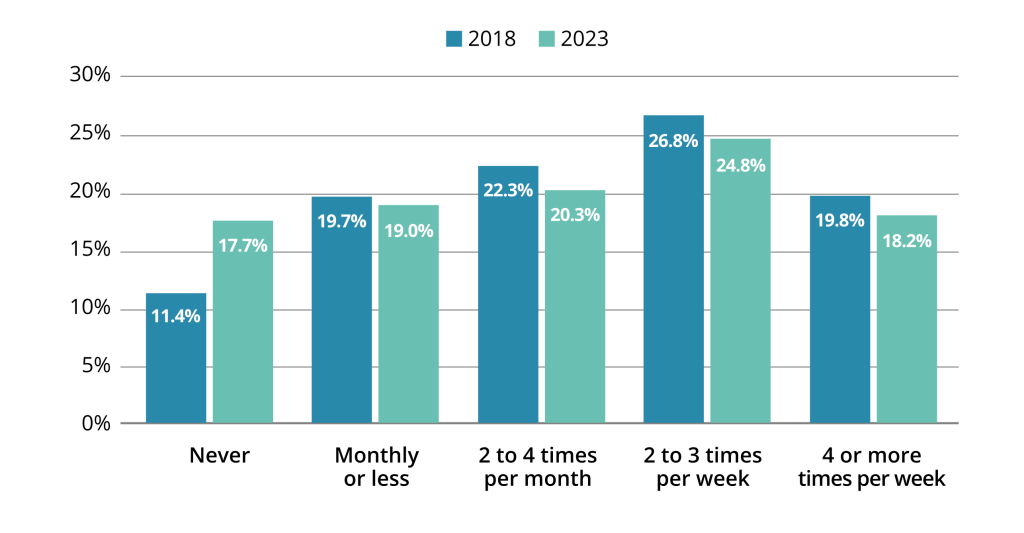
Nearly a fifth of all residents say they drink alcohol four or more times per week, with nearly a quarter saying they drink alcohol a couple of times per week.
Around a fifth of people say they drink alcohol a few times per month, or less.
These patterns have been forming since the early 00s, with ever increasing numbers of people describing themselves as teetotal and few people saying they drink alcohol multiple times per week or per month.
The number of people admitting to ‘binge drinking’ has fallen too.
The Wellbing Survey defines ‘binge drinking’ as “having five or more drinks in a drinking session”.
By this definition, the proportion of people who partake in a ‘binge drinking’ session dropped from 18.2% in 2018 to 15.8% in 2023.
Health officials are still worried about the practice though.
“Guernsey and Alderney have a culture which normalises regular alcohol consumption with many people who have risky drinking behaviours not recognising this as a
cause for concern,” cautions Public Health in the latest substance misuse report.
“It is therefore important to create an environment for health and wellbeing through policy and legislation to normalise safer alcohol consumption, as we look to reduce the proportion of individuals with harmful levels of alcohol consumption.”
Public Health said it will look to continue trying to reduce any harmful alcohol consumption by continued taxation and increased duties on the beverages.
“At population level, levels of alcohol consumption are known to be influenced by changes in alcohol pricing and taxation. The Combined Substance Use Strategy does not give specific direction on the rates of excise duties on alcohol as it does for tobacco products. However, the Committee for Health & Social Care recommended an annual increase to excise duties for alcohol of at least RPI + 5% in 2025, to be in line with the annual recommended increase in tobacco duties and commensurate with the health harms caused by alcohol consumption. The 2025 Budget presented by the Policy & Resources Committee proposed a freeze on alcohol duty for 2025 and this was subsequently approved by the States.”
