

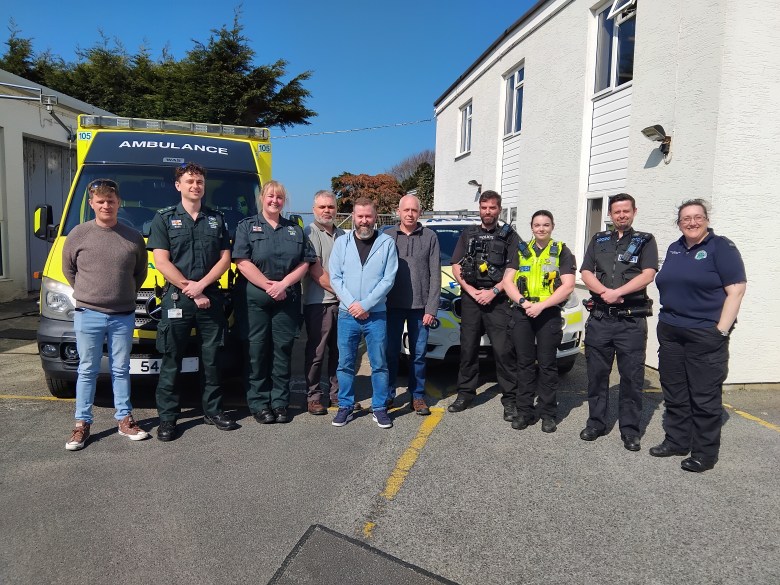
When Leon Ogier suffered a cardiac arrest he was lucky that Simon Welch was driving past as his quick response helped to save Mr Ogier’s life.
Having suffered a heart attack earlier this year, Mr Ogier was returning to exercise under his doctor’s guidance when he went out on a bike ride a few weeks ago.
As an experienced cyclist that was nothing unusual, but around ten minutes in he suddenly started to experience some familiar feelings.
“I was probably not even ten minutes into my ride yet. I understand from the heart attack that a warm up is very important now, and my heart rate was below my working heart rate. It was only 95 so I wasn’t even in work out zone yet.
“I remember seeing the bus shelter at the Halfway and I remember coming over really dizzy really quickly. It was almost instant. I thought I’d stop just after the bus stop, which I did, and then I don’t remember a thing.”
Mr Welch saw Mr Ogier sitting near the Halfway bus shelter and he instantly knew something was wrong, so he pulled over in his car and asked if he needed some help.
“His upper body was shaking really badly, and it seemed to me initially that he was having a fit or some kind of shock or something, so I pulled on to the pavement and ran out and asked him if needed an ambulance and he said ‘yes’.
“I noticed his legs were bent in a funny position so I thought maybe he’s broken his leg or something and he’s in pain, but he said ‘I’m having a heart attack, I’ve had one before and I’m having another’ and that’s when I stopped talking to him and I made the call.”
Rachel Lee was the Operator at the Joint Emergency Services Call Centre that took the 999 call that morning.
She dispatched the emergency services and first responders to the scene, with Guernsey Police first to arrive, followed by the paramedics and then Community First Responder Ben Nichols. The Fire and Rescue Service also arrived along with Community First Responder Rob Jordan.
While the trained professionals and volunteers are on their way to help with the casualty, Ms Lee kept Mr Welch talking, including giving him instructions for performing CPR on Mr Ogier.
PC Alex Hearn and PC Lisa de Sousa were the first of the emergency services to arrive, with PC Phil Graves and PC Jessica Clarke arriving seconds later.
PC de Sousa took over the chest compressions from Mr Welch, while PC Hearn got a defibrillator out of the back of their police car.
“I carry a med kit with oxygen in and all kinds of stuff for improving air ways,” explained PC Graves.
“I could see Alex had the defib so I went over and cut (Mr Ogier’s) expensive cycling gear off, and we got the defib on and kept his air ways open.”
The police officers delivered the first of three shocks Mr Ogier received from a defibrillator on the pavement that morning.
“It was the first time I’ve initiated a shock on a defib, and when you hear that on a defib saying ‘shock advised’ you know it’s serious,” said PC Hearn.
By the time the paramedics arrived, the situation was still escalating said Emily Baudain, who was among the first Ambulance and Rescue crew to arrive.
“When we arrived his heart was beating, but he deteriorated while we were with him as we treated him on the scene.”
Ms Baudain’s said this is what they are trained to deal with, but for Mr Welch it was his first experience of such an emergency medical situation.
His initial reaction to stop and help, and then delivering first aid with the guidance of Ms Lee helped to save Mr Ogier’s life.
Mr Welch said he would do it again and would urge anyone else to offer help too.
“Without a doubt, you’ve got to help someone. If someone’s distressed you need to help them. It doesn’t matter who they are.
“Get some first aid training, which is what I’m going to do, at least CPR and defib training I think because that’s the primary life saver really, and if you see it just do it, just have a go, because it can’t be any worse than if you just walk past.
“If you try your best that’s all you can do and I would have done that regardless of whether I had someone on the end of the phone or not, I would have just done what I could.”
Mr Ogier was sent to Southampton for the second time this year for heart surgery following his cardiac arrest. He spent almost two weeks in hospital there before coming home, and he has already resumed light exercise under his doctor’s supervision as his recovery continues.
“It’s very light and they watch over me the whole time, and they’re tracking my heart rate all the time, but it’s very progressive let’s say. I don’t think I’ll be on the bike as quick as I was last time but the gym side of things are nice and easy and we’re getting there.”
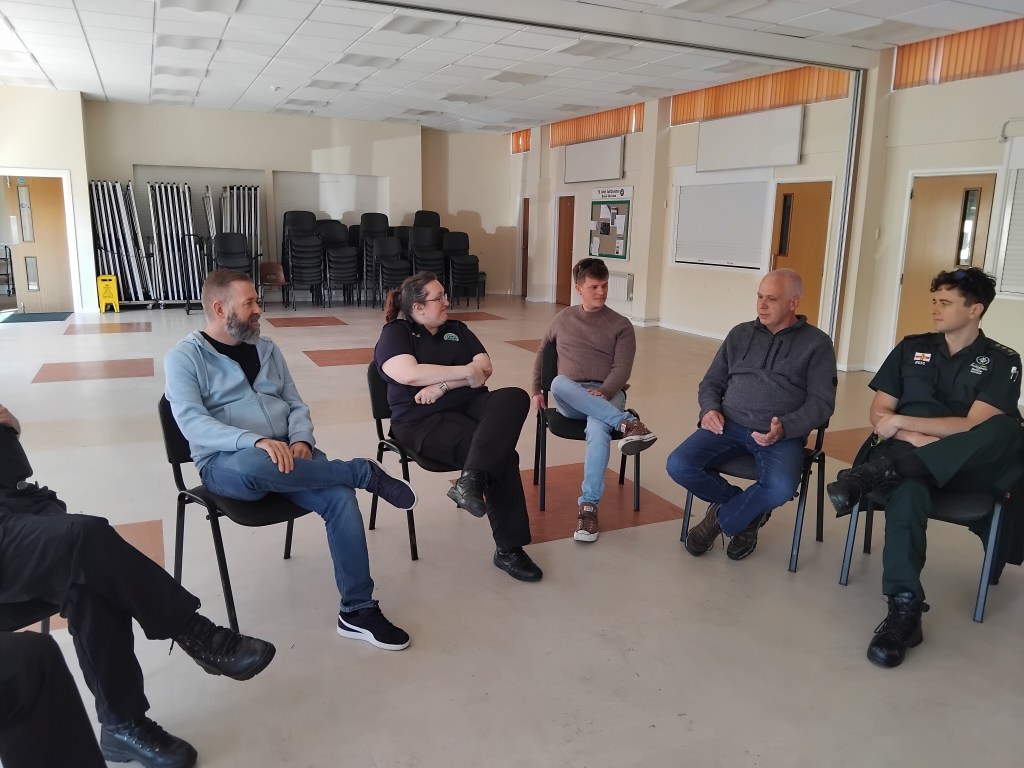
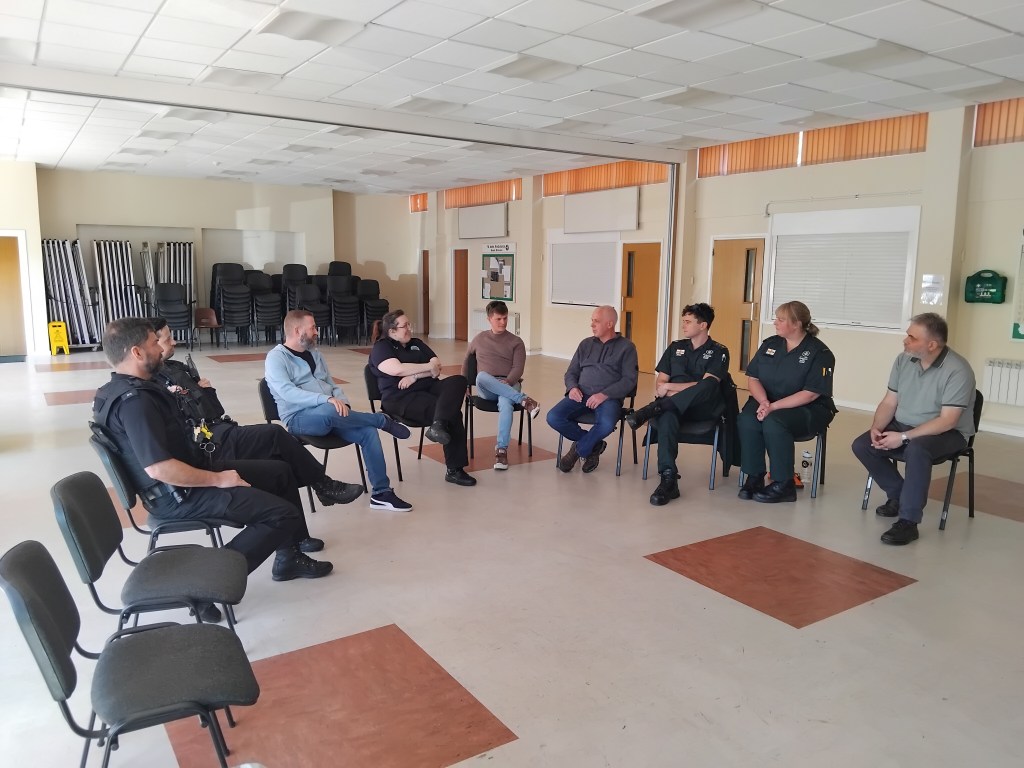
Mr Ogier and Mr Welch had already met up socially with their families, before yesterday meeting the emergency service personnel and the Community First Responders who also helped to save his life.
Mr Ogier spent time chatting to each, thanking them for all they did.
“It’s not just me that he saved, I’ve got two young daughters and a son who lives in the UK. There’s just so many people, so many friends and family that would have been devastated if I hadn’t pulled through.”
LISTEN:
