

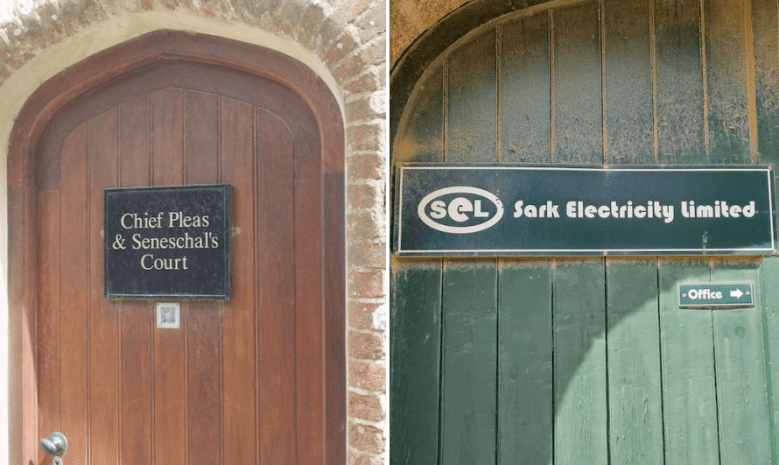
Chief Pleas has recommended an independent valuer as part of its compulsory purchase of Sark Electricity Limited, meaning the process could now move on quickly if both sides agree.
The owner of SEL has been asked to back the appointment of accountancy firm Begbies Traynor – but he could refuse to, leading to court action to have a valuer imposed on both sides.
Explaining the plan to Chief Pleas last night, Conseiller John Guille said: “The objective is to ensure Sark has a safe, reliable and affordable electricity supply for generations to come by bringing it into community ownership”.
He explained how the planned compulsory purchase will go through stages to reach that end result.
“Today, on the 1st October 2025, the Policy & Finance Committee delivered a final proposal to the Managing Director of SEL to attempt to reach a mutual agreement on the appointment of the valuer. Under the Law the appointment of the valuer is made by Order of the Court of the Seneschal on the application of either party. The Committee will shortly be applying to the Court for an Order appointing Begbies Traynor, and it hopes to be able to tell the Court that both parties support the appointment, but such mutual agreement is not required for the application to be made or for the Court to make an Order. A decision has been requested from SEL within two weeks.”
If SEL’s owner does not agree with the appointment of Begbies Traynor, the Sark court can impose that valuer or a different one of its choosing.

Alan Witney-Price has repeatedly said the compulsory purchase is not human rights compliant and that he wants to sell to a third party – Island Power – rather than Chief Pleas.
Conseiller Guille and others in Sark believe that bringing the island’s only electricity provider into community ownership – aided by Chief Pleas – is the best outcome for the island.
He told Chief Pleas last night that Island Power is not a realistic buyer for the utility.
“Discussions between Island Power and Sark, not involving SEL, have been held several times since 2019, the most recent being in April 2025,” explained Conseiller Guille. “None of the proposals presented were considered to have been financially credible, technically appropriate, suitable from a community perspective, or compliant with the tender process.”
Conseiller Guille assured Chief Pleas that once the compulsory purchase of SEL has been completed, all staff will be retained and that they will be tasked with an immediate “safety and reliability upgrade program under the supervision of GEL managers and highly qualified technicians”.
Mr Witney-Price has yet to comment on behalf of SEL regarding the proposed appointment of Begbies Traynor.
Price Control Order
A price control order came into force yesterday, forcing SEL to drop its charges to a maximum of 52p per unit.
The cost of electricity in Sark had rocketed to £1.13 per unit during September, after SEL imposed two levies on customers.
The additional 60p per unit that came into effect on 1 September was made up of 40p per unit to help fund SEL’s legal challenge to the compulsory purchase order, and 20p per unit to fund a legal challenge against the Electric Price Commissioner if he tried to remove the original legal levy.
The EPC said both those charges were unfair and unreasonable, and although he could not direct SEL to remove them immediately he issued a price control order on 30 September to take effect on 1 October.
“On the 16th of September 2025, I determined that the unit price charged by SEL was neither fair nor reasonable, and today I have made a price control order which limits the price which SEL can charge,” explained EPC Shane Lynch.
The price control order specifies the following limits:
- A maximum unit price of 52 p/kwh,
- Maximum monthly metering charges of £3.43 for a single-phase meter and £4.65 for a three-phase meter, and
- A maximum monthly standby charge for “own-generators” of £5/kw.
The price control order will last for two years but can be varied if circumstances change, said Mr Lynch.

The maximum 52p per unit charge SEL can now legally charge its customers is similar to what it was charging customers in August.
Customers will receive their bills for September next week, and Express understands a number of bill payers will be refusing to pay the legal levies if they are charged.
This includes Chief Pleas, which has already said it won’t pay the additional charges for any electricity used by publicly owned buildings or facilities including the harbour, medical centre, abattoir, and more.
