


We all know artificial intelligence can be a bit useless sometimes, but when it comes to translating Guernsey’s native language it’s completely ‘crapaud’, warns one Guernésiais expert.
Fluent speaker Yan Marquis says the technology can confuse our language and culture with our larger, and some might argue inferior, cousin Jersey.
Mr Marquis, a teacher and translator, said although AI translations can seem “authentic”, the technology often fills in gaps in its knowledge with other dialects of Norman, classical French or Jèrriais – Jersey’s native language.
The problem happens for a few reasons, he said, including the fact Guernésiais is an oral language, so there’s no agreed spelling, and the small amount of training data available.
Deep knowledge
There’s an art to translation, Mr Marquis says, and he should know.
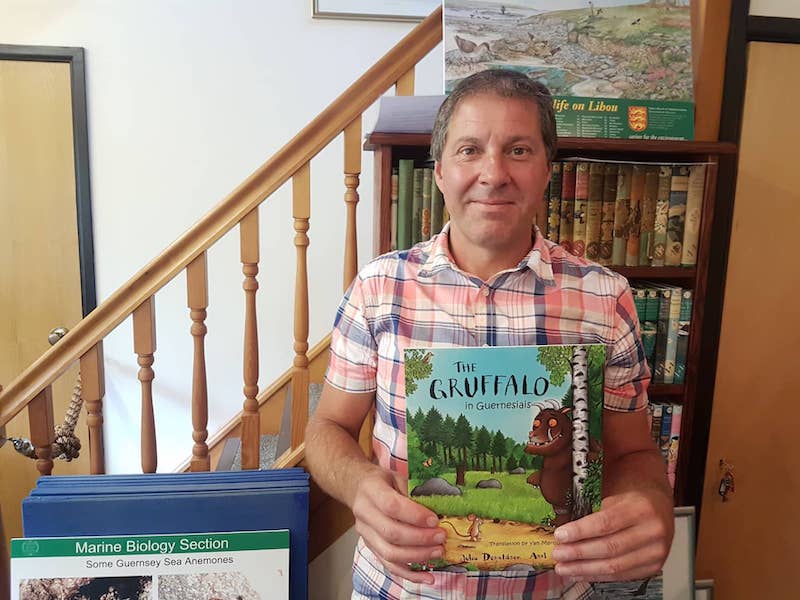
As well as offering free translations, he’s translated several poetry and children’s books including Julia Donaldson’s ‘The Gruffalo’, and also wrote ‘My First Guernesiais Word Book’, an introduction to the language for children.
“I’ve translated everything from house names, tattoos, product branding, poetry, and stories, to job titles, official documents and reports.
“The scope is truly diverse and at times the number of translation requests can be high.”
Translation was not an “exact art”, Mr Marquis said, instead needing “a deep knowledge and understanding of language and culture”.
“At times, a target language has no direct equivalent for a word or expression, so translators must make choices as to the closest equivalent term to use.”
Sample size
Despite its name, there’s nothing ‘intelligent’ about AI models like ChatGPT or Microsoft Copilot.
Instead of understanding what it’s saying, the technology – also known as a Large Language Model (LLM) – uses massive amounts of data to predict ‘what comes next’.
For example, in the sentence: “For lunch today, I’d like a” the next word is far more likely to be “cheese sandwich” than “fried toad”.
While this works well for languages like English, Spanish, and Chinese – which have huge numbers of documents to train the AI model on – minority languages like Guernésiais don’t fare as well.
Mr Marquis explained: “Who hasn’t used Google Translate?
“These systems use deep learning to translate whole sentences, and their results can be impressive, especially for widely-spoken languages with standardised grammar and spelling, and with vast quantities of language data to analyse and process.
“But how does AI fare with translating into a minoritised language like Guernésiais, one without standardised grammar, with no universally agreed spelling system, and with very limited data to analyse and process?”
The answer? Not great.
“Without access to a rich, reliable database of Guernésiais, how can AI learn the grammar, essence, idiom, lyricism, spirit or cultural heritage embedded in a language?” Mr Marquis said.

Concerning
Mr Marquis said he was getting more and more “verification requests” for AI‑generated Guernésiais translations.
While it was “reassuring” many people suspected something wasn’t “quite right” about them, it was “concerning” that many AI‑generated Guernésiais translations would never be checked.
“As AI becomes more deeply embedded into our daily lives and we rely on it ever more and may even cease to question it,” he said.
“Some language enthusiasts fear that Artificial Guernésiais might become the norm, or at least impact its authentic future,” he added.
In time, it’s possible computer scientists figure out the problem, but for now AI translations into Guernésiais will remain flawed.
Luckily, until then the Guernsey Language Commission offers a free translation service, supported by Guernsey Museums.
